
Updated:
A Wisconsin rental application is a tenant screening form for landlords. The form lists the applicant’s identity, income, rental history, employment, credit, occupants, pets and vehicles. Landlords use it before signing a rental agreement, especially when several applicants want one unit.
This page walks through the form block by block, shows sample entries for every step, and sets out the Wisconsin deposit, disclosure and notice rules that follow an approved application into the lease.
Key facts

Build Your Document
Answer a few simple questions to make your document in minutes
Save and Print
Save progress and finish on any device, download and print anytime
Sign and Use
Your valid, lawyer-approved document is ready
A Wisconsin rental application is the form a prospective tenant completes so a landlord can compare applicants for one unit by identity, income, rental history and credit before offering a lease.
The application comes before the lease and does not rent the unit by itself. It collects the facts a landlord weighs, and its signature block holds the applicant’s authorizations to check them. The same questions go to every applicant, so the landlord compares like with like.
A rental application is handed out once a unit is advertised and before the landlord chooses a tenant. Each person who will sign the lease is an applicant. People who will live in the unit without signing are listed in the form’s Other Occupants block.
The rental application gathers information about the applicant; the lease sets the rent, the term and each party’s duties. A lease is a separate document signed after the landlord approves the application. The Wisconsin lease agreement forms page lists the lease types.
The Wisconsin rental application form asks for the applicant’s identity, housing history, income and credit, plus the other occupants, vehicles, pets and an emergency contact. Its blocks run in this order:
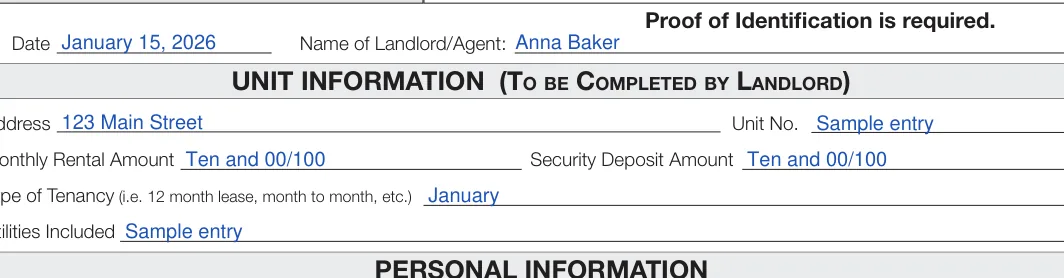
The Unit Information block is the one part of the application the landlord completes. It names the landlord or agent, the address and unit number, the monthly rent, the security deposit amount, the type of tenancy and the utilities included. The applicant reads it first to confirm the terms of the unit applied for.
The authorizations sit above the Signature of Applicant line at the end of the form. By signing, the applicant agrees to the checks they describe, so the answers about employers, landlords, banks and creditors are verified rather than taken on trust. Every answer is better true and complete: a mismatch found in a check weighs on the landlord’s decision.
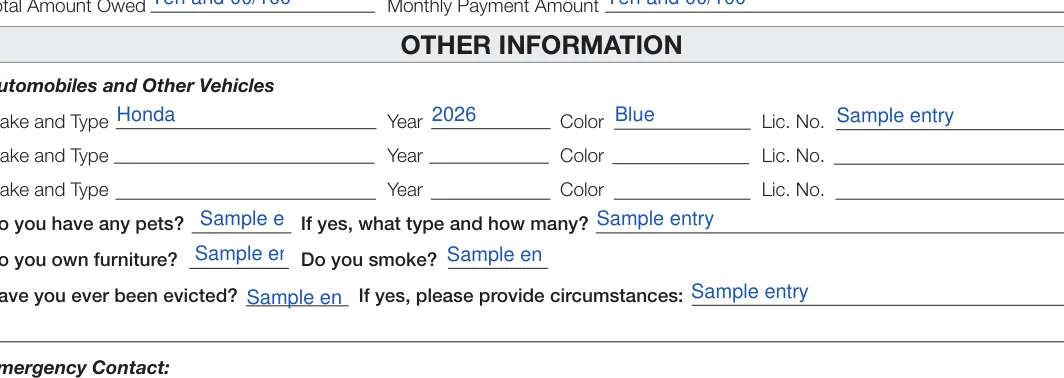
The Other Information block asks yes or no questions about pets, furniture, smoking and past evictions. A yes on pets asks for the type and how many; a yes on evictions asks for a short explanation on the line below.
The Wisconsin rental application has a credit report line where the applicant writes the amount paid for a consumer credit report, if one is paid with the application. The line stays blank when nothing is paid.
Earnest money is a payment a prospective tenant hands the landlord before a lease is signed, to hold the unit while the application is considered. If charges for water, heat or electricity are not included in the rent, the landlord shall disclose this fact to the tenant before entering into a rental agreement or accepting any earnest money or security deposit, under Wis. Admin. Code ATCP 134.04.
The Unit Information block has a line for the utilities included, so the application itself shows which of them the rent covers.
The table below sums up the Wisconsin rental application form: the other names it goes by, the average time to fill it in, the count of fillable fields and the format.
| Document Name | Wisconsin Rental Application Form |
| Other Names | WI Rental Application, Wisconsin Application to Rent |
| Avg. Time to Fill Out | 18 minutes |
| # of Fillable Fields | 103 |
| Available Formats | Adobe PDF |
The Wisconsin rental application is filled out in form order, from the Unit Information block to the applicant’s signature. The steps below follow that order, one block at a time, typed into the fillable PDF or handwritten on a printed copy.
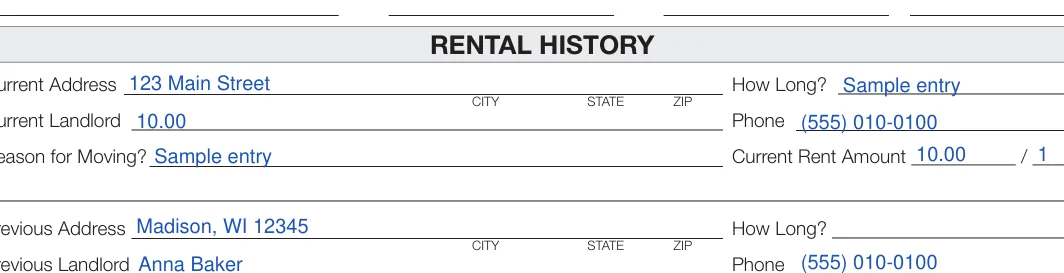
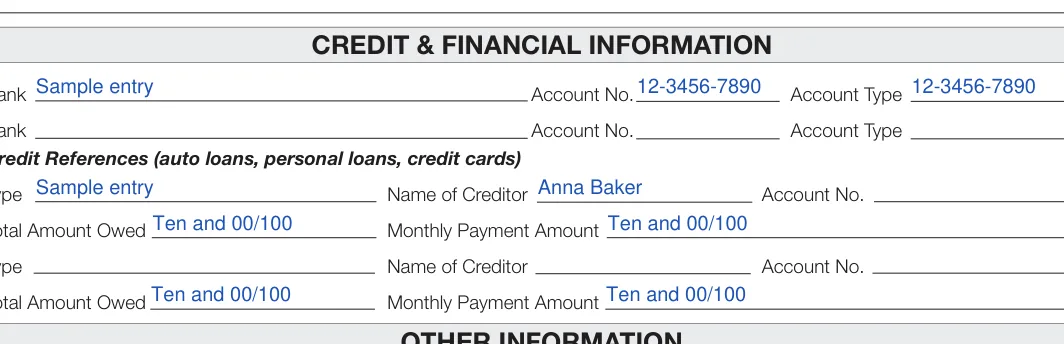
The screenshots under each step show the Wisconsin Rental Application filled with sample entries in blue, so you can see where each answer goes. The names, addresses, dates and amounts are examples only.
Before you start, gather your current and previous addresses, your employer’s details and your bank information. Having them at hand makes the form quicker to complete.

















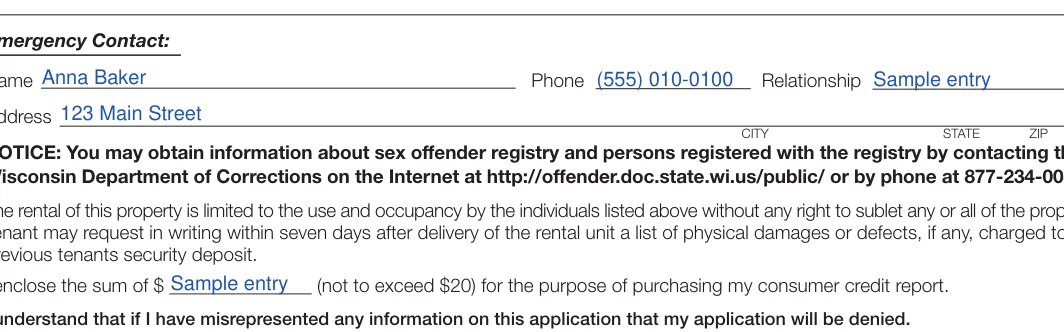


A Wisconsin rental application opens a process in which the landlord owes the applicant disclosures about unpaid utilities, nonstandard rental provisions and known lead-based paint, each under its own cited section. The utility rule is set out above under earnest money.
Nonstandard rental provisions belong to Wis. Stat. § 704.28, the section on what a landlord may withhold from a security deposit. Any such nonstandard rental provisions shall be provided to the tenant in a separate written document entitled "NONSTANDARD RENTAL PROVISIONS," under Wis. Stat. § 704.28. The landlord shall specifically identify each nonstandard rental provision with the tenant before the tenant enters into a rental agreement, under Wis. Stat. § 704.28.
Target housing means any housing constructed before 1978, except housing for the elderly or persons with disabilities or any 0-bedroom dwelling (unless a child under 6 years of age resides or is expected to reside there), under 42 U.S.C. § 4851b.
For target housing, the lessor provides the lessee with a lead hazard information pamphlet, discloses any known lead-based paint or lead-based paint hazards, and provides any lead hazard evaluation report available to the lessor, under 42 U.S.C. § 4852d.
The Wisconsin rental application shows the security deposit amount in its Unit Information block, and the landlord returns that deposit, less the amounts the section allows, within 21 days after any of the events listed in Wis. Stat. § 704.28.
The Wisconsin rental application names the type of tenancy in its Unit Information block, and for a month-to-month tenancy at least 28 days’ notice must be given to end it, except in the cases below, under Wis. Stat. § 704.19.
These notice periods apply to periodic tenancies, such as month to month, and to tenancies at will, under Wis. Stat. § 704.19. The tenancy type on the form shows the applicant whether one of them applies before the lease is signed.
An approved Wisconsin rental application leads to the lease, the move-in check and the first deposit steps, in this order:
Yes. The screenshots under each step of the filling guide above show the form with sample entries in blue. The names, addresses, dates and amounts in them are made up and show only where each answer goes.
A landlord chooses which application form to hand out, whether a trade group’s form, such as one from the Wisconsin REALTORS Association, or their own. Any of them can be read against the blocks listed on this page: identity, rental and employment history, income, credit, occupants and the authorizations above the signature.
The details table above lists about 18 minutes. The time depends on how many details you have at hand. Gather your addresses, employer information and bank details first, and the form goes faster.
Yes. The template is a fillable PDF, so you can type your answers into the fields on a computer and then print it. You can also print the blank form and write in the answers by hand.
Read through each answer once more and check that names, dates and phone numbers are correct. Sign and date the form, then keep a copy before you hand the original to the landlord.
General information, not legal or tax advice.
