
A Louisiana motor vehicle power of attorney form is a legal document that allows the principal to name an agent, or attorney-in-fact, to act for them on motor vehicle matters. This authority typically includes registering, titling, selling, or purchasing a vehicle for the principal. The document helps when you cannot handle these matters in person because of absence, illness, or time constraints.
Last Updated: October 2026. This guide is reviewed and updated regularly to reflect current law. If you notice an error or outdated information, please contact us.
Build Your Document
Answer a few simple questions to make your document in minutes
Save and Print
Save progress and finish on any device, download and print anytime
Sign and Use
Your valid, lawyer-approved document is ready
This table summarizes the FormsPal template. It shows the document name, a link to the Louisiana Office of Motor Vehicles (OMV) website, how long the form takes to fill out, and the number of fillable fields. The template is a PDF that you can fill in on a computer or print and complete by hand.
| Document Name | Louisiana Motor Vehicle Power of Attorney Form |
| State Form Name | None |
| Relevant Link | Louisiana Office of Motor Vehicles |
| Avg. Time to Fill Out | 15 minutes |
| # of Fillable Fields | 25 |
| Available Formats | Adobe PDF |
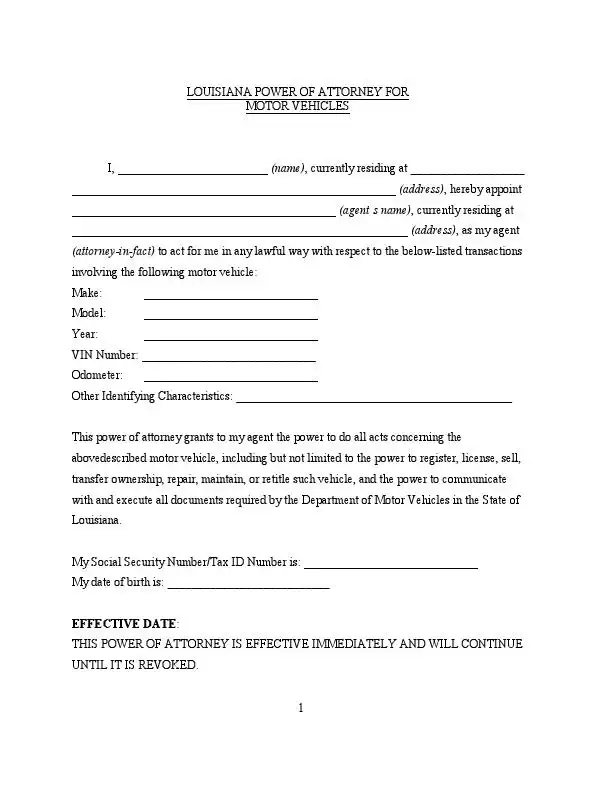
These steps follow the FormsPal Louisiana motor vehicle power of attorney template that you can create or download on this page. They go in the order the form is laid out, from the names at the top of page 1 to the notary block on page 3.
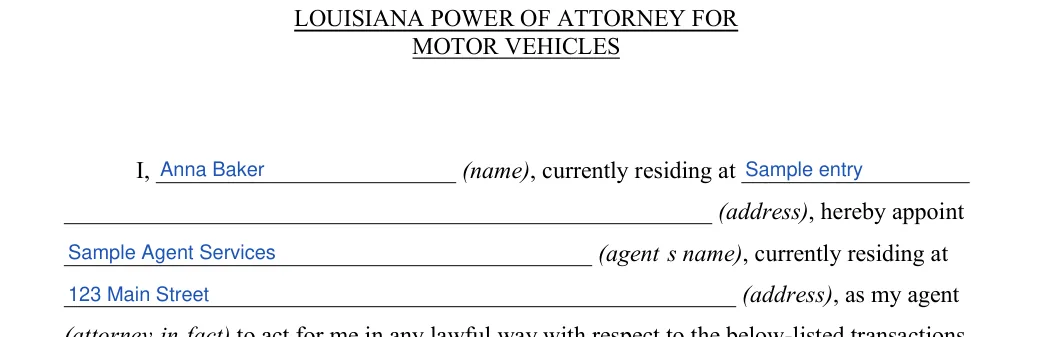
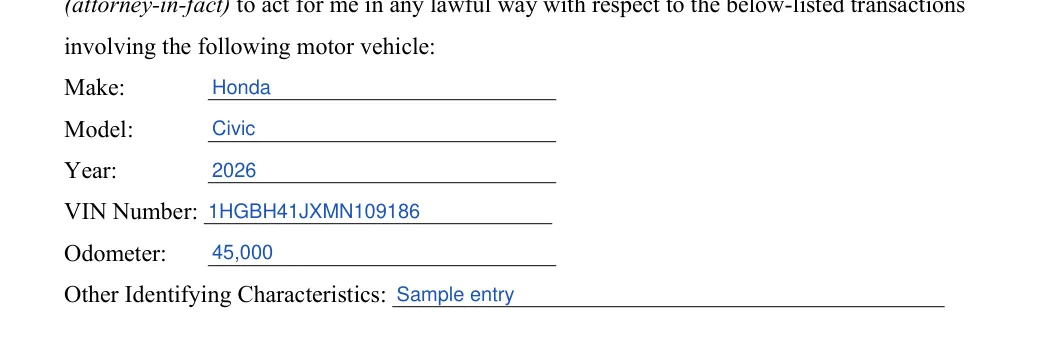
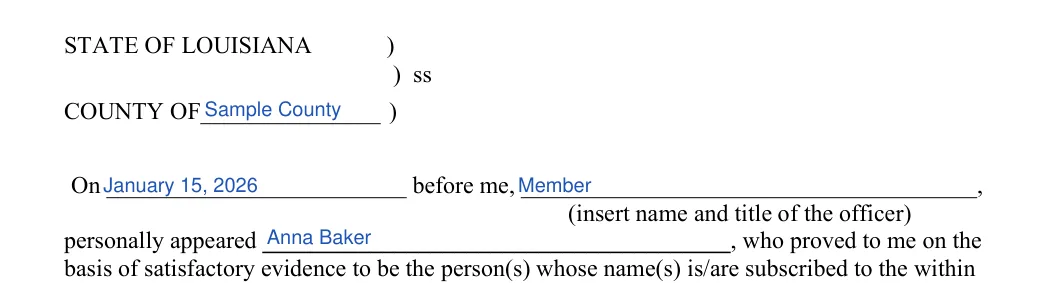
The screenshots under each step show the FormsPal Louisiana Motor Vehicle Power of Attorney template filled with sample entries in blue, so you can see where each answer goes. The names, addresses, dates and amounts are examples only.
Principal and agent
At the top of page 1, enter your full name and address as the principal. Then enter the full name and address of your agent (attorney-in-fact), the person you pick to act for you on the vehicle. Check that both names match the IDs.
Motor vehicle details
Fill in the make, model, year, Vehicle Identification Number (VIN) and odometer reading. If you use the mandate to transfer the vehicle, it must contain a complete description of the vehicle (make, year, and VIN).[1] Use the Other Identifying Characteristics line for details such as the color or custom changes. The powers paragraph under these lines is already printed on the form, so there is nothing to fill in. It lists registering, licensing, selling, transferring, repairing, maintaining and retitling the vehicle.
Social Security Number/Tax ID Number and date of birth
For identification purposes, you must provide your Social Security Number or Tax ID Number, along with your date of birth. The effective date line below these entries is already printed and needs no entry.

Successor Attorney-in-Fact
If you want a backup agent, go to the top of page 2. Enter your agent's name again, then the name and address of the alternate agent. The form names this person as successor if your agent is unable or unwilling to serve.

Date, signature and printed name
The POA must be signed and dated to be legally valid. Below the paragraph about third parties, enter the day, month and year, then sign and print your name. Read every entry once more to confirm it is filled in correctly before you sign.

Acknowledgment: state, county and date
On page 3, enter the county and the date, the name and title of the notary or officer, and the name of the person who signed, which is the principal.
Officer signature and seal
The signature line at the bottom of page 3, next to the (seal) mark, belongs to the notary or officer, so leave it blank.

Common mistake: leaving the agent's name off page 2. The successor paragraph repeats the agent's name, so enter it there as well as on page 1.
Once every entry is complete, print the form and finish the paperwork by hand. The steps below cover reviewing the pages, when the document needs a notary, and keeping copies where you and your agent can find them.
Review the pages
Read all three pages once more. Check that the names, the VIN and the odometer reading are correct and match your IDs and the vehicle documents.
Notarization
If you sign the mandate in Louisiana, the usual practice is to sign it in front of a notary public. The Office of Motor Vehicles requires notarization only on powers of attorney executed in Louisiana and in other states that require title documents to be notarized.[1]
Keep copies
Keep a signed copy for your records and give your agent a copy to keep with their papers.
In Louisiana, the concept of “mandate” is detailed in Chapter 2 of the Louisiana Civil Code. This chapter is a part of the state’s legal framework concerning contractual relationships where one party, the principal, grants authority to another party, the agent, to perform certain acts on their behalf. This legal relationship is comparable to what is commonly known as a power of attorney form in other jurisdictions.
A power of attorney in Louisiana must meet specific legal requirements to be valid. These include being in written form and clearly specifying the vehicle involved and the extent of powers granted. This ensures that the document is legally binding and that the actions taken by the agent are authorized and recognized by entities such as the Louisiana Office of Motor Vehicles.
Have the names and addresses of the principal and the agent, the vehicle details, and your identification numbers ready before you open the form. The list below shows everything the template asks for.
Plan on about 15 minutes. Gather the vehicle details and the agent's address first, so you can fill in the form in one sitting.
The principal is the person who gives the authority, which is you. The agent, also called the attorney-in-fact, is the person you name on the form to act for you on the vehicle. The form also has a line for a backup agent, called the successor attorney-in-fact.
Yes. Download the PDF and print it, or create the form online and print it when it is ready. Whether you type or write by hand, make sure every entry can be read.
General information, not legal or tax advice.
