
A Delaware prenuptial agreement is a written contract signed by two people before they marry that sets out how their property, debts, and spousal support will be handled. Delaware law calls it a premarital agreement, and it becomes effective only when the marriage takes place.[1.1]
Last Updated: September 2026 This guide is reviewed and updated regularly to reflect current Delaware law. If you notice an error or outdated information, please contact us.
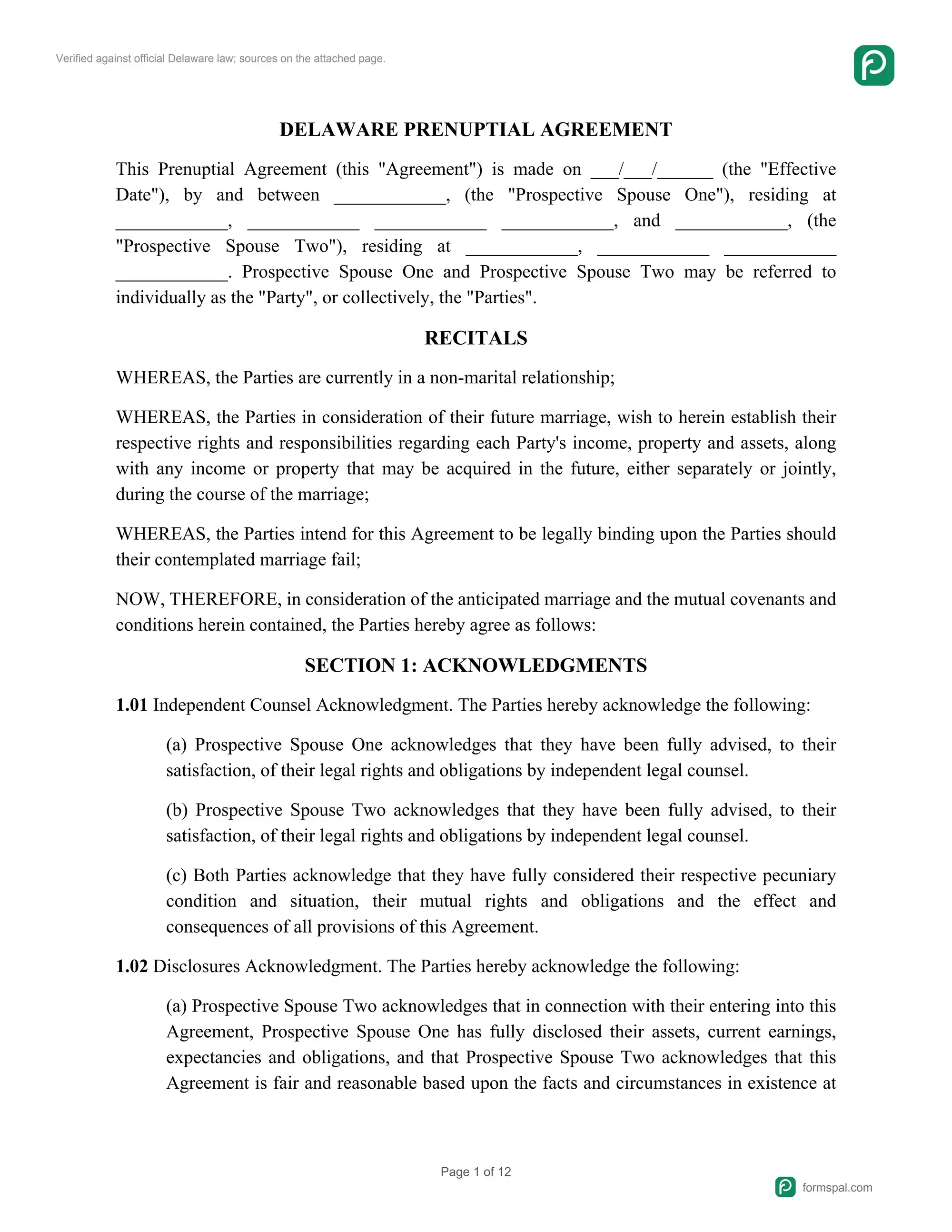
Build Your Document
Answer a few simple questions to make your document in minutes
Save and Print
Save progress and finish on any device, download and print anytime
Sign and Use
Your valid, lawyer-approved document is ready
The contract can cover property either spouse owns now or acquires later, alimony, and what happens to that property on separation, divorce, or death. It cannot reduce a child's right to support.[1.3] Signing one is optional, and a general prenuptial agreement template covers the rules shared across states.
Delaware's premarital agreement rules sit in Subchapter II of Chapter 3, Title 13 of the Delaware Code, at Sections 321 to 328. Delaware's version follows the Uniform Premarital Agreement Act. Each of the eight sections does one job, from defining the document to setting the deadline for bringing a claim.
Under Section 322 of Title 13, the agreement must be in writing and signed by both parties. Nothing of value has to change hands to make it binding, because the statute says it is enforceable without consideration.[1.2]
A premarital agreement must be in writing and signed by both parties. It is enforceable without consideration.
Section 322 lists no other formality, so no notary, no witnesses, and no waiting period before the wedding is required.[1.2] Couples often sign in front of a notary anyway, so that the signatures are easy to prove years later.
After the wedding, the couple can amend or revoke the agreement only through a written agreement that both spouses sign. A spoken change does nothing. The amendment or the revocation is enforceable without consideration, on the same terms as the original.[1.5]
Sometimes a court later rules that the marriage itself was void. In that case the document is enforceable only as far as is necessary to avoid an inequitable result.[1.7]
Any statute of limitations on a claim under a premarital agreement is tolled while the parties are married. The clock starts again once the marriage ends. Equitable defenses that limit the time for enforcement, including laches and estoppel, stay available to either party.[1.8]
Section 323 of Title 13 lets the parties contract about eight categories. They run from property rights and alimony through wills, trusts, and life insurance to the choice of law that governs the document. The eighth category is open ended and takes in any other matter the law does not forbid.[1.3]
A premarital agreement may not adversely affect a child's right to support.[1.3] That limit holds whatever the two parties write into the document.
A Delaware court will not enforce a premarital agreement if the spouse resisting it proves one of two things. The first is that they did not sign voluntarily. The second is that the agreement was unconscionable when signed and they were denied fair financial disclosure. Any issue of unconscionability is decided by the court as a matter of law.[1.6]
Section 326 gives two grounds:
The three disclosure conditions are:
Full disclosure of assets and debts is therefore the single best way to protect an agreement you want to survive a challenge. Delaware courts weigh what each spouse knew about the other's finances before signing.[1.6]
Yes. Section 322 asks only that the agreement be in writing and signed by both parties, and it says nothing about hiring an attorney.[1.2] A court can still set aside a do-it-yourself agreement on the grounds in Section 326, so honest financial disclosure matters far more than who typed the document.[1.6]
Each party should also read the draft without pressure and keep a copy of the financial statements exchanged before signing.
A Delaware premarital agreement becomes effective upon marriage.[1.4] Until the wedding, the signed document binds nobody. The statute defines a premarital agreement as one made in contemplation of marriage and effective upon marriage, so if the couple never marries, the agreement never takes effect at all.[1.1]
No. Delaware divides marital property by equitable distribution, so a judge splits it on what is fair in the circumstances rather than into two equal halves. A premarital agreement lets couples fix the division themselves instead of leaving it to a court. Section 323 allows the parties to agree how property is disposed of on separation, marital dissolution, or death.[1.3]
Prenuptial agreements in Delaware are priced two ways. Either a lawyer drafts the document, or you prepare it yourself and pay only for a review. ContractsCounsel's marketplace data puts the average Delaware drafting fee near $890 and the average review fee near $550.
Family law hourly rates run between $200 and $350. Completing a template yourself costs nothing beyond the form.

