
A Montana prenuptial agreement is a written contract between two people who plan to marry. Montana law calls it a premarital agreement and defines it as an agreement between prospective spouses made in contemplation of marriage and effective upon marriage.[2.1] It settles who owns what, who owes what, and whether spousal support will be paid if the marriage ends.
Montana adopted the Uniform Premarital Agreement Act, and Sections 40-2-601 through 40-2-610 of the Mont. Code Ann. govern these contracts.[1] To be valid the agreement must be in writing and signed by both parties.[3] It takes effect on the day the marriage happens.[5]
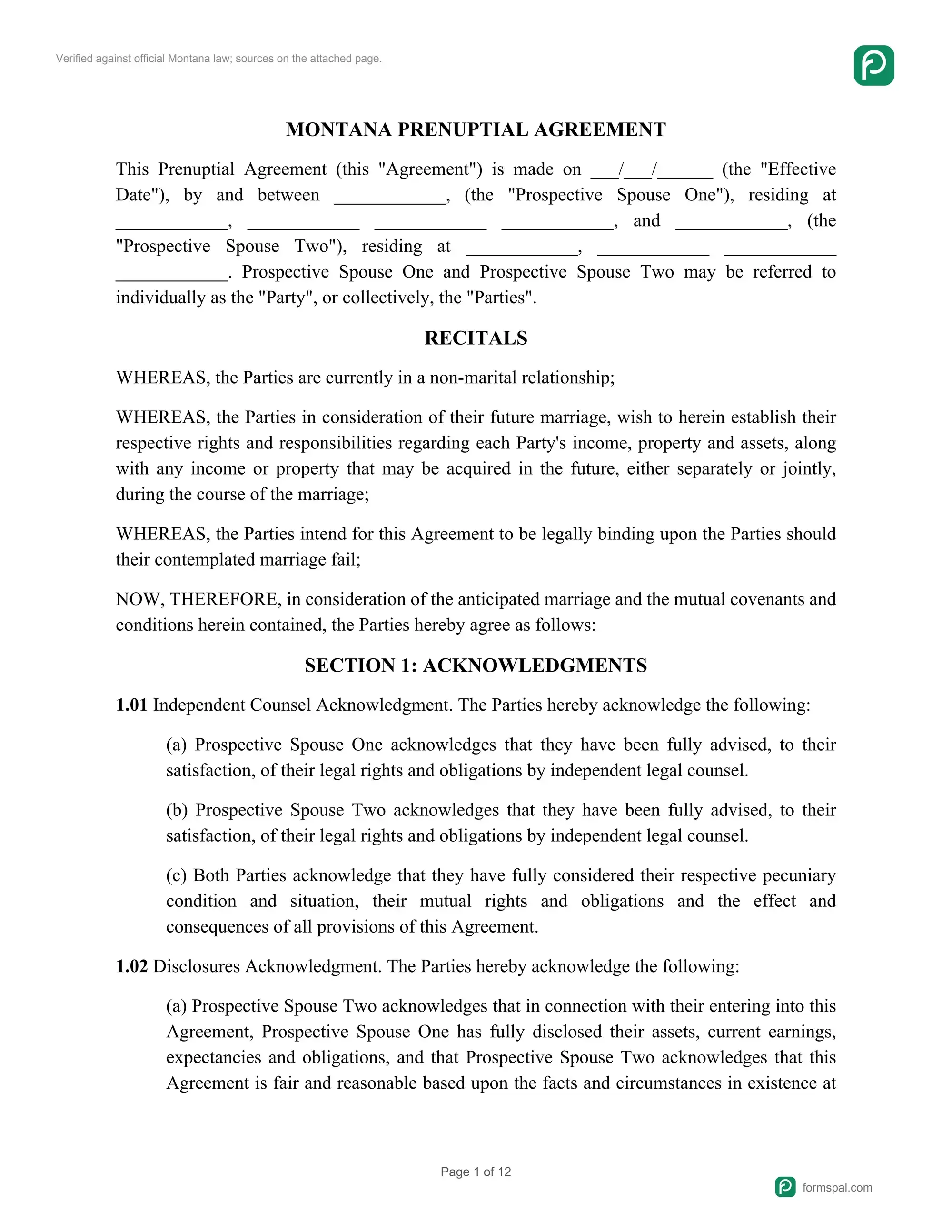
Build Your Document
Answer a few simple questions to make your document in minutes
Save and Print
Save progress and finish on any device, download and print anytime
Sign and Use
Your valid, lawyer-approved document is ready
Without a premarital agreement, a Montana court decides how your property and debts are divided when a marriage ends. A prenup lets the two of you make that decision in advance, in writing, while you still agree. The court can divide property after a divorce or a death, but the result may not be what either of you wanted.
This free prenuptial template gives you the structure. You fill in the terms that fit your situation.
A Montana premarital agreement earns its keep when any of these apply:
Ten sections of the Mont. Code Ann., numbered 40-2-601 through 40-2-610, make up Montana's Uniform Premarital Agreement Act.[1] They cover the form the agreement must take, the day it becomes binding, the subjects it may address, and the grounds a court may use to set it aside.
Section 40-2-604 of the Mont. Code Ann. sets the entire formality test, and it is a short one.
A premarital agreement must be in writing and signed by both parties. It is enforceable without consideration.
Montana does not require a notary or witnesses for a premarital agreement. Many couples still sign in front of a notary because it makes each signature easier to prove years later. No waiting period applies before the wedding either, though signing well in advance helps show the agreement was voluntary.
Signing on the morning of the wedding is the most common way a Montana prenup is attacked later. A court can refuse to enforce an agreement a party did not execute voluntarily.[7.1] Give both partners time to read the terms and to get their own legal advice.
Nothing in the Act requires a lawyer. Montana family law attorneys still advise that each partner have their own counsel review the contract first. Separate legal advice is the clearest record that both parties understood the full terms and signed voluntarily.
A premarital agreement becomes effective upon marriage.[5] Until the wedding takes place it binds no one. If the marriage is later declared invalid, the agreement is enforceable only to the extent necessary to avoid an inequitable result.[8]
After marriage, a premarital agreement may be amended or revoked only by a written agreement signed by both parties.[6] A spoken promise does not change it. The amendment or the revocation is enforceable without consideration, so no payment is needed for the change to hold.[6]
Section 40-2-605 of the Mont. Code Ann. lists the subjects a Montana premarital agreement may address. Property is defined broadly as an interest, present or future, legal or equitable, vested or contingent, in real or personal property, including income and earnings.[2.2] That definition reaches a ranch, a business, a retirement account, and a paycheck alike.
The will and trust clause is why many couples pair the contract with a Montana last will. The prenup records the promise and the will carries it out.
Two hard limits apply to every Montana premarital agreement. The right of a child to support may not be adversely affected by the agreement.[4.9] No term may violate public policy or a statute imposing a criminal penalty.[4.8] Child support belongs to the child, so parents cannot trade it away in a contract signed before the marriage.
Inside those two limits the Act is permissive. It lets the parties address any other matter, including their personal rights and obligations. The real constraint is not the subject you pick but whether the agreement survives the disclosure and fairness tests in Section 40-2-608.
A Montana court will not enforce a premarital agreement if the party resisting it proves one of the grounds in Section 40-2-608 of the Mont. Code Ann. The grounds are narrow. A bargain that simply turned out badly for one side is not enough, and unconscionability is decided by the court as a matter of law rather than by a jury.[7.6]
The last three grounds work together, and all of them must be shown alongside unconscionability before an agreement falls on disclosure grounds. Trading a full written financial affidavit of your assets and debts before you sign is the simplest way to close that door.
Time limits work differently here. Any statute of limitations on a claim under a premarital agreement is tolled during the marriage of the parties.[9] Equitable defenses limiting the time for enforcement, including laches and estoppel, remain available to either party.[9]
No. Montana divides marital property by equitable apportionment, not by an automatic half-and-half split. A judge weighs the circumstances of the marriage and reaches the division the court considers fair, which is often uneven. A premarital agreement replaces that default with terms the two of you chose, and that is the main reason Montana couples sign one.
Spousal maintenance is the money one former spouse pays the other after a divorce. The premarital agreement statute calls it spousal support, and Section 40-2-605 lets a premarital agreement modify or eliminate it.[4.4] That makes maintenance one of the few money questions a couple can settle years before any divorce.
The waiver is not absolute. A court can override it when the modification or elimination leaves one party eligible for support under a program of public assistance at separation or marital dissolution.[7.5] The court may then require the other party to provide support to the extent necessary to avoid that eligibility.[7.5]
Montana law sets no minimum. A premarital agreement is enforceable without consideration, which means neither partner has to pay the other or transfer anything for the contract to bind.[3] What matters is the writing, both signatures, and a full, honest account of the assets and debts each of you brings.
Couples with modest assets still use one. Student loans, a first house, a small business, and an inheritance that has not arrived yet all count as property under the Act.[2.2]
Last Updated: September 2026. This guide is reviewed and updated regularly to reflect current Montana law. If you notice an error or outdated information, please contact us.

Unless noted otherwise, the sources below are from the Mont. Code Ann..