
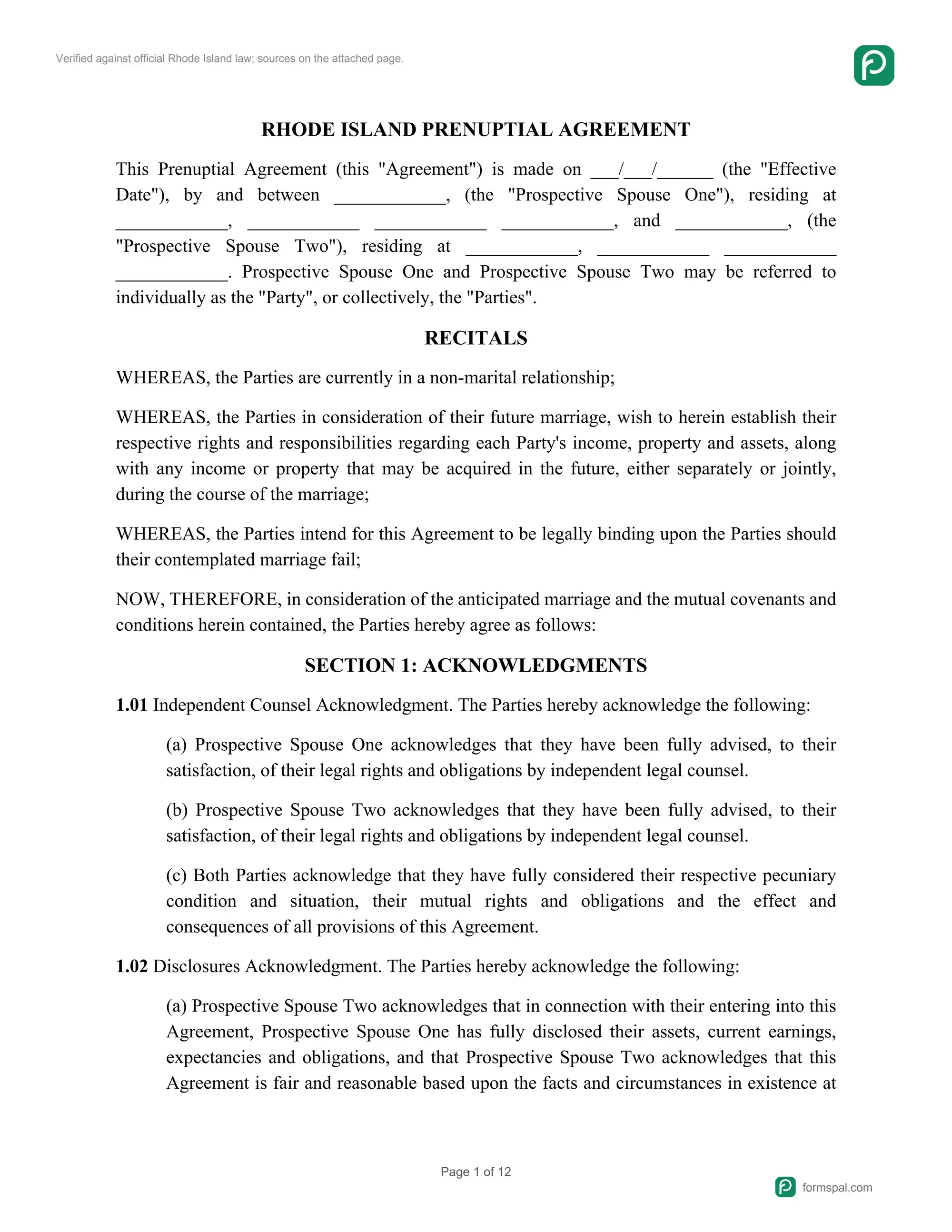
Download the Rhode Island Prenuptial Agreement: PDF | Word (.docx) | OpenDocument (.odt)
A Rhode Island prenuptial agreement is a written contract between two people who plan to marry. It takes effect on the day they marry, and not before. The contract sets out who owns what, who owes which debts, who receives a life insurance payout, and whether either spouse can claim support if the marriage ends.[1]
The one thing it cannot do is cut a child out of support.[3] For a general overview of the document, read our guide to the prenuptial agreement form.
Build Your Document
Answer a few simple questions to make your document in minutes
Save and Print
Save progress and finish on any device, download and print anytime
Sign and Use
Your valid, lawyer-approved document is ready
It is an agreement between prospective spouses, made in contemplation of marriage and effective upon marriage. Rhode Island law calls it a premarital agreement. The couple use it to fix the rights and obligations each of them will have over their property, their debts, and their income, before the marriage rather than after it breaks down.[1]
"Premarital agreement" means an agreement between prospective spouses made in contemplation of marriage and to be effective upon marriage.
Premarital agreements are not only for the wealthy. Any couple where one partner owns a business, carries student debt, or has children from an earlier relationship has assets to protect. If you are already married, the equivalent document is a postnuptial agreement.
You need one if you want your own terms to replace whatever a divorce court would otherwise decide about your property and your income. A prenup earns its keep when one partner brings a business, a house, an inheritance, or a large debt into the marriage. It is also the only place you can agree in advance to reduce or remove spousal support.[3]
Prenuptial agreements in this state most often settle these subjects:
Rhode Island has no official prenup form. Premarital agreements are written from scratch, so you can include any term the statute allows. Give each partner a separate family law attorney, so that neither side can argue at divorce that the deal was one sided.
The rules sit in chapter 15-17 of the General Laws of Rhode Island, inside Title 15 on domestic relations. The chapter defines the agreement, sets the signing formalities, lists the subjects the contract may settle, and states the narrow grounds on which a court may refuse to enforce it.[1] The chapter follows the Uniform Premarital Agreement Act, the model law most states use for prenuptial agreements.
Section 15-17-2 imposes three conditions, and no others, on how the agreement is made.[2]
There is no notary step and no witness step in the statute.
The agreement becomes effective upon marriage.[4] After the wedding, you can change it or cancel it only through a second written agreement that both spouses sign, and that amendment is also enforceable without consideration.[5]
Rhode Island does not force couples into a separate property or community property split. You set those terms yourselves, and the agreement decides which assets stay with which spouse. The statute reads the word property broadly. It covers any interest, present or future, legal or equitable, vested or contingent, in real or personal property, including income and earnings.[1]
Section 15-17-3 lists eight subjects a premarital agreement may settle. They run from property rights and the everyday control of assets through to spousal support, estate planning, life insurance, and the state whose law governs the contract. The last item is a catch-all, so long as the term does not break public policy or a statute carrying a criminal penalty.[3]
Very little does. A spouse who wants out of a Rhode Island premarital agreement carries a heavy load. They must prove that they did not sign it voluntarily. They must also prove that the agreement was unconscionable when it was signed, and that financial disclosure failed. Section 15-17-6 joins those limbs with an and, so meeting one of them is not enough.[6]
The challenging spouse has to establish all of the following:
Every one of those elements must be proven by clear and convincing evidence, and the burden sits on the spouse asking the court to set the agreement aside.[6] Whether an agreement is unconscionable is decided by the court as a matter of law.[6]
One limit applies even to an agreement no one can void. Say the contract cuts or removes spousal support, and that leaves one spouse eligible for public assistance at separation or divorce. The court may then order the other spouse to pay enough support to avoid that eligibility.[6]
If the marriage itself is later determined to be void, the agreement is enforceable only to the extent necessary to avoid an inequitable result.[7] Outside those narrow situations, Rhode Island courts enforce premarital agreements as written.
Yes. The statute asks only that the agreement be in writing and signed by both parties, so nothing in Rhode Island law requires either spouse to hire counsel. The practical risk is a different question. Every ground a court can use to set an agreement aside turns on disclosure or voluntariness.[6] Those are exactly the points a separate attorney for each side is there to protect.
A do it yourself template is a sensible starting point for short agreements between two parties with straightforward finances and no legal complications. Bring in a family law attorney once a business, a trust, or a large inheritance is in play, because those are the assets a later challenge tends to target.
Work through the five steps below in order. Each one closes off a ground that Section 15-17-6 would otherwise leave open to the spouse who later wants out, and together they cover timing, disclosure, terms, independent review, and signature.[6]
Longer than you would expect. Any statute of limitations that applies to a claim under a premarital agreement is tolled during the marriage, so the clock stops while the couple is married. A disclosure problem from the weeks before the wedding can still be raised at a divorce many years later.[8]
Waiting is not free, though. Equitable defenses that limit the time for enforcement, including laches and estoppel, remain available to either party.[8]
Last Updated: September 2026 This guide is reviewed and updated regularly to reflect current Rhode Island law. If you notice an error or outdated information, please contact us.

Unless noted otherwise, the sources below are from the R.I. Gen. Laws.