
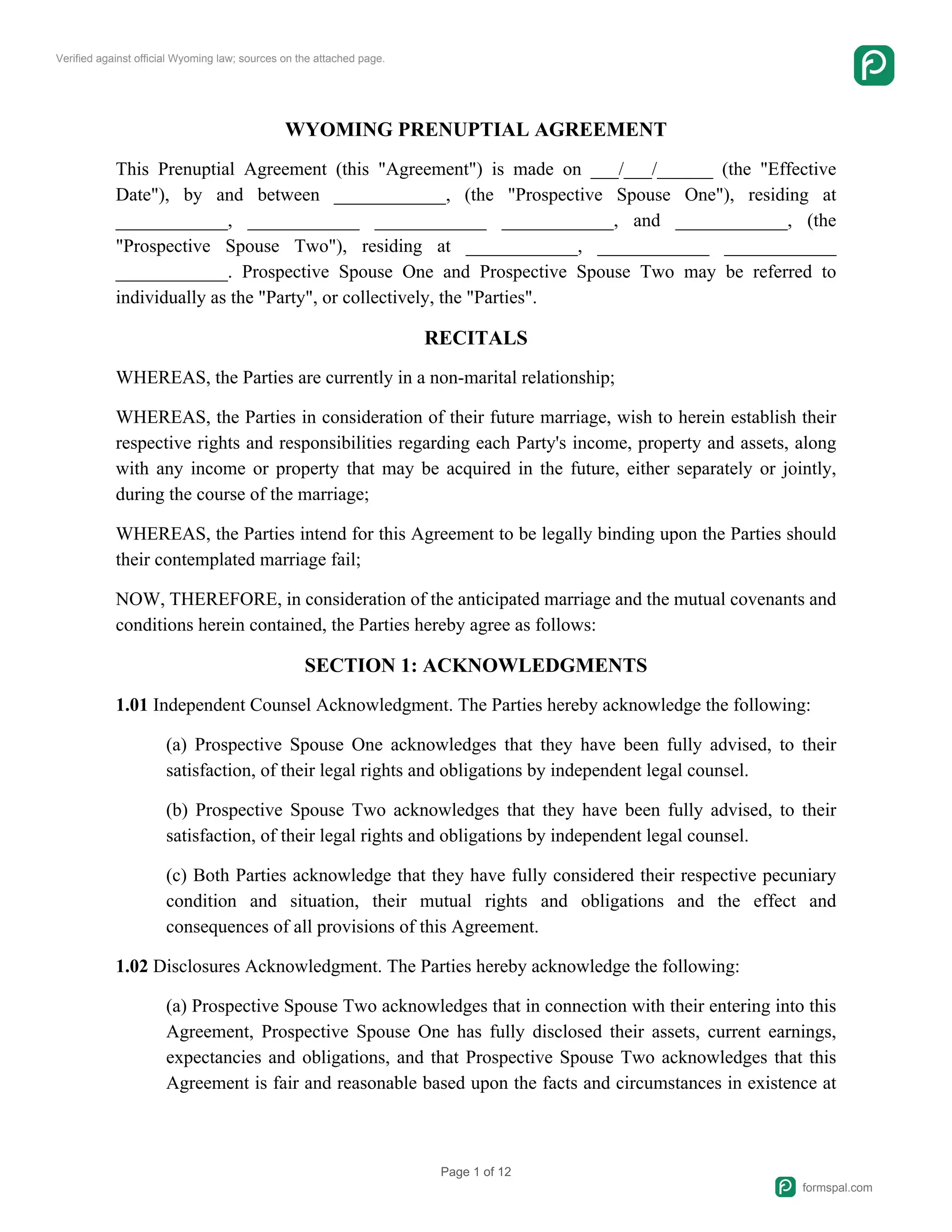
Download the Wyoming Prenuptial Agreement: PDF | Word (.docx) | OpenDocument (.odt)
A Wyoming prenuptial agreement is a written contract that two people sign before they marry. It records who owns what, who owes what, and how property, debt and spousal support will be handled if the marriage ends in divorce or death. Wyoming has no premarital agreement statute and never adopted the Uniform Premarital Agreement Act, so the courts read a prenup as an ordinary contract made in consideration of marriage.
Two Wyoming statutes still shape it. One puts an agreement made on consideration of marriage inside the statute of frauds, so the contract must be written and signed. The other lets a spouse waive elective-share and allowance rights in the other spouse's estate. Our general prenuptial agreement guide covers the parts every state version shares, and the free template above follows the same structure.
Build Your Document
Answer a few simple questions to make your document in minutes
Save and Print
Save progress and finish on any device, download and print anytime
Sign and Use
Your valid, lawyer-approved document is ready
A Wyoming prenuptial agreement is a contract that two future spouses make before the wedding to fix their property rights in advance. It takes effect only when the couple marries, and it matters only if the marriage later ends by divorce or by death. Couples use it to keep a ranch, a business or an inheritance separate, and to settle who carries which debt.
The couple writes the provisions themselves. All Wyoming prenuptial agreements carry the same core parts:
Wyoming has no premarital agreement act, so there is no single chapter of the laws to read. Prenuptial agreements are judged as contracts. The Wyoming Supreme Court has treated them that way since Laird v. Laird in 1979 and Lund v. Lund in 1993. Two statutes apply directly. One puts the agreement under the statute of frauds. The other governs waivers of a surviving spouse's claims on an estate.
Section 1-23-105(a)(iii) of the Wyo. Stat. places every agreement made on consideration of marriage inside the statute of frauds. Such an agreement is void unless it is in writing and subscribed by the party to be charged with it.[1] In practice both parties sign, and they do it before the wedding.
In the following cases every agreement shall be void unless such agreement, or some note or memorandum thereof be in writing, and subscribed by the party to be charged therewith: (i) Every agreement that by its terms is not to be performed within one (1) year from the making thereof; (ii) Every special promise to answer for the debt, default or miscarriage of another person; (iii) Every agreement, promise or undertaking made upon consideration of marriage, except mutual promise to marry;
Wyoming legal practice treats notarization as optional but sensible. A notarized signature is cheap proof against a later claim of forgery or pressure, and most couples use a notary for that reason alone.
Can the couple change it later? Yes, but only in a new document. Postnuptial agreements made after the wedding follow the same contract rules: in writing, subscribed by both parties, and agreed to without pressure.
A Wyoming judge asks contract questions. Was the agreement written and signed? Did both parties sign it voluntarily? Did each one have full financial disclosure from the other? Are the provisions so lopsided that enforcing them would shock the conscience? Prenuptial agreements that answer all four cleanly are hard to defeat in a Wyoming divorce case.
A Wyoming judge sets prenuptial agreements aside on the grounds that undo any contract: fraud, duress, concealed finances, or provisions the court finds unconscionable. Child custody and child support sit outside the agreement altogether. A family court judge decides those on the child's best interests at the time of the divorce, whatever the couple wrote years earlier.
A Wyoming prenuptial agreement can settle almost any financial question the parties agree on. Property owned before the wedding, income earned during the marriage, debt, business interests, a life insurance policy and inheritance rights all fit inside it. The Wyoming laws add one more item. Section 2-5-102 of the Wyo. Stat. lets each spouse waive the right of election, the homestead allowance, exempt property and the family allowance in the other's estate.[2]
That waiver may be total or partial, and it can be signed before or after the marriage. It has to take the form of a written contract, agreement or waiver, signed by the party waiving the right, and it has to follow fair disclosure.[2]
Yes. Wyoming enforces prenuptial agreements, and it has done so for decades under contract law rather than under a premarital agreement statute. The case law comes from two Wyoming Supreme Court decisions: Laird v. Laird in 1979 and Lund v. Lund in 1993. Both treat an agreement made in contemplation of marriage as a binding contract, with the marriage itself supplying the consideration. A written, voluntary, fully disclosed prenuptial agreement is enforceable.
No. Wyoming divides property by equitable distribution, not by an automatic half-and-half split. Under Section 20-2-114 of the Wyo. Stat., a judge granting a divorce disposes of the couple's property in whatever way appears just and equitable. The judge weighs the merits of each party, the condition each will be left in, whom the property came through, and the burdens carried on it. A prenuptial agreement is what removes that discretion.[3]
Under the same section a judge may award reasonable alimony out of the estate of the other spouse. A support waiver in the prenup is written to take that question off the table.[3]
The process matters more than the wording. Wyoming prenups are usually beaten on how they were signed, not on what they say: a signature collected the week of the wedding, or a bank account nobody mentioned. Work through the steps below with enough time that neither future spouse can later say they were rushed or kept in the dark.
Last Updated: September 2026. This guide is reviewed and updated regularly to reflect current Wyoming law. If you notice an error or outdated information, please contact us.

Wyoming publishes its statutes through the state legislature, and the three sections below are the ones this page relies on. The standards for enforcing prenuptial agreements are a different matter. They come from Wyoming Supreme Court decisions rather than from the statutes, so the legal test is a matter of case law. Those decisions are named in the prose above rather than listed here.
Unless noted otherwise, the sources below are from the Wyo. Stat..