
Updated:
A third party financing addendum is a home purchase contract's loan attachment. It lists the loan type and approximate amount, from conventional to FHA, VA, USDA and reverse mortgage loans. Buyers borrowing from a lender use it; seller-financed buyers use a different addendum.
This page gives you a free addendum to fill in online or download, a field-by-field guide, and answers to the questions buyers and sellers ask most. The addendum sits beside your printable purchase and sale agreement; for other add-ons, see our addendum to real estate purchase contract list.
Build Your Document
Answer a few simple questions to make your document in minutes
Save and Print
Save progress and finish on any device, download and print anytime
Sign and Use
Your valid, lawyer-approved document is ready
A third party financing addendum is an attachment to a real estate purchase agreement that names the outside loan the buyer will use to pay for the property, with its type and approximate amount. "Third party" means the money comes from a lender, not from the buyer or the seller.
The addendum does not replace the purchase agreement. It sits beside it and adds the financing details, such as the loan type and the approximate amount, in one place.
With the addendum attached, the sale depends on the buyer getting that loan. The buyer is the party who applies for the loan, so the buyer is usually pre-approved by a lender before the addendum is filled in. If the loan falls through, the addendum gives the buyer a way out of the contract on the terms it sets.
Keep the signed third party financing addendum together with your purchase agreement. That way, both documents are easy to find when a buyer, a seller or a lender asks to see them later.
A third party financing addendum protects the buyer first: it makes the purchase depend on loan approval, so a buyer whose loan is denied can cancel instead of being bound to buy without the money.
The protection works only when the buyer acts on time. Read the addendum's notice terms, and if the loan will not come through, tell the seller in writing as soon as possible.
A buyer who cancels late, or without the written notice the addendum asks for, risks being in breach of the sales contract and losing the earnest money.
If you are the buyer, let the seller know as soon as you can that you are not receiving the loan and need to cancel the sale.
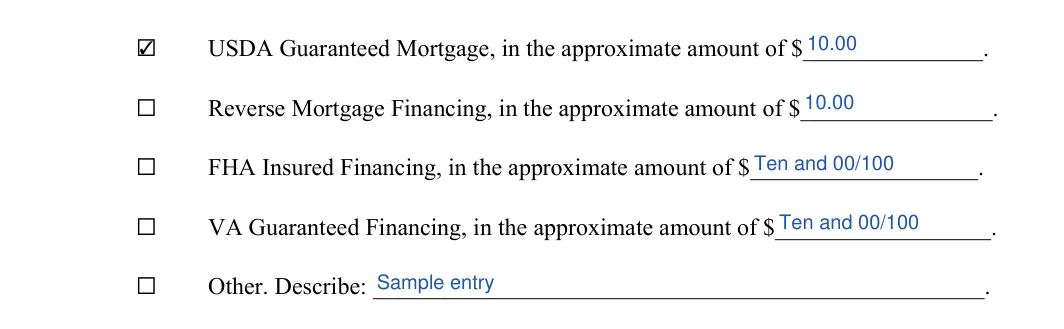
Third party financing comes in several loan types, and the addendum lists each one with its own check box. Pick the type that matches the loan the buyer has applied for:
Each loan type comes with its own terms, so the details you enter on the addendum differ from one type to the next.
Third party financing differs from owner financing in who lends the money: a bank or mortgage lender in the first case, the seller in the second. The third party financing addendum covers only the first.
If the seller is carrying the loan, use an owner financing addendum instead, and see our real estate addendums for the add-on that fits.
The financing addendum includes the parties, the property, the loan type with its terms and amount, the lender and property approval, and the signatures. The layout may look slightly different depending on the loan, but these parts appear on almost every version.
The heading names the buyer and the seller with their addresses. It also gives the date of the addendum and the date of the purchase agreement it belongs to.
The financing section names the loan type and the approximate loan amount.
Make sure you always indicate the amount of money the buyer is trying to receive from the loan company.
Lender approval means the lender agrees to make the loan to this buyer; property approval means the lender accepts the home itself as security.
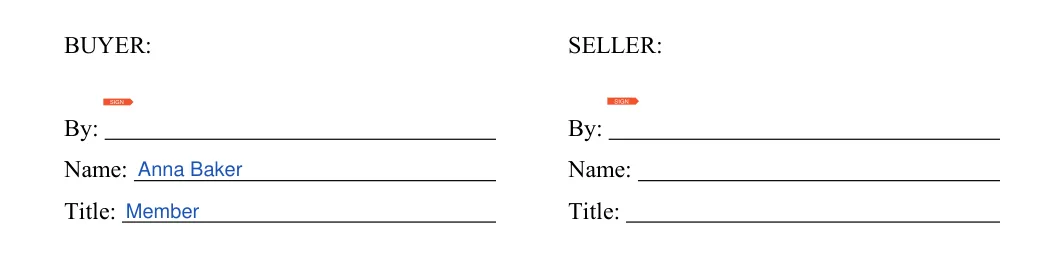
The execution block is where the buyer and the seller sign. Each prints a full name, and the names and signatures should match the ones on the original purchase agreement.
The FormsPal third party financing addendum template that this page hands out runs three pages and has 28 fillable fields, and the five steps below follow it in order. Compare each entry with your purchase agreement, so that the names, addresses and dates match.
The screenshots under each step show the FormsPal Third (3rd) Party Financing Addendum template filled with sample entries in blue, so you can see where each answer goes. The names, addresses, dates and amounts are examples only.
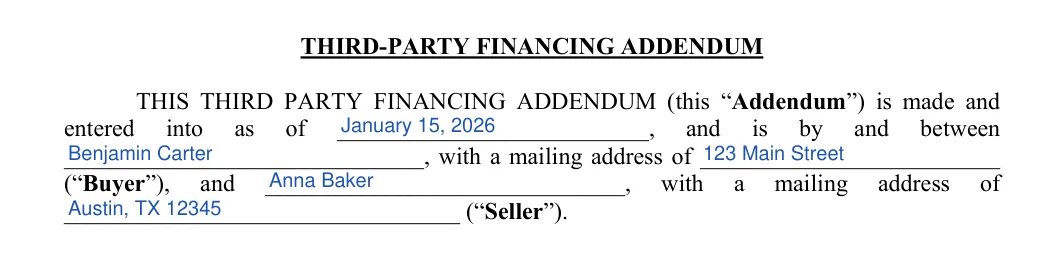

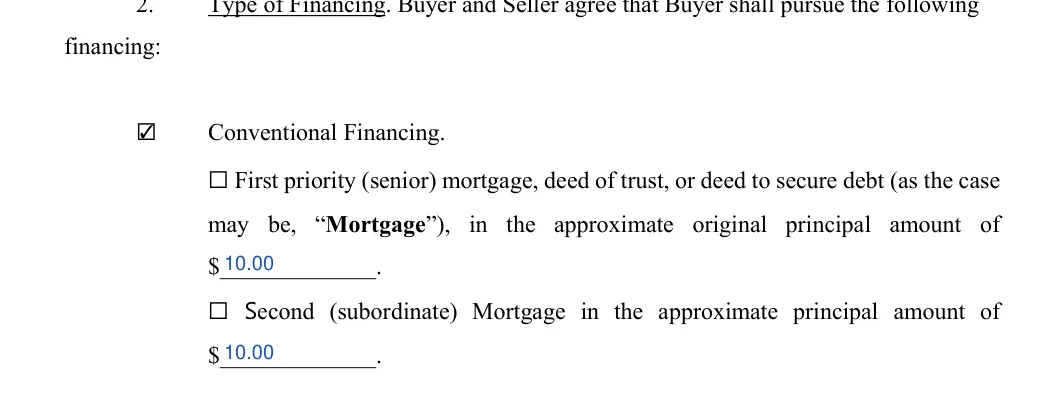
Third party financing addendum example. Jordan Lee agrees to buy 123 Sample Street, Springfield, from Pat Rivera under a purchase agreement dated March 2. Jordan dates the addendum March 4, checks Conventional Financing and the first mortgage box, and enters an approximate amount of $240,000. Jordan and Pat each sign on the By line and print their names below.
The financing addendum changes the terms of a land sale contract, so the buyer and the seller should put it in writing and both sign it, just as they signed the purchase agreement. Two state statutes in the FormsPal fact base, checked against the official state code, set out a written contract rule for land sales:
| State | Written contract rule for a sale of land | Source |
|---|---|---|
| Alabama | A contract for the sale of land is void unless it, or a note or memorandum of it expressing the consideration, is in writing and signed by the party to be charged; the exception applies only if the purchase money, or part of it, is paid and the seller puts the buyer in possession of the land. | Ala. Code § 8-9-2 |
| Massachusetts | When an action is brought on a contract for the sale of land or an interest in it, the contract, or a memorandum or note of it, has to be in writing and signed by the party to be charged or by a person that party lawfully authorized. | Mass. Gen. Laws ch. 259, § 1 |
This table lists only these two states, which does not mean other states have no such rule. Signing every addendum in writing keeps it together with the purchase agreement it changes.
These answers cover the basics of the FormsPal addendum template, including the six loan types that it lists, who signs it, and how to fill in the PDF on your computer.
A financing addendum is an attachment to a real estate purchase agreement that sets out how the buyer will pay. A third party financing addendum covers a loan from a lender; an owner financing addendum covers a loan from the seller.
A third party financing addendum is one example: it adds the buyer's loan details to a purchase agreement. Others cover a home inspection, the sale of the buyer's current home, or items that stay with the property.
The buyer can usually cancel the sale and ask for the earnest money back, on the terms the addendum sets. The buyer should give the seller written notice promptly, because a late or missing notice can cost the buyer that protection.
Yes, a buyer can change lenders, but a change of loan type or amount should go on a new or amended addendum signed by both parties. That keeps the written loan terms in line with the loan the buyer is really getting.
The buyer and the seller each have a signature block on the last page. A name and title are printed below each signature, so that the signers can be identified.
Yes. Download the PDF from this page and fill it in with the online PDF editor, then save or print your copy.
Keep a signed copy with your purchase agreement and give a copy to the other party. That way, both sides can find the document again when they want to check the loan details.
General information, not legal or tax advice.
