
Updated:
A car release of liability form is a signed vehicle sale document. It names the seller and the buyer, describes the vehicle and gives the date of the transfer. Sellers fill in this FormsPal template online, then print the PDF to sign.

Build Your Document
Answer a few simple questions to make your document in minutes
Save and Print
Save progress and finish on any device, download and print anytime
Sign and Use
Your valid, lawyer-approved document is ready
A car release of liability form, also called a release for car sale, is a document that the seller and the buyer sign when a car changes hands. It puts the sale date, both parties and the vehicle on one page, so the seller can show when the car stopped being theirs.
The form works for any passenger vehicle sold between two people: a car, a truck, an SUV or a van. It is short, it uses plain fields, and each party keeps a signed copy.
The FormsPal version is a fillable template. You answer questions online, and the answers land in the right fields of the PDF.
| Document Name | Car Sale Release of Liability Form |
| Other Name | Release for Car Sale |
| Avg. Time to Fill Out | 12 minutes |
| # of Fillable Fields | 35 |
| Available Formats | Adobe PDF |
Use this form when you sell a vehicle yourself, without a dealer handling the paperwork. If something happens with the car after the handover, the signed and dated release shows when the sale took place and who bought it. It binds only the seller and the buyer who sign it, and it does not tell the DMV about the sale.
A DMV may keep its own notice of transfer for sellers, as the section on DMV notices below shows for Texas and California, so check what the DMV where the car is registered asks of you.
The release is most useful in these situations:
For a car paid for in installments, pair the release with the car sale loan agreement, which sets out the payment plan.
A car sale release does not take the place of the other sale papers. The motor vehicle bill of sale sets out the price and the terms of the purchase, and the vehicle title shows who owns the car.
A release from claims after an accident, an injury or a risky activity is a different document. For those, start from the general release of liability form instead.
Selling a car involves more than handing over the keys, because the paperwork and the way you meet the buyer both matter.
A vehicle release form includes the names and addresses of the seller and the buyer, the vehicle’s make, model, year, color and VIN, the odometer reading and the date of the sale.
The seller can keep a copy for their own records.
The FormsPal template has three pages and these parts:
Keep the vehicle title or registration at hand while you gather these details. Both show the VIN, make, model and year in one place, which saves a second trip to the car.
To fill out the form, enter the date, the seller’s and the buyer’s details and the vehicle description, then have each party sign and date their own line.
These six steps follow the FormsPal template from the first line to the last page, in the order the document is laid out. Each step has a screenshot with sample entries, so you can see where every answer goes before you start typing.
The screenshots under each step show the FormsPal Car Sale Release of Liability template filled with sample entries in blue, so you can see where each answer goes. The names, addresses, dates and amounts are examples only.
Enter the date
At the top of page 1, write the date on the DATE line. The opening paragraph below it ties the form to that date and to the two parties listed after it.

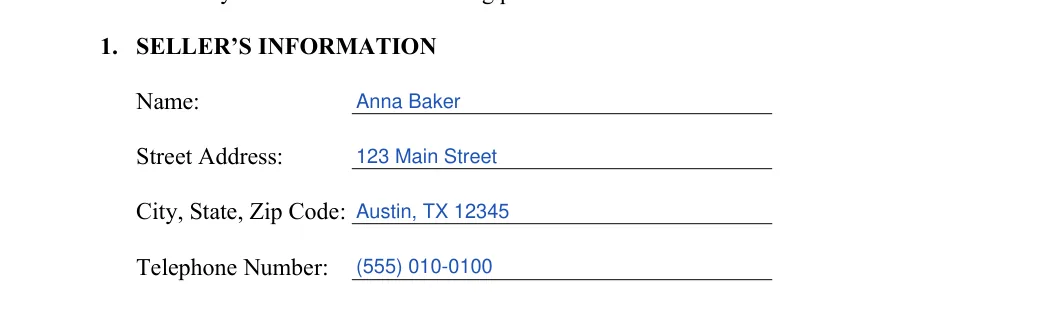
Seller’s Information (Section 1)
Enter the seller’s name, street address, city, state and zip code, and telephone number.
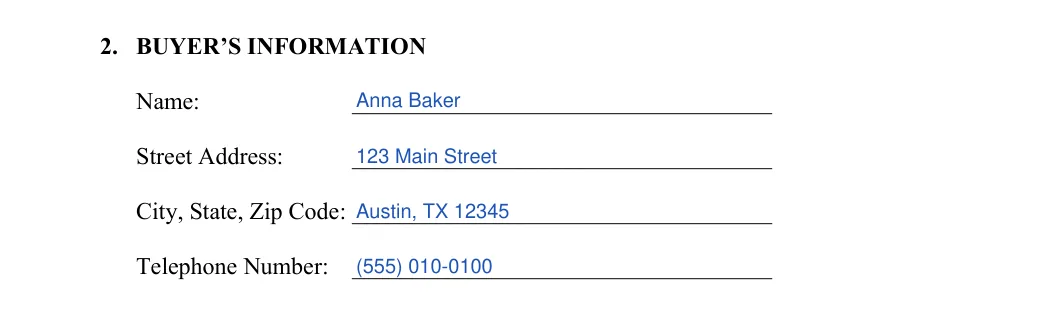
Buyer’s Information (Section 2)
Enter the buyer’s name, street address, city, state and zip code, and telephone number in the second block.
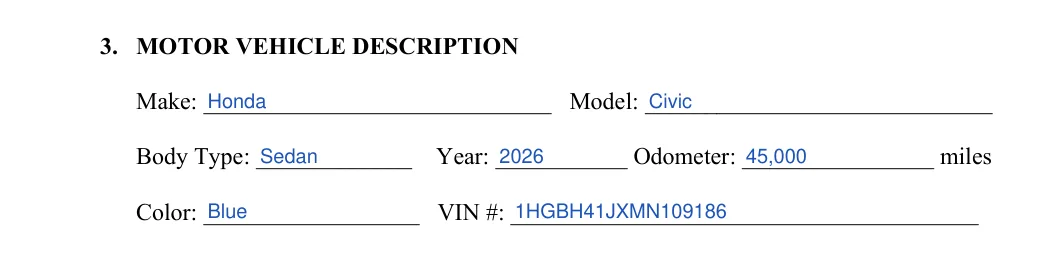
Motor Vehicle Description (Section 3)
Enter the vehicle’s make, model, body type, year, odometer reading in miles, color and VIN. Copy the VIN from the vehicle title or registration so it matches exactly.
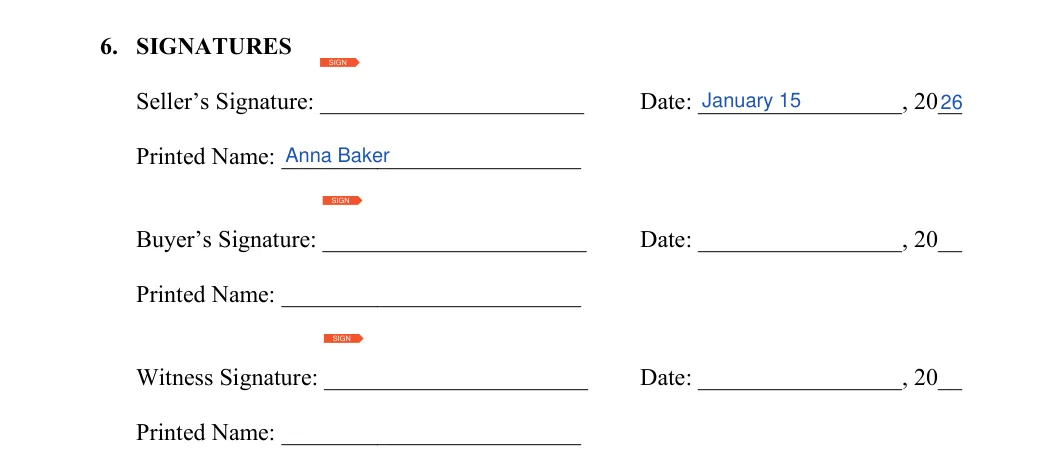
Signatures (Section 6)
Sections 4 and 5 are text only, so read through them first. Page 2 then has a line for the seller, the buyer and a witness. Each one signs and adds a date and a printed name on their own line.
Acknowledgment
Page 3 holds the acknowledgment block. It has lines for the state, the county and the date. It also has lines for the officer’s name and title, the person who appeared and the state for the perjury statement. The officer’s signature goes under “WITNESS my hand and official seal”.
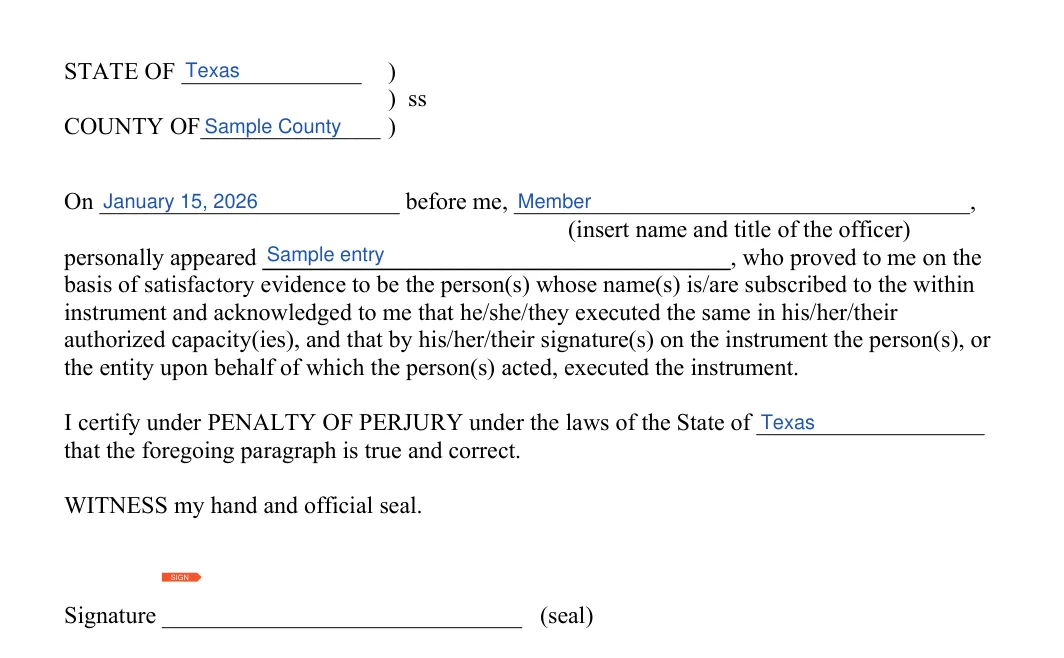
When every section is complete, save the file and print it for signing.
The FormsPal car sale release is a private agreement between the seller and the buyer, and it is not a DMV form. FormsPal does not send it to any DMV office, and nobody else receives it unless you hand it over.
Some searchers look for a “DMV release of liability form”. If the motor vehicle office where the car is registered has its own notice of sale or transfer form, that form is separate from this one, and this template does not take its place.
Signing this release does not report the sale to the DMV. Many DMVs have their own seller notice of sale or transfer. The table gives two examples, Texas and California, each with a deadline counted from the date of sale:
| State | DMV notice for the seller | When | Official source |
|---|---|---|---|
| Texas | Vehicle Transfer Notification; when you file the notification within 30 days from the date of sale, you cannot be held responsible for parking tickets and toll violations that have been committed by the person who purchased the vehicle | Within 30 days from the date of sale | Texas DMV, Buying or Selling a Vehicle |
| California | Sellers must also submit a Notice of Transfer and Release of Liability (NRL) within 5 days. | Within 5 days | California DMV, Title Transfers and Changes |
This page covers those two DMVs only. For a car registered anywhere else, ask the DMV office near you, or check its website, for what it expects from a seller after the sale.
The release section of the form is the text in which the seller and the buyer who sign it set out, between the two of them, who answers for the vehicle after the sale date. It has no fields to fill in, so read it in full before anyone signs.
It binds only those two parties. Tickets and tolls after the sale follow the DMV’s own notice rules: in Texas, when you file the notification within 30 days from the date of sale, you cannot be held responsible for parking tickets and toll violations that have been committed by the person who purchased the vehicle (Texas DMV, Buying or Selling a Vehicle). Check the rule for your car with the DMV where it is registered. Whether a seller answers for other people’s claims after the sale, such as an accident, is not settled by this release, and this page does not cover it; ask where the car is registered.
A release has limits. In California, a contract that has for its object, directly or indirectly, to exempt anyone from responsibility for their own fraud, willful injury to the person or property of another, or violation of law, whether willful or negligent, is against the policy of the law (Cal. Civ. Code § 1668).
Our legal sources give that rule for California only, and they hold no rule written for car sale releases elsewhere. This page adds none from other places.
Before anyone signs, compare the release text with what you agreed out loud. If the buyer was promised a repair or a return period, write it down in the sale papers so both sides read the same terms.
Most errors on the form come from rushing the motor vehicle details or leaving a line empty. A quick check of the finished document against the vehicle title and the registration helps catch them before anyone signs.
Once the form is signed, what is left is the paperwork around it. Make a copy for your own records and keep it with the bill of sale and the vehicle title.
Give the buyer a signed copy too, so both sides hold the same version with the same date and VIN.
Other FormsPal documents that go with the sale of a vehicle:
Yes. The form comes as an Adobe PDF that you create online with FormsPal, save and print.
The details table above lists an average of 12 minutes for the 35 fillable fields.
Yes. The signature page has a line for the seller, one for the buyer and one for a witness, and page 3 has an acknowledgment block.
Our legal sources hold no rule on this for a car sale release, so this page gives none. The last page of the template has an acknowledgment block, with a line for the officer’s signature and seal, for parties who want their signatures acknowledged.
No. The release ties the seller, the buyer, the vehicle and the sale date to a signed release, while a bill of sale sets out the price and the terms of the purchase.
Yes. Select Create My Document and answer a few questions, then save the form and download it as a PDF to print.
The VIN is printed on the vehicle title and the registration. Copy it exactly as it appears there.
General information, not legal or tax advice.
