
An Iowa living will is a written document that lets a person state in advance which medical treatments they want or refuse if illness or injury leaves them unable to communicate. Iowa Code Chapter 144A calls it a declaration relating to the use of life-sustaining procedures, and it guides doctors and family members once the person can no longer speak for themselves.
Last Updated: September 2026. This guide is reviewed and updated regularly to reflect current Iowa law. If you notice an error or outdated information, please contact us.
A living will form covers decisions about mechanical ventilation, artificial nutrition and hydration, and other treatments that only prolong life. The declarant, the person making the document, decides in advance whether to accept or refuse these treatments. This guide covers Iowa’s signing rules and walks through the state’s form.
Iowa Code Chapter 144A sets the rules for a living will, called a declaration relating to the use of life-sustaining procedures. Iowa Code § 144A.3 requires the declaration to be in writing, signed by the declarant (the person making the document), dated, and either witnessed by two people or acknowledged before a notary public.[1]
If the declarant cannot sign, another person may sign for them, as long as it happens at the declarant’s direction and the document still shows the date it was signed.[1]
Tip: If you cannot find two eligible witnesses, Iowa law lets you complete a notary acknowledgment instead.[1]
Iowa law disqualifies certain people from serving as a witness for the declaration.[1]
At least one of the two witnesses must not be related to the declarant by blood, marriage, or adoption within the third degree, so a close family member cannot serve as the only witness.[1]
Both witnesses must watch the declarant sign, or watch the person signing on the declarant’s behalf, while they are all in the room together.[1]
A declaration takes operative effect only when your condition has been determined to be terminal and you are unable to make treatment decisions (Iowa Code § 144A.3(1)).[1]
Under Iowa Code § 144A.4, you may revoke your declaration at any time and in any manner by which you can communicate the intent, whatever your mental or physical condition. As to your attending physician, the revocation takes effect once it is communicated to that physician.[2]
Iowa Code § 144A.3 sets out the exact wording of the declaration you sign when you make a living will. The statute gives you this language so you do not have to write your own legal phrasing from scratch, and the state’s form reproduces it below.[1]
Declaration if i should have an incurable or irreversible condition that will result either in death within a relatively short period of time or a state of permanent unconsciousness from which, to a reasonable degree of medical certainty, there can be no recovery, it is my desire that my life not be prolonged by the administration of life-sustaining procedures. if i am unable to participate in my health care decisions, i direct my attending physician to withhold or withdraw life-sustaining procedures that merely prolong the dying process and are not necessary to my comfort or freedom from pain.
| Document Name | Iowa Living Will Form |
| State Form Name | Iowa Declaration Relating to Use of Life-Sustaining Procedures |
| Signing Requirements | Two Witnesses or Notary Public |
| Validity Requirements | Iowa Code § 144A.3 |
| State Laws: Iowa Code §§ 144A.1 to 144A.12 | |
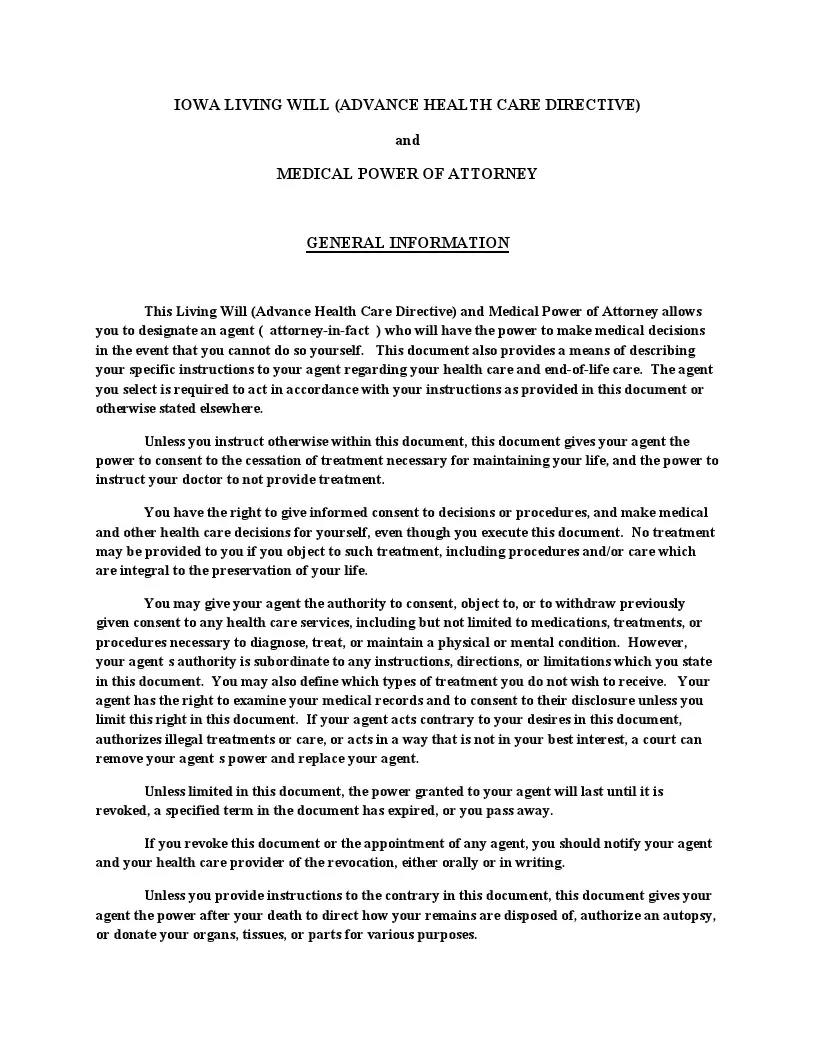
Complete the Iowa living will and medical power of attorney form in the order below. Read each section before you fill it in, and initial only the items on the form that reflect your wishes.

A few common mistakes can keep an otherwise valid Iowa living will from holding up in a hospital or a court. Most come from the signing and witnessing step, where a single disqualified witness or a missing date can undermine the whole document. Watch for these before you sign.
The Iowa form combines a living will with a medical power of attorney, so one document names an agent to carry out your wishes. The form calls this person your attorney-in-fact, and it lists the specific powers you give them.
The form lets your agent act for you in several ways once you can no longer make your own health care decisions.
The form states that your agent’s authority becomes effective once your treating physician certifies in writing that you can no longer make informed health care decisions. The form also grants your agent HIPAA release authority, so health care providers can share your medical records with your agent when needed.
The form states that if a court needs to appoint a conservator for you, your named agent is your nominee for that role unless you choose someone else. A signed photocopy of the document counts the same as the original, so your agent can share copies as needed. If one part of the document is ever found invalid, the rest of the document still stands.
The form states that you may revoke or end the document at any time. Tell your agent and your health care provider about the revocation, in writing or out loud.
To set up a living will in Iowa, put your wishes about life-sustaining treatment in writing, sign the document yourself or have someone sign at your direction, and complete it in front of two qualifying witnesses or a notary public. The Iowa Code sets out the wording and the witnessing steps that make the document valid.[1]
Most people complete the form in one sitting, then store the signed original somewhere their agent and family can find it.
General information, not legal or tax advice.
