
A Washington small estate affidavit is a sworn statement by a person claiming to be a successor of a decedent. It asks whoever holds the decedent's personal property or owes the decedent a debt to pay or deliver it. It works for an estate worth no more than one hundred thousand dollars ($100,000), once at least forty days have passed since the death.[1]
Last Updated: October 2026. This guide is reviewed and updated regularly to reflect current Washington law. If you notice an error or outdated information, please contact us.
Build Your Document
Answer a few simple questions to make your document in minutes
Save and Print
Save progress and finish on any device, download and print anytime
Sign and Use
Your valid, lawyer-approved document is ready
The rule is in Wash. Rev. Code § 11.62.010, cited as RCW 11.62.010, part of chapter 11.62 RCW (Sections 11.62.005 to 11.62.030).[2] It applies after forty days from the date of a decedent's death. Then a person who owes the decedent a debt, or holds the decedent's personal property, must pay or deliver it to a person claiming to be a successor. The holder acts once it receives proof of death and an affidavit that meets the statute's requirements.[1]
The statute sets these conditions for using the affidavit.
The rule covers property and debts owed to the decedent that are subject to probate. Real property is not part of it.[1]
Under RCW 11.62.005(1), personal property includes tangible personal property, instruments evidencing a debt, obligation, stock, chose in action (a legal claim to money or property), license or ownership, debts, and other intangible property.[2]
| Max. Estate (Small Estate Affidavit Limit) | $100,000[1] |
| Min. Time to Wait After Death | 40 days[1] |
| Notice to Other Successors | Written notice, then at least 10 days[1] |
| State Laws | Washington Revised Code, Section 11.62.010 |
A successor who claims property under the affidavit must first tell the other successors. The statute requires written notice that identifies the claim and describes the property claimed. At least ten days must pass after the notice is served or mailed.[1]
That the claiming successor has given written notice, either by personal service or by mail, identifying his or her claim, and describing the property claimed, to all other successors of the decedent, and that at least ten days have elapsed since the service or mailing of such notice;
Two more points apply.
Two separate clocks apply. The forty days run from the death. The ten days run from the service or mailing of the notice to the other successors.[1]

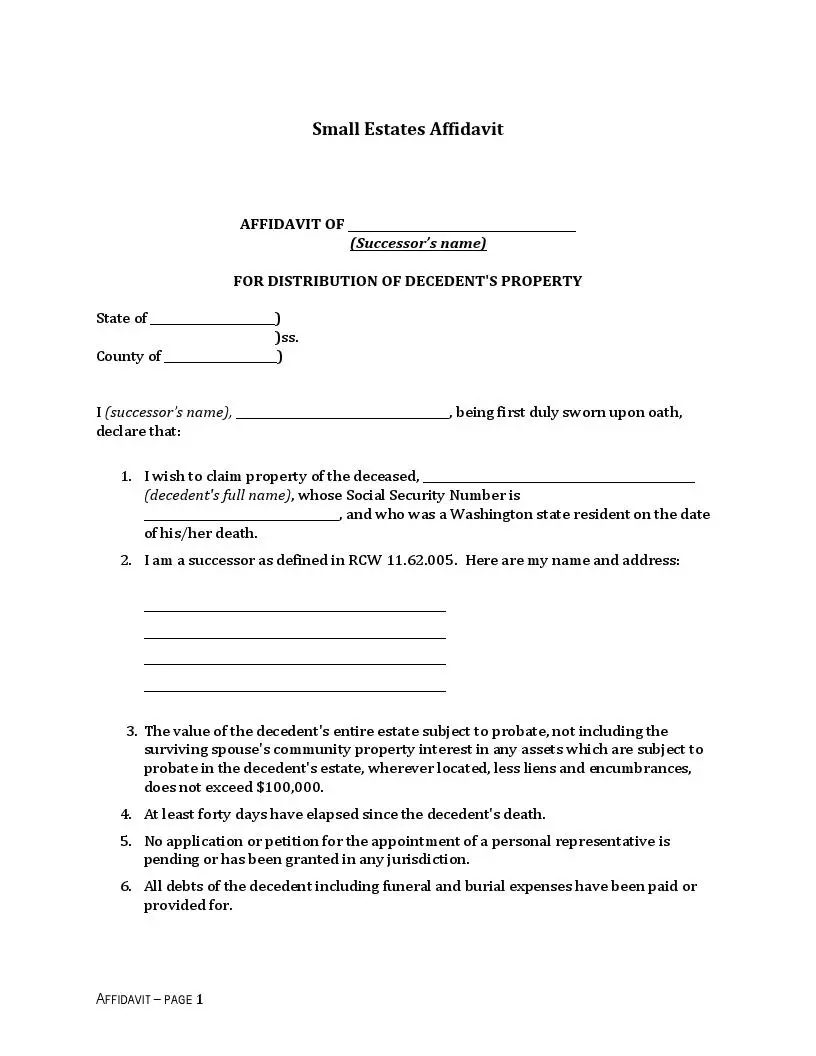
These instructions follow the order of the form, so you can work through the process one step at a time. Fill in the downloaded PDF with our online PDF editor, or print it and write the answers by hand. Each step names the part of the form it covers.
The screenshots under each step show the FormsPal Washington small estate affidavit template filled with sample entries in blue, so you can see where each answer goes. The names, addresses, dates and amounts are examples only.

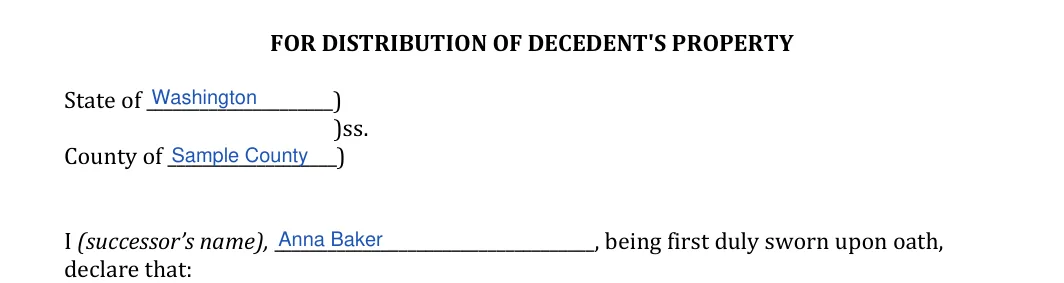

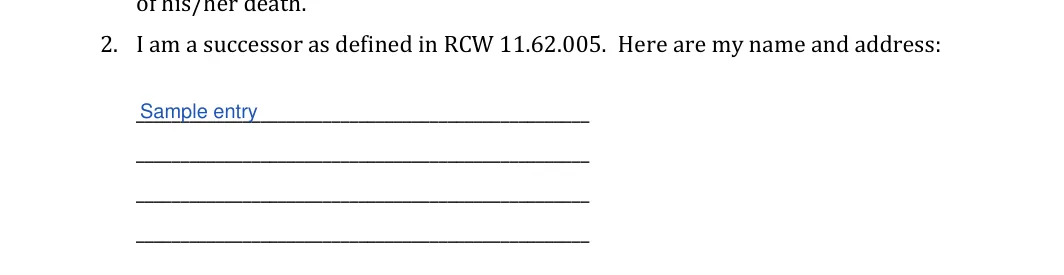
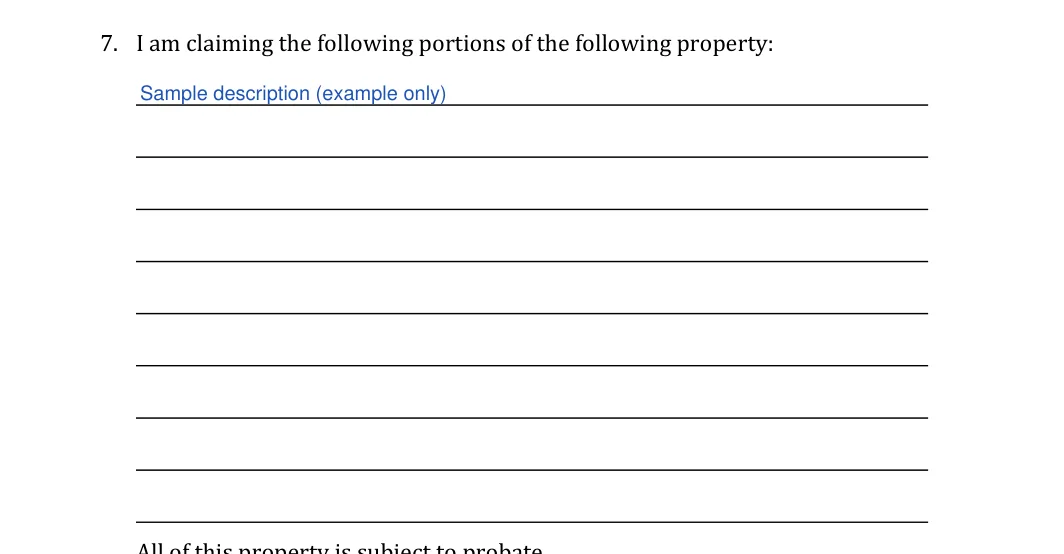
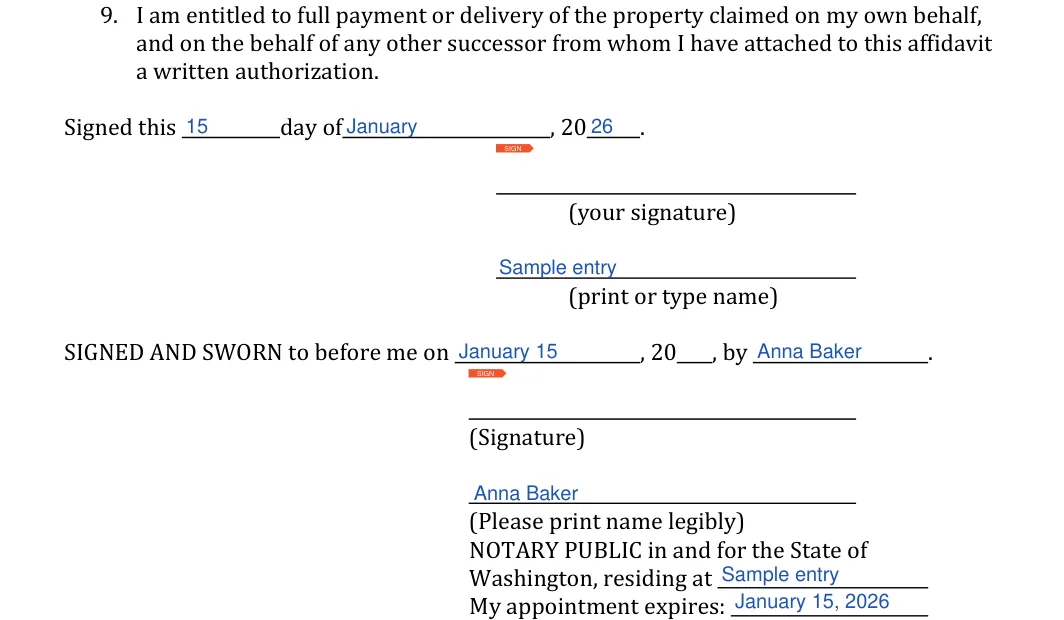

The answers below cover the value limit, the waiting period, the tax release rule and the copy of the affidavit that goes to the Department of Social and Health Services. Use them to check each point before you start the form.
The limit is one hundred thousand dollars ($100,000). It applies to the decedent's entire estate subject to probate.[1]
The small estate affidavit covers an estate worth no more than one hundred thousand dollars ($100,000).[1]
At least forty days after the decedent died. After that, the person who owes the decedent a debt or holds property of the decedent must pay or deliver it once the claiming successor gives both of these.[1]
No. No release from any Washington state or local taxing authority may be required before assets or debts are paid or delivered to a successor.[1]
A copy of the affidavit, including the decedent's Social Security number, must be mailed to the state of Washington, Department of Social and Health Services, office of financial recovery.[1]
General information, not legal or tax advice.
