
An Arizona firearm bill of sale is a written record of a gun sale, trade or gift. It names the buyer and the seller, describes the firearm by make, model, caliber and serial number, and states the price and how it is paid. Arizona law does not allow selling or transferring a deadly weapon to a prohibited possessor, so a signed record also shows who the parties were.[1] Download the free PDF or create the form online below. For other kinds of sales, read our bill of sale guide.
Last Updated: October 2026. This guide is reviewed and updated regularly to reflect current Arizona law. If you notice an error or outdated information, please contact us.
Build Your Document
Answer a few simple questions to make your document in minutes
Save and Print
Save progress and finish on any device, download and print anytime
Sign and Use
Your valid, lawyer-approved document is ready
Find more Arizona bill of sale templates for other kinds of sales.
Arizona and federal law set a few rules that apply when a gun changes hands. Arizona prohibits selling or transferring a deadly weapon to a prohibited possessor. Federal law sets minimum ages for buyers and requires a background check when a licensed dealer transfers a firearm to an unlicensed person. The rules below name their sources.
Arizona law prohibits selling or transferring a deadly weapon to a prohibited possessor.[1] The statute says:
Selling or transferring a deadly weapon to a prohibited possessor
| Subject | Long Guns | Hand Guns |
| Selling or transferring to a prohibited possessor[1] | Prohibited (Ariz. Rev. Stat. § 13-3102) | |
| Minimum age when buying from a licensee[2.1] | 18 (rifle or shotgun) | 21 (other firearms) |
| Background check before a licensed dealer transfers a firearm to an unlicensed person[2.2] | Required (18 U.S.C. § 922(t)(1)) | |
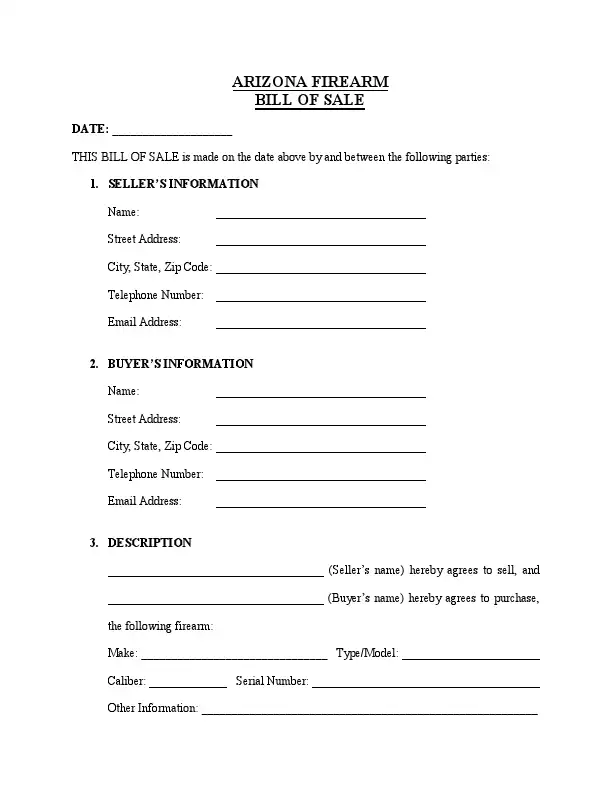
A firearm bill of sale, sometimes called a gun bill of sale, records one transaction between a seller and a buyer. The FormsPal form covers the date, both parties, the firearm, the price and payment method, and signatures. A signed copy gives both sides written proof of the sale, and each side should keep one.
Copy the serial number exactly as it is stamped on the firearm. Many sellers also ask to see the buyer's photo ID, so the name on the form matches the person buying.
Our free Arizona firearm bill of sale is a ready-to-use PDF. You can also create it online with the document builder at the top of this page. Print it and have each party sign, or fill in the PDF on screen with our PDF editor. FormsPal also offers a general firearm bill of sale template.
These steps follow the FormsPal Arizona firearm bill of sale from the date at the top to the notary page at the end. Each step names the part of the form it covers. Have the details of the sale ready before you start, and fill in every field in order.
Step 1: Enter the date at the top of the form.

Step 2: Fill in the seller's and buyer's information in sections 1 and 2. Each section has the same fields:

Step 3: Describe the firearm in section 3. Write the seller's and buyer's names in the opening lines, then fill in:

Step 4: Enter the purchase date, price and payment method in section 4.
Type in the purchase date and the total purchase price. Then tick one box to show how the buyer pays:
Last, select how the price is paid: cash, check (with the check number), cashier's check or money order.

Step 5: Read the disclosures and the miscellaneous terms in sections 5 and 6.
Section 5 lists statements that the seller and the buyer each confirm, and each has a signature line on page 3. Section 6 sets the "as is" terms: the buyer takes the firearm in its current condition, with no warranties, and accepts all liability for it as of the sale date.

Step 6: Complete the signatures in section 7.
Fill in each date line. The seller and the buyer each sign and print their name. The form also has a line where a witness can sign and print their name.

Step 7: Complete the acknowledgment on the last page.
The last page of the form is a notary acknowledgment. When it is used, sign in front of the notary, who then fills in the county, the date, their name and title, their signature and their seal. Each party should keep a copy of the signed bill of sale.

Arizona law prohibits selling or transferring a deadly weapon to a prohibited possessor, as Section 13-3102 of the Ariz. Rev. Stat. states.[1] In practice, a seller should know who the buyer is before the sale. A written record with the buyer's name and address helps both sides show who took part.
General information, not legal or tax advice.
