
Florida Firearm Bill of Sale Form

A Florida firearm bill of sale is a written record of a gun sale between a seller and a buyer. It names both parties, describes the firearm by make, model, caliber and serial number, and states the price and how it is paid. Use it for firearms sold between private parties in the state of Florida. The free FormsPal template below covers each of these details.

Last Updated: October 2026. This guide is reviewed and updated regularly to reflect current Florida law. If you notice an error or outdated information, please contact us.
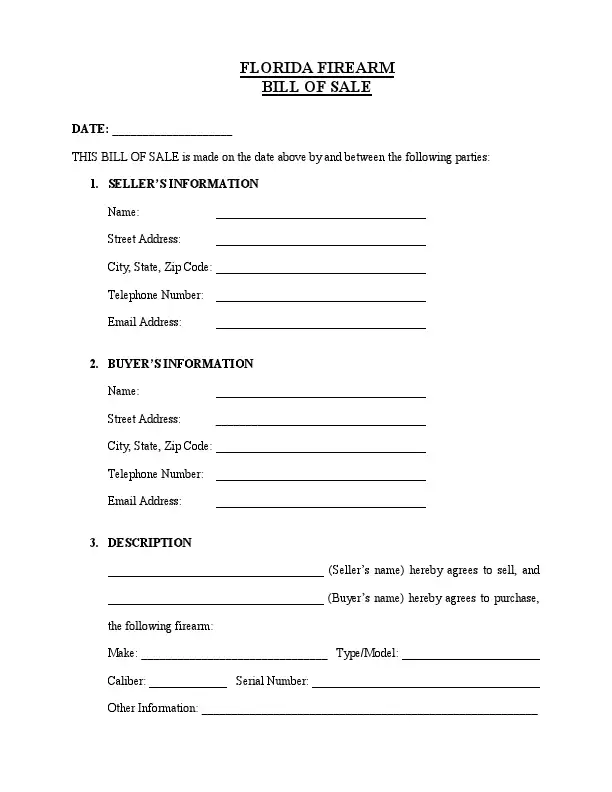
Florida firearm bill of sale form preview

Create a Free Florida Gun Bill of Sale Now!

Build Your Document

Answer a few simple questions to make your document in minutes

Save and Print

Save progress and finish on any device, download and print anytime

Sign and Use

Your valid, lawyer-approved document is ready

... or download your Florida Firearm Bill of Sale Form as a  PDF file

For more background, read our guide to bill of sale documents. You can also browse the Florida bill of sale templates, which come with instructions. Other Florida sale documents include a Florida boat bill of sale, a Florida motorcycle bill of sale and a Florida trailer bill of sale.

Florida State and Federal Laws for Selling a Firearm

A Florida gun sale has to follow both state and federal law. Under these laws the buyer must be at least 21, a prohibited person may not buy, and a licensed dealer must run a background check before a transfer of firearms.[2][1.1][1.2] A bill of sale records the sale. The state and federal rules below govern who may buy and who may sell firearms.

Florida state law sets the age. Under Section 790.065 of the Fla. Stat., the buyer must be at least 21.[2] The statute reads:

A person younger than 21 years of age may not purchase a firearm.

Fla. Stat. § 790.065

Federal law also limits who may sell firearms. Under 18 U.S.C. § 922(d), it is unlawful to sell or otherwise dispose of a firearm to a person in a prohibited group.[1.1] This applies when the seller knows, or has reasonable cause to believe, that the person is in one. The groups include a person who:

  • is under indictment for, or has been convicted of, a crime punishable by imprisonment for a term exceeding one year
  • is a fugitive from justice
  • is an unlawful user of, or addicted to, a controlled substance

Federal law gives licensed dealers an extra duty. A licensed importer, manufacturer or dealer may not transfer a firearm to an unlicensed person unless it first contacts the National Instant Criminal Background Check System.[1.2] The contact must come before the transfer is complete.

State law covers the cost of a dealer check. When a licensed dealer sells or delivers a firearm, the buyer pays a fee for the criminal history check. The Florida Department of Law Enforcement sets the fee, and it may not exceed $8 per transaction.[3]

Keep a signed copy of your Florida gun bill of sale. It is your dated record of who bought the firearm, which firearm it was and what was paid.

Florida Firearm Purchase Details

SubjectWhat the law saysSource
Minimum age to buy a firearmThe buyer must be at least 21State law, Fla. Stat. § 790.065[2]
Sale to a prohibited personUnlawful when the seller knows, or has reasonable cause to believe, the buyer is in a prohibited groupFederal law, 18 U.S.C. § 922(d)[1.1]
Background check on a dealer transferThe dealer contacts the National Instant Criminal Background Check System before the transfer is completeFederal law, 18 U.S.C. § 922(t)(1)[1.2]
Background check fee on a dealer saleSet by the Florida Department of Law Enforcement, up to $8 per transactionState law, Fla. Stat. § 790.065(1)(a)2.[3]
Template Preview
Create a Free Florida Gun Bill of Sale Now!

How to Fill Out a Florida Firearm Bill of Sale

Use the online builder above, or download the PDF and fill it in on screen with our PDF editor, or print it and write by hand. Work through the numbered parts in order. The form runs five pages, and the last page is an acknowledgment. Before you start, have these details ready:

  • Full names, addresses, telephone numbers and email addresses for both parties
  • The firearm's make, type or model, caliber and serial number, copied from the firearm itself
  • The agreed price, the payment method and the date of the sale
  1. DATE (page 1). Write the date on the DATE line at the top of the form.
    Part for indicating creation date of firearm bill of sale form for Florida
  2. 1. Seller's Information and 2. Buyer's Information (page 1). For each party, fill in the name, street address, city, state and ZIP code, telephone number and email address.
    Section for typing in purchaser's and seller's details of a Florida firearm bill of sale
  3. 3. Description (page 1). Write both names in the sale statement. Then enter the firearm's make, type or model, caliber, serial number and any other information.
    Firearm identification section of bill of sale document for firearm for Florida
  4. 4. Purchase Date, Purchase Price and Method (page 2). Enter the purchase date and the total price. Then check one option: all at once, deposit and balance, gift, or trade-in. For a deposit, add the deposit amount and both dates.
    Section for information about way of receiving money of a document of firearm bill of sale for Florida
  5. Buyer's firearm and payment type (page 2). For a trade-in, describe the buyer's firearm and add any extra payment. Then select how the price is paid: cash, check (with the check number), cashier's check or money order.
  6. 5. Buyer and Seller Disclosures (pages 2 and 3). The seller reads the seller's statements, such as owning the firearm and having the right to sell it, and signs. The buyer reads the buyer's statements and signs on the buyer's line.
    Part for disclosures and provisions of a Florida firearm bill of sale form
  7. 6. Miscellaneous Provisions (pages 3 and 4). Both parties read this part. It has no fields. It says the sale is "as is," with no express or implied warranties, and that the buyer accepts all liability for the firearm as of the sale date.
  8. 7. Signatures (page 4). Fill in the Date lines. The seller, the buyer and a witness each sign and print a name. Keep a signed copy for your records.
    Signing section of firearm bill of sale template for Florida
  9. Acknowledgment (page 5). A notary or other officer completes this page. It has lines for the county, the date, the officer's name and title, the name of the person who appeared, and the officer's signature and seal.
    Notarization section of Florida bill of sale for firearm

Frequently Asked Questions

These short answers cover common questions about a private gun sale in the state of Florida. Each answer cites the state or federal source it comes from, and the full list of sources follows at the end of this page.

Can I Sell a Gun Privately in Florida?

A seller may not sell a firearm to a prohibited person. Federal law makes it unlawful to sell a firearm to anyone the seller knows, or has reasonable cause to believe, is a prohibited person.[1.1] That includes a person who is a fugitive from justice or has been convicted of a crime punishable by imprisonment for a term exceeding one year.

How Do I Privately Sell a Handgun in Florida?

Start with the buyer's age. A person younger than 21 may not purchase a firearm under Florida state law, Section 790.065 of the Fla. Stat.[2] Then take two more steps:

  • Make sure the buyer is not a prohibited person under federal law.
  • Record the sale on a bill of sale that names both parties and describes the firearm by make, model, caliber and serial number.

What Information Does the Florida Form Ask For?

The Florida firearm bill of sale form on this page is a five-page document. It records the people involved, the firearm and the sale terms in one place, so each party keeps the same details. The form asks for:

  • The date, plus the name, street address, city, state, ZIP code, telephone number and email address of each party
  • The firearm: make, type or model, caliber, serial number and other information
  • The purchase date, the total price and how the sale is made: all at once, deposit and balance, gift or trade-in
  • How the buyer pays: cash, check, cashier's check or money order
  • Disclosures, each with a signature line
  • A signature page with lines for both parties and a witness
  • An acknowledgment page for a notary or other officer

General information, not legal or tax advice.

Sources

  1. 18 USC 922 §§ 18 USC 922 to 922(t)(1).
    • 1.1 18 USC 922
    • 1.2 § 922(t)(1)
  2. Fla. Stat. § 790.065.
  3. Fla. Stat. § 790.065(1)(a)2.
Published: Jun 9, 2022
Mara Erlach
Mara Erlach
Writer & Attorney
Mara has been practicing estate planning and trust law in California since 2003, taking pride in helping clients of all backgrounds and asset profiles form a complete and customized estate plan. Her specialties are: estate planning, wills and trusts, trust and probate administration.