
Updated:
Get Form Now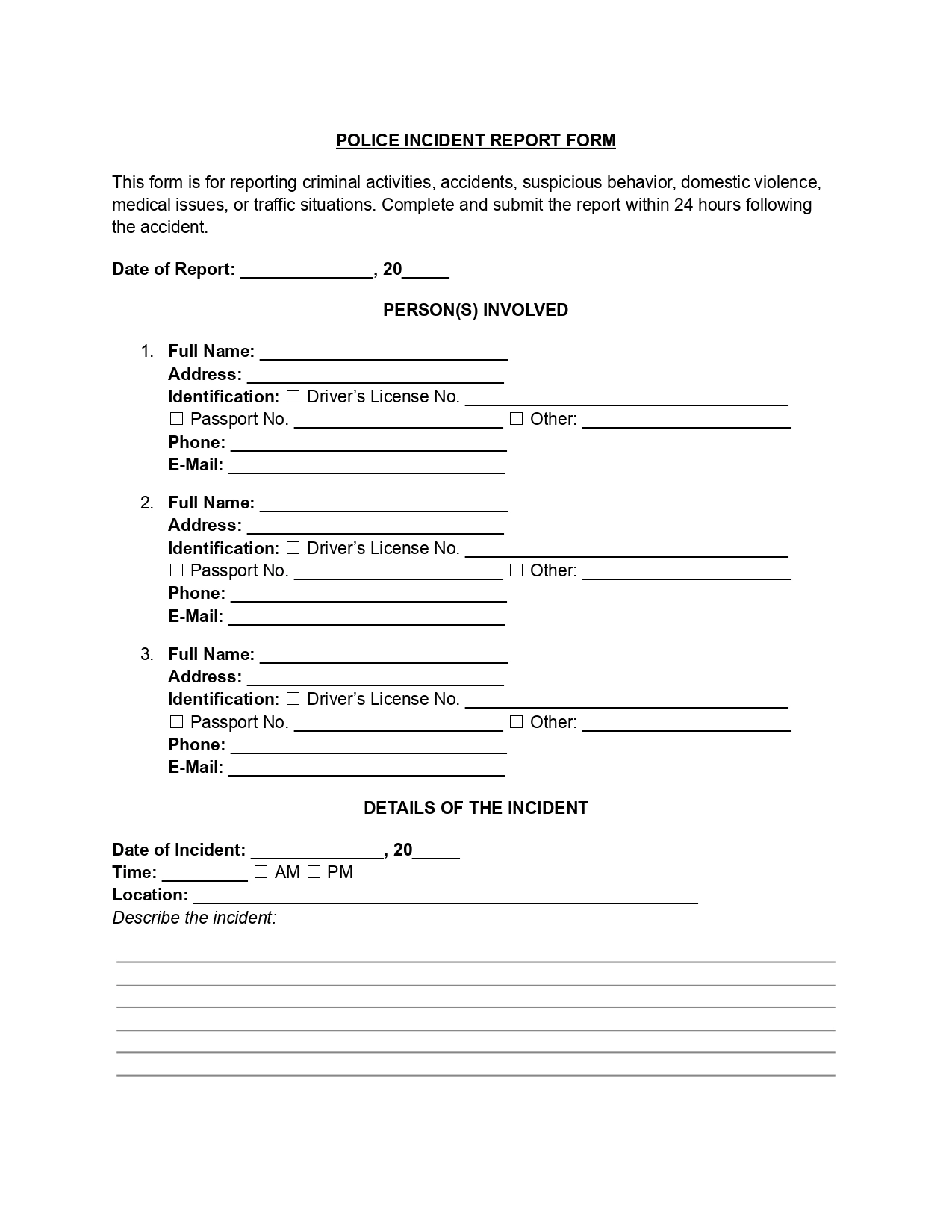
This police incident report form is a fillable template for your own written account of an incident, as a victim or a witness. It has sections for the event, the people involved and any evidence. Use it to write your account down; in an emergency, call the police first.
Unlike a police report written by officers about what they observed, this form is for victims and witnesses to provide their own narratives. Below you will find what the blank form asks for, how to fill it out section by section, a filled-in example and answers to common questions.
The blank police report template is a fillable PDF with sections for the report date, the people involved, the incident, injuries, people who saw it, the police and medical response, and a signature. You can type your answers in our PDF editor or print the form and write by hand.
Each part of the form covers one topic:
The fillable version keeps your typed text neat and easy to read. The printable version suits anyone who prefers a pen, and both versions have the same sections.
To fill out the police incident report sample, gather your details first, then complete each section from top to bottom, sign the form and keep a copy. The seven steps below follow the sections of the form in order. Have these details close at hand before you begin:
If you do not know a detail, write “unknown” instead of guessing. An honest blank is more useful than a wrong answer.
Start by entering the report date at the top of the form. Next, provide detailed personal information for each person involved in the incident. This includes their full name, address, identification details (such as driver’s license or passport number), phone number, and email address. Use today’s date as the report date, even if the incident happened earlier.
Specify the date and time of the incident, selecting AM or PM as appropriate. Name the exact place where the incident occurred. Give the street name, the nearest cross street and the direction people or vehicles were moving. Write the facts in the order they happened and leave out guesses about why it happened.
Indicate whether anyone was injured in the incident by checking the appropriate box. If there were injuries, describe them in detail, including the nature and extent of the injuries. If you are unsure about an injury, describe what you saw, such as a bleeding hand.
Note whether anyone else saw the incident. If someone did, include their names and contact details, which help an officer follow up and confirm what happened. Add a phone number or email address for each of these people.
Note whether the police were told about the incident and whether they wrote a police report. Also, note whether any medical treatment was provided, and if so, specify where the treatment was administered (such as on site or at a hospital). Write the report number exactly as it appears on any paperwork, if you have one.
The person filling out the report should sign at the designated space. Add the date you hand in the report and print the name of the person submitting the report. Use the same spelling of your name that appears on your ID. Then look over every page one more time.
The final section is reserved for office use and should be filled out by the receiving official. This section typically includes the name of the officer who received the report, its date, and any follow-up action taken. Leave this part blank when you fill in the form yourself.
A clear police incident report gives plain facts in the order they happened and leaves out opinions and guesses, so an officer can follow and check every detail. Use the same spelling, dates and numbers everywhere, so the details line up when an officer reads the report later.
A short, factual report is easier for anyone to follow than a long one. If you notice a mistake after you finish, such as a wrong date, fix it before you hand the form in and keep a copy of the final version.
A police incident report example shows how each section looks once it is filled in, so you can match the level of detail in your own form. The sample below uses made-up details for a stolen bicycle. Replace every entry with your own facts and keep the same level of detail in your own form.
| Section of the form | Sample entry |
|---|---|
| Reporter | Anna Baker, 123 Main Street, Springfield |
| Phone and email | (555) 010-0199, anna.baker@example.com |
| Date and time of the incident | October 3, between 8:00 AM and 5:30 PM |
| Place | Front porch at 123 Main Street |
| What happened | A blue bicycle was taken from the porch while Anna was at work. The lock was cut and left on the ground. |
| Injuries | None |
| Witnesses | Ben Carter, neighbor, (555) 010-0142 |
| Police notified | Yes, by phone. Report number 12345 |
| Signature | Anna Baker, signed and dated |
Sample description: I left home at 8:00 AM on October 3 and locked my blue bicycle to the porch rail. When I came back at 5:30 PM, the bicycle was gone. The cut lock was lying on the porch floor. My neighbor Ben Carter saw a gray van parked in front of the house around noon.
Notice how the description sticks to facts: what was taken, where it was and what was left behind. It names no suspect and offers no guesses. When your form is finished, save the PDF and keep a printed copy of every page as well.
Report an incident to the police when it involves a crime, an accident with injuries or serious damage, suspicious behavior or a threat to someone's safety, even if you are unsure it matters. There are specific types of incidents that should be reported:
Three questions help you decide how fast to act:
It is best to inform the authorities about something you saw, even if you are unsure of its importance. If someone is in danger right now, call the police first and fill in the form afterward.
You report an incident through the police department's own channel: call 911 in an emergency, otherwise use the department's non-emergency line or its online reporting page. This form is your written account to bring along or copy from, and the department writes its own report.
Each department sets its own channels. For example, the Seattle Police Department takes online reports only for crimes with no suspects, not in progress and with no injury (Seattle Police Department, Online Reporting). Ask your local department which channel fits your incident.
After you report, the police may contact you for more details. Keep these points in mind:
These answers cover the questions people ask most about the police incident report form.
A police incident report is usually the record the police make of an incident; this template is for your own account of it, as a victim or a witness. It covers the case, the people involved and any evidence that supports the account.
Yes, the police report template is free to fill out on a computer or to print. You can click into the fillable PDF on a computer and type your text, or print the form and write by hand. Either way, read through every section once more before you sign.
This form holds your own account in your own words, while an officer's report describes what the officer saw and learned. Your form can help the officer, but it does not replace the report the police department writes.
Yes, for your own written account, and it fits best a minor property crime such as a theft or vandalism with no known suspect. For an assault, a burglary of a home or business, or any case where you know who did it, call the police so an officer takes the report; the Seattle Police Department, for example, takes none of these online (Seattle Police Department, Online Reporting). Your written account can still help you give the officer the details.
Write what happened in the order it happened. Include the place, the time and the people involved. Stick to what you saw or heard yourself and leave out guesses. Short sentences of plain text are easier to read than one long block.
Check that every name and date on every page matches your documents. Sign and date the form, then keep a copy for your own records. Ask the police department how it takes reports and hand the form in that way.
General information, not legal or tax advice.
