
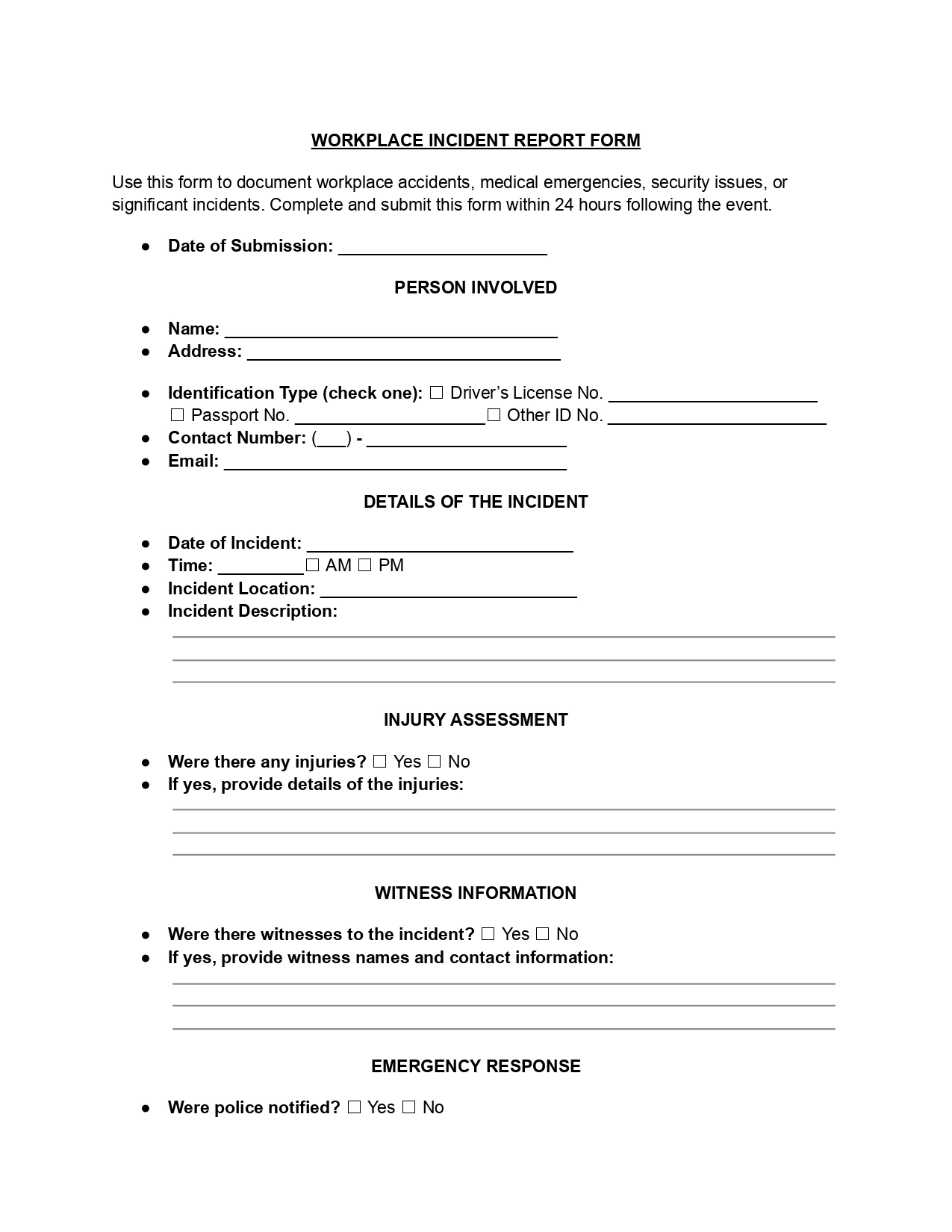
A workplace incident report template is a form that records any event at work that caused harm, loss or a stop in normal work. It captures what happened, when and where it happened, and who was involved. A clear and accurate report helps a company look into the event and take steps to prevent similar accidents.
Last Updated: October 2026. This guide is reviewed and updated regularly to reflect current law. If you notice an error or outdated information, please contact us.
Reporting a broad spectrum of incidents in the workplace is imperative to maintain a safe and compliant working environment. This reporting includes everything from minor hazards to significant emergencies, which can impact employee well-being and operational safety. Here are the essential types of incidents that should be documented:
By systematically reporting these incidents, organizations address immediate safety concerns and gather data crucial for future risk assessments and safety planning. This process aids in preventing similar occurrences and also supports continual improvement in safety protocols.
Reporting workplace incidents to the Occupational Safety and Health Administration (OSHA) is a critical compliance requirement for many businesses in the United States. Knowing when to report these incidents is essential for maintaining legal and ethical standards in the workplace.
OSHA mandates that specific severe incidents be reported immediately. Here are the main criteria for incidents that must be reported:
These incidents must be work-related, meaning they occurred in the workplace or while the employee was performing work-related duties, and involve a serious injury or health consequence.
There are exceptions to OSHA’s reporting requirements. Incidents in a commercial motor vehicle on a public roadway or those involving public services like police or firefighters may have different reporting guidelines. Also, hospitalizations solely for observation or diagnostic testing do not require reporting.
Employers can report incidents to OSHA by calling the nearest office during business hours, using the 24-hour hotline at 1-800-321-OSHA (6742), or through the online reporting application on OSHA’s website. Understanding and following these guidelines ensures compliance with legal standards and supports a proactive approach to workplace safety.
Using workplace incident report templates is essential for maintaining a comprehensive record of incidents, which helps manage immediate and long-term safety concerns. These forms help document accidents, providing a structured, consistent way to capture all relevant information. This detailed incident reporting process ensures that every aspect of the situation is evaluated, which is crucial for further investigation.
By analyzing this data, businesses can identify patterns or recurring issues that may not be obvious without formal documentation. A written record helps a company:
Furthermore, workplace incident reports are helpful in legal action. They can be used in workers’ compensation and insurance claims and in defending the company in disputes. Furthermore, workplace incident reports are critical regarding legal compliance and liability management.
Our printable workplace accident report form can be filed and stored securely. Physical copies are easy to distribute among relevant departments like human resources, safety compliance teams, and legal advisors without the dependency on digital access or technological tools. A good template prompts the reporter for details in consistent categories. These include the time of the incident, the injury or damage, witnesses, and immediate actions taken.
Anyone who witnesses or is directly involved in an incident should file a workplace incident report form. This inclusive approach ensures that all relevant information is recorded, providing an accurate account of what occurred. The timely documentation of these incidents is vital for effective incident management and subsequent analysis. Here’s a closer look at who typically files these forms.
Anyone directly involved in an incident should complete a report form. This includes those who have suffered injuries caused by or affected by the incident.
Employees or contractors who witness an incident must also complete a report form. Their observations can provide an additional perspective and contribute to a comprehensive understanding of the events that transpired.
If a supervisor or manager becomes aware of an incident, they are responsible for filing a report. They may fill out the form themselves or oversee its completion by the involved parties. They are crucial in confirming the report’s accuracy and initiating immediate corrective actions.
In organizations with dedicated health and safety personnel, these officers may be responsible for completing or collecting incident reports. They play a primary role in analyzing incidents to identify trends and areas for safety improvements.
In some cases, if the incident involves potential legal or compliance issues or personal injuries, human resources personnel may also file or collect incident reports. Their involvement is essential for addressing potential workplace relations and legal compliance implications.
Sometimes, external parties such as emergency responders or consultants might also contribute to incident reports, especially in cases requiring specialized knowledge or where external verification of processes and events is needed.
A useful incident report sticks to facts. It records what happened in plain words and leaves out guesses and opinions. Gather these details before you sit down to write the report.
Witnesses can also write their own account on a witness incident report.
Fill out the incident report template one part at a time. Work through the seven parts below in order, use plain words and stick to facts that you saw or heard yourself.
The report usually goes to a supervisor or the safety team. They read it, ask follow-up questions and look for the root cause. The team then picks actions that fix the problem and records them with the incident file, so the documentation stays in one place.
The way you word an incident report matters as much as the facts in it. A clear report is easy to read, easy to check and useful to the people who review it later. These habits help you write one.
Most questions about an incident report come down to who writes it, how much detail to give and what to do when the template runs out of space or the details are unclear.
An incident report template is a form with set fields for recording an event at work. It guides the writer through who took part, what happened, any injuries, the witnesses and the response.
Often, yes. A coworker or supervisor can write the report when the injured person cannot. Add the writer’s name so readers know who prepared it.
Tell the story in the order it happened and cover these points.
Skip guesses about blame.
Fill out a separate form for each person, so every injury has its own record.
Yes. A near miss shows a hazard before anyone gets hurt. A short report helps the team fix the problem early.
General information, not legal or tax advice.
