
Updated:
Get Form Now
The CDC US Standard Certificate of Death is an official document used across the United States to register and record the details of an individual’s death. Issued by the Centers for Disease Control and Prevention’s National Center for Health Statistics, this form collects comprehensive information about the deceased, including the cause, personal statistics, and place of death. This standardized format ensures consistency in data collection across different states and territories, facilitating national statistics and health-related research. CDC US Standard Certificate of Death also serves legal and personal purposes, such as settling estates, claiming life insurance, and accessing pension benefits.
Other PDF Forms
Are you looking for other PDF forms? Check out the selection following next to see what you could fill in and edit with our tool. Besides that, remember that you can actually upload, fill out, and edit any PDF form at FormsPal.
What it is: U.S. Standard Certificate of Death, with a LOCAL FILE NO. and a STATE FILE NO.
Who signs: 22. Signature of funeral service licensee or other agent. 26. Signature of person pronouncing death (Only when applicable). 45. Certifier (Check only one): Certifying physician, Pronouncing & Certifying physician, or Medical Examiner/Coroner. Signature of certifier.
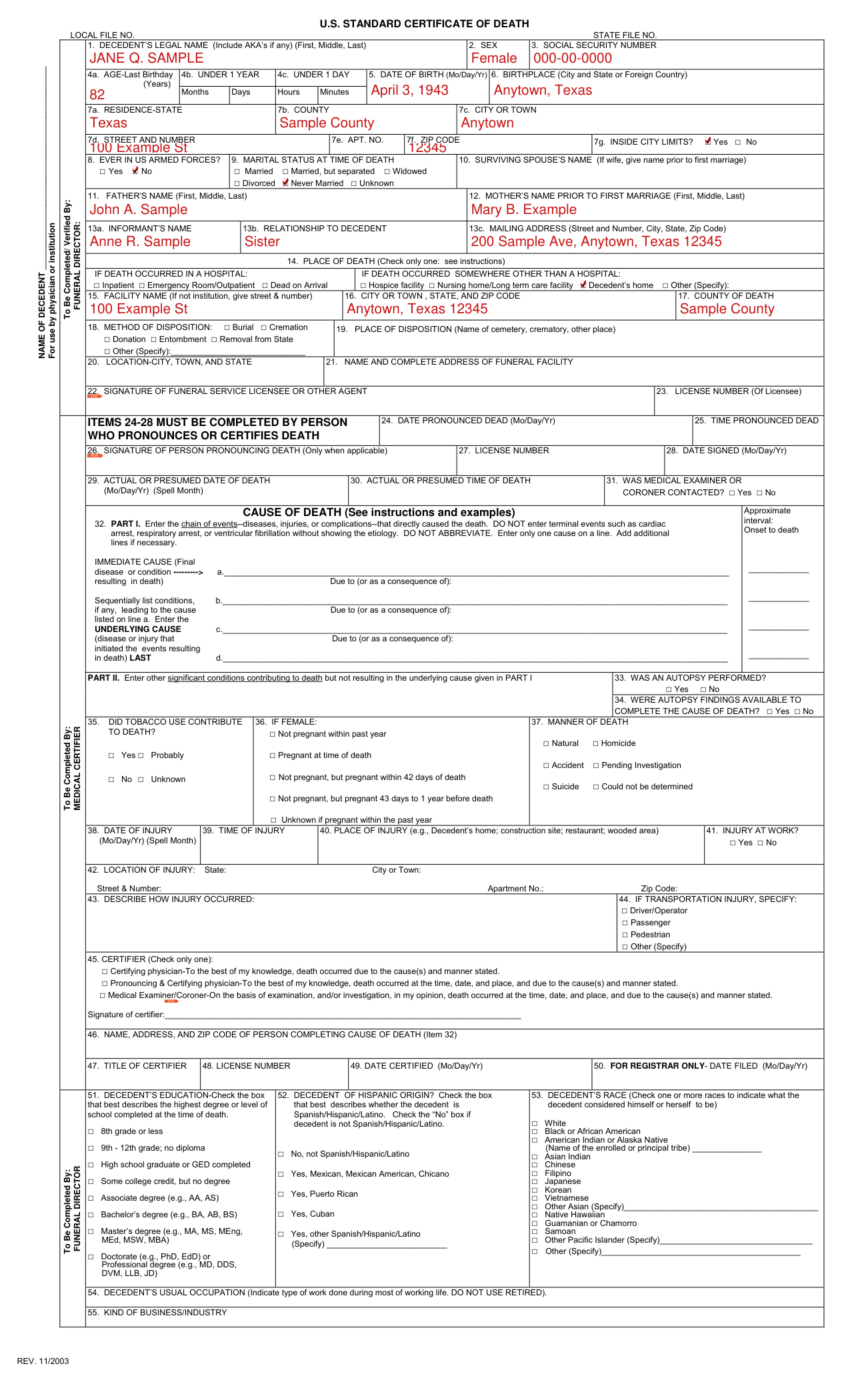
Include any other names used by decedent, if substantially different from the legal name, after the abbreviation AKA (also known as) e.g. Samuel Langhorne Clemens AKA Mark Twain, but not Jonathon Doe AKA John Doe.
Date of birth: enter the full name of the month (January, February, March etc.) Do not use a number or abbreviation to designate the month.
Residence of decedent is the place where the decedent actually resided.
Never enter a temporary residence such as one used during a visit, business trip, or vacation.
If the decedent was an infant who never resided at home, the place of residence is that of the parent(s) or legal guardian.
Ever in U.S. armed forces? Yes No.
If the decedent was married at the time of death, enter the full name of the surviving spouse. If the surviving spouse is the wife, enter her name prior to first marriage.
Enter the name used prior to first marriage, commonly known as the maiden name.
The place where death is pronounced should be considered the place where death occurred.
If the place of death is unknown but the body is found in your State, the certificate of death should be completed and filed in accordance with the laws of your State. Enter the place where the body is found as the place of death.
Check only one: see instructions.
When death occurred, Items 24-25 and 29-31 should always be completed.
Items 24-25, 29-30: spell out the name of the month.
If the exact date of death is unknown, enter the approximate date. If the date cannot be approximated, enter the date the body is found and identify as date found.
Enter the exact hour and minutes according to a 24-hour clock; estimates may be provided with “Approx.” placed before the time.
Line (a) MUST ALWAYS have an entry. DO NOT leave blank.
Item 32 - CAUSE OF DEATH: take care to make the entry legible. Use a computer printer with high resolution, typewriter with good black ribbon and clean keys, or print legibly using permanent black ink in completing the CAUSE OF DEATH Section.
ALWAYS enter the underlying cause of death on the lowest used line in Part I.
Enter all diseases or conditions contributing to death that were not reported in the chain of events in Part I and that did not result in the underlying cause of death.
If two or more possible sequences resulted in death, or if two conditions seem to have added together, report in Part I the one that, in your opinion, most directly caused death. Report in Part II the other conditions or diseases.
33 - Enter “Yes” if either a partial or full autopsy was performed. Otherwise enter “No.”
34 - Enter “Yes” if autopsy findings were available to complete the cause of death; otherwise enter “No”. Leave item blank if no autopsy was performed.
Check “yes” if, in your opinion, the use of tobacco contributed to death.
Indicate “Pending investigation” if the manner of death cannot be determined whether due to an accident, suicide, or homicide within the statutory time limit for filing the death certificate. This should be changed later to one of the other terms.
Indicate “Could not be Determined” ONLY when it is impossible to determine the manner of death.
Items 38-44 - ACCIDENT OR INJURY - to be filled out in all cases of deaths due to injury or poisoning.
38 - Enter the exact month, day, and year of injury. Spell out the name of the month. DO NOT use a number for the month.
41 - Complete if anything other than natural disease is mentioned in Part I or Part II of the medical certification, including homicides, suicides, and accidents. Enter “Yes” if the injury occurred at work. Otherwise enter “No”.
43 - Enter a brief but specific and clear description of how the injury occurred.
44 -Specify role of decedent (e.g. driver, passenger).
If the facility uses a separate pronouncer or other person to indicate that death has taken place with another person more familiar with the case completing the remainder of the medical portion of the death certificate, the pronouncer completes Items 24-28.
If a certifier completes Items 24-25 as well as items 29-49, Items 26-28 may be left blank.
Check the box that corresponds to the highest level of education that the decedent completed.
Doctorate (e.g., Ph.D., Ed.D.) or Professional degree (e.g., MD, DDS, DVM, LLB, JD).
Was decedent of Hispanic origin? Check “No” or check the “Yes” box that best corresponds with the decedent's ethnic Spanish identity as given by the informant.
Note that “Hispanic” is not a race and item 53 must also be completed.
Do not leave this item blank.
Enter the race of the decedent as stated by the informant.
Please specify the name of enrolled or principal tribe (e.g., Navajo, Cheyenne, etc.) for the American Indian or Alaska Native.
If the decedent was of mixed race, enter each race (e.g., Samoan-Chinese-Filipino or White, American Indian).
Questions concerning occupation and industry must be completed for all decedents 14 years of age or older.
Enter the usual occupation of the decedent. This is not necessarily the last occupation of the decedent. Never enter “retired”.
KIND OF BUSINESS/INDUSTRY: kind of business to which occupation in item 54 is related, such as insurance, farming, coal mining, hardware store, retail clothing, university, or government. DO NOT enter firm or organization names.
To Be Completed/ Verified By: FUNERAL DIRECTOR.
To Be Completed By: MEDICAL CERTIFIER.
Should additional medical information or autopsy findings become available that would change the cause of death originally reported, the original death certificate should be amended by the certifying physician by immediately reporting the revised cause of death to the State Vital Records Office.
The terminal event (for example, cardiac arrest or respiratory arrest) should not be used. Terms such as senescence, infirmity, old age, and advanced age have little value for public health or medical research.
[1] U.S. Standard Certificate of Death (REV. 11/2003), National Center for Health Statistics, Centers for Disease Control and Prevention (the Official source link on this page).