
Updated:
Get Form Now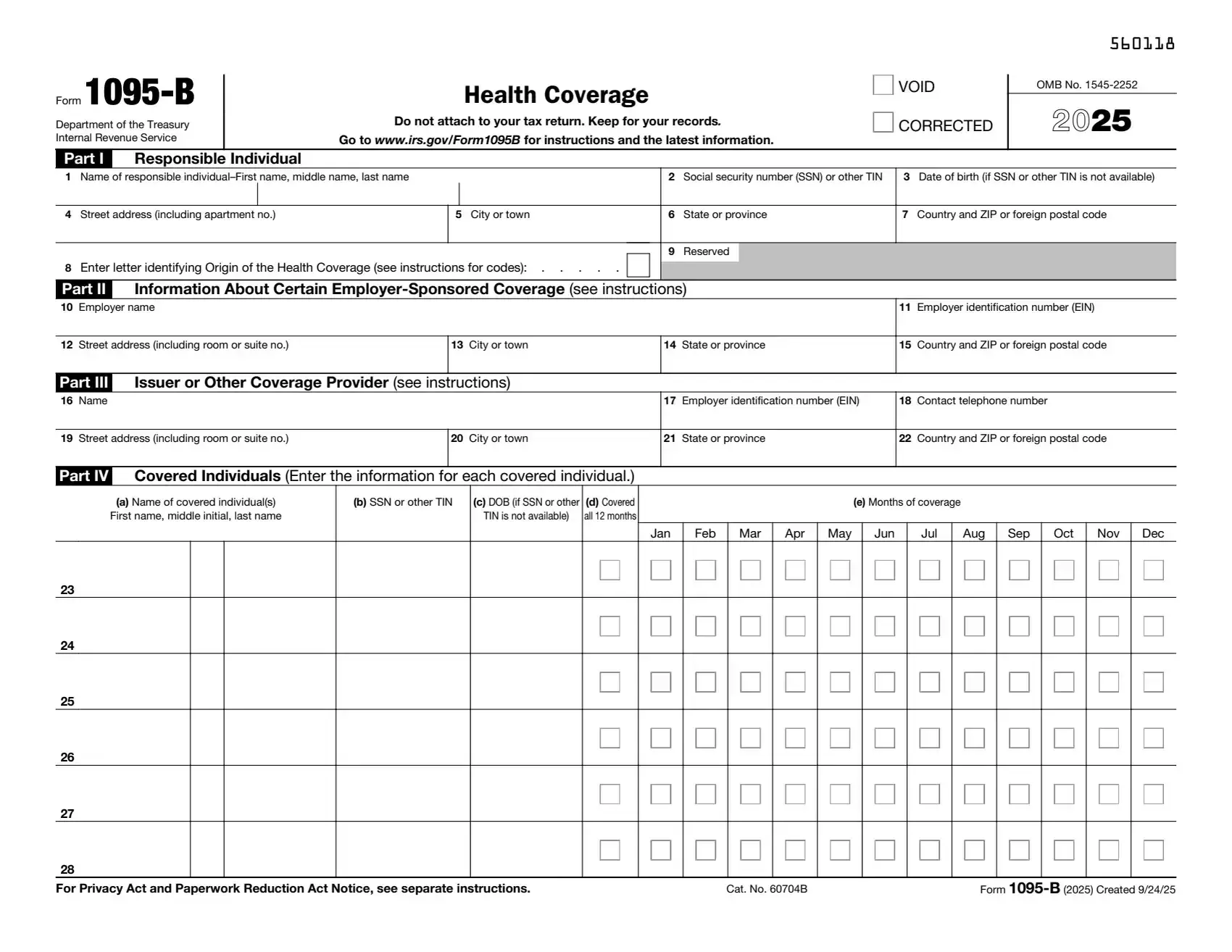
Form 1095-B, titled “Health Coverage,” is a tax document provided by insurance companies and other health coverage providers, including small employers and government agencies like Medicare or Medicaid. It confirms that individuals and their families had health insurance coverage during the year. This form lists information such as the type of coverage, the months during which the coverage was in effect, and the individuals covered under the policy. Form 1095-B shows the months in which individuals had minimum essential health coverage.
Although the individual mandate penalty for not having health insurance was reduced to zero at the federal level, this form may still be required for state tax purposes in states that have their health insurance mandates. Additionally, Form 1095-B helps individuals confirm that the coverage reported by insurers matches their records, ensuring they have documentation to support their tax filings and state insurance requirements. This form plays a crucial role in maintaining compliance with healthcare reporting requirements and assists taxpayers in managing their health insurance information.
Other IRS Forms for Individuals
Along with the form to report information about health coverage in your family to the IRS, there may be some other IRS forms for individual taxpayers that you might need. Check the forms we prepared for you below.
You can file the form online or via mail. If you choose the second option, find the mailing address in the IRS instructions for Forms 1094-B and 1095-B. Electronic filing goes through the IRS ACA Information Returns (AIR) system, and a provider that files 10 or more information returns in total during the year must file electronically.
What it is: Form 1095-B, Health Coverage, provides information about the individuals in the tax family of the recipient who had certain health coverage for some or all months during the year (2025, page 2, 560220).
Where and when to file: When To File Generally, the return and transmittal form must be filed with the IRS on or before February 28 if filing on paper (March 31 if filing electronically) of the year following the calendar year of coverage. How To File Filing Paper Returns With the IRS Shipping and mailing. If you’re filing on paper, send the forms to the IRS in a flat mailing (not folded) and don’t staple or paperclip the forms together.[2]
Providers of minimum essential coverage are required to furnish only one Form 1095-B for all individuals whose coverage is reported on that form.
Who Must File Every person who provides minimum essential coverage to an individual during a calendar year must file an information return reporting the coverage.[2]
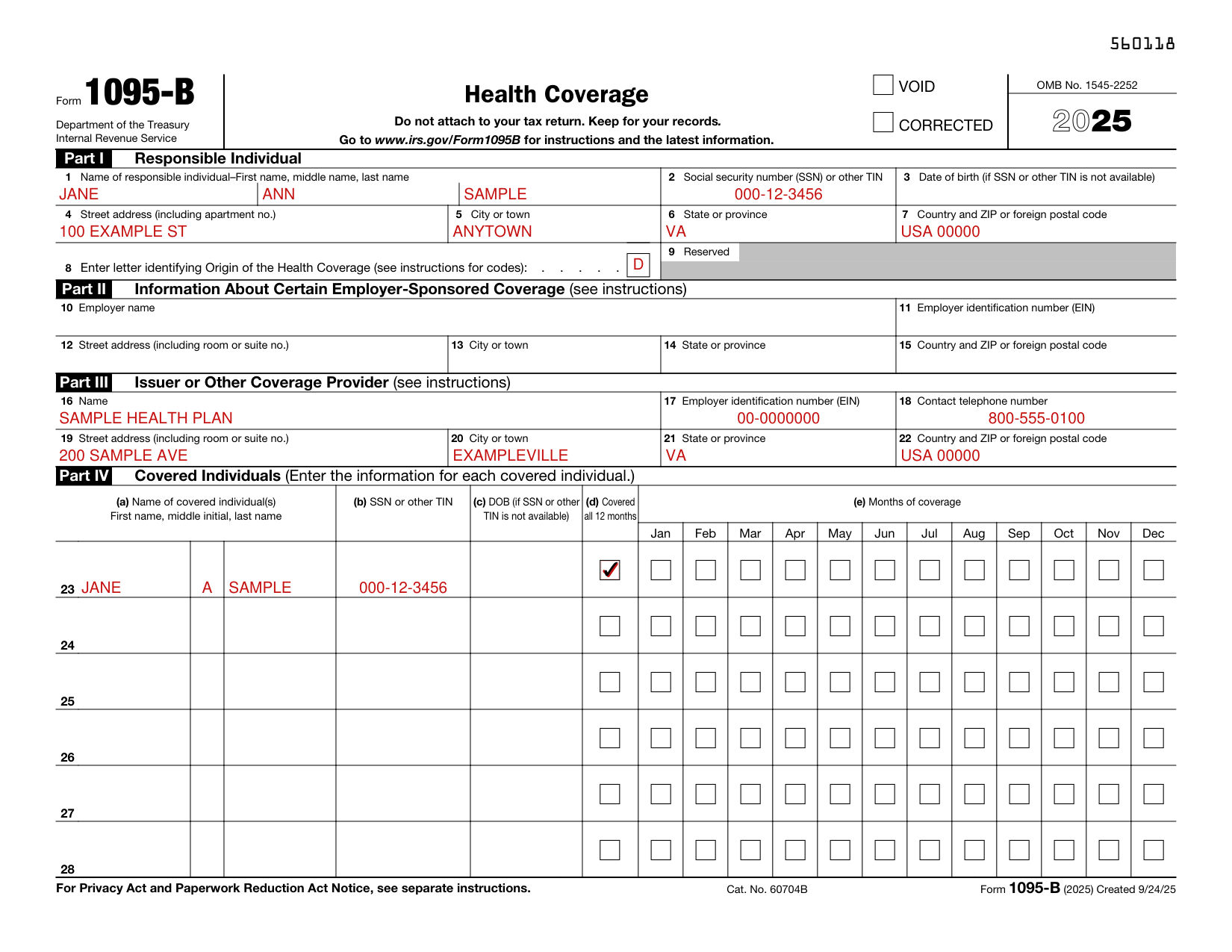

Part I, Responsible Individual, lines 1-9, reports information about you and the coverage.
Line 2 reports your social security number (SSN) or other taxpayer identification number (TIN), if applicable. For your protection, this form may show only the last four digits. However, the coverage provider is required to report your complete SSN or other TIN, if applicable, to the IRS.
Your date of birth will be entered on line 3 only if line 2 is blank.
Line 9. Reserved.

Line 8 is the code for the type of coverage in which you or other covered individuals were enrolled. Only one letter will be entered on this line.
Line 8: A. Small Business Health Options Program (SHOP), B. Employer-sponsored coverage, C. Government-sponsored program, D. Individual market insurance, E. Multiemployer plan, F. Other designated minimum essential coverage, G. Individual coverage health reimbursement arrangement (HRA).

If you had employer-sponsored health coverage, Part II, Information About Certain Employer-Sponsored Coverage, lines 10-15, may provide information about the employer sponsoring the coverage.
Part II may show only the last four digits of the employer's EIN.
Part II may also be left blank, even if you had employer-sponsored health coverage. If Part II is blank, you do not need to fill in the information or return it to your employer or other coverage provider.

Part III, Issuer or Other Coverage Provider, lines 16-22, reports information about the coverage provider (insurance company, employer providing self-insured coverage, government agency sponsoring coverage under a government program such as Medicaid or Medicare, or other coverage sponsor).
Line 18 reports a telephone number for the coverage provider that you can call if you have questions about the information reported on the form.
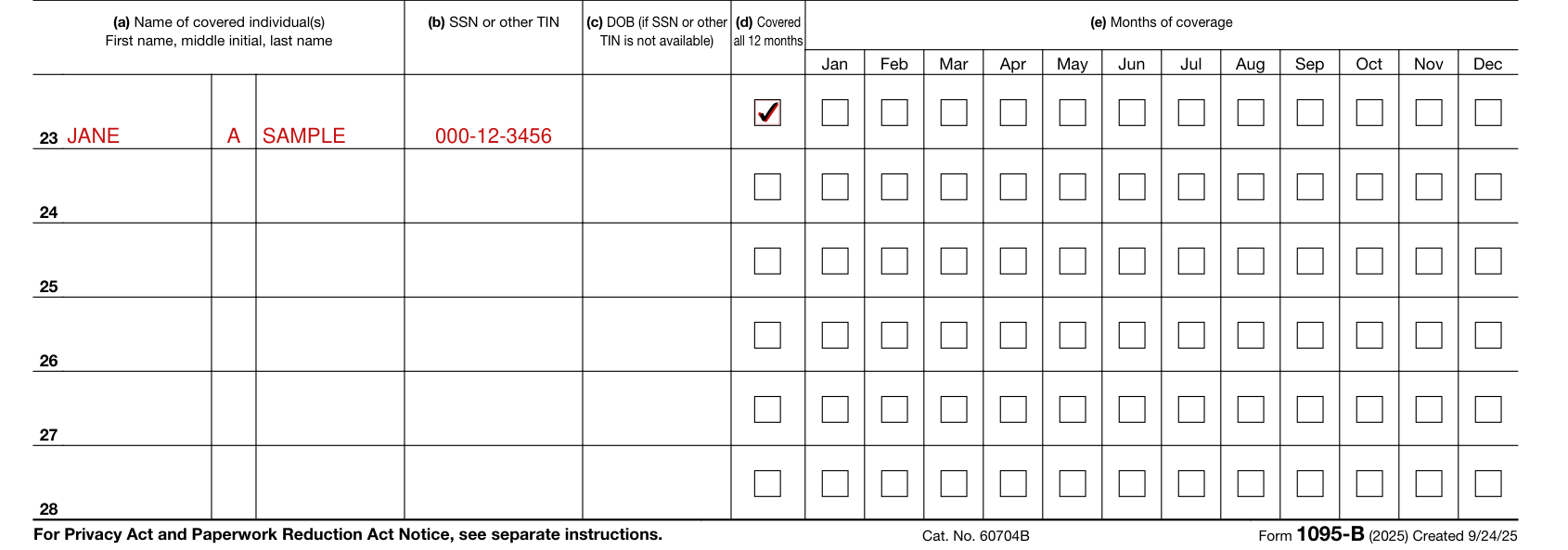
Part IV, Covered Individuals, lines 23-28, reports the name, SSN or other TIN, and coverage information for each covered individual.
Only if the SSN or other TIN is not entered in column (b) will a date of birth be entered in Part IV, column (c).
Part IV, column (d) will be checked if the individual was covered for at least 1 day in every month of the year.
For individuals who were covered for some but not all months, information will be entered in Part IV, column (e) indicating the months for which these individuals were covered.
If there are more than six covered individuals, see Part IV, Continuation Sheet(s), for information about the additional covered individuals.
Do not attach to your tax return. Keep for your records. Go to www.irs.gov/Form1095B for instructions and the latest information.
As the recipient of this Form 1095-B, you should provide a copy to other individuals covered under the policy if they request it for their records.
For additional information about the tax provisions of the Affordable Care Act (ACA) and the premium tax credit, see www.irs.gov/ACA or call the IRS Healthcare Hotline for ACA questions (800-919-0452).
If you or another family member received health insurance coverage through a Health Insurance Marketplace (also known as an Exchange), that coverage will generally be reported on a Form 1095-A rather than a Form 1095-B.
If you or another family member received employer-sponsored coverage, that coverage may be reported on a Form 1095-C (Part III) rather than a Form 1095-B.
If individuals in your tax family are eligible for certain types of minimum essential coverage, you may not be eligible for the premium tax credit.
For more information on the premium tax credit, see Pub. 974, Premium Tax Credit (PTC).
Form 1095-B, Health Coverage, provides information about the individuals in the tax family of the recipient who had certain health coverage for some or all months during the year (2025, page 2, 560220). Minimum essential coverage includes government-sponsored programs, eligible employer-sponsored plans, individual market plans, and other coverage the Department of Health and Human Services designates as minimum essential coverage.
[1] Form 1095-B (2025), Health Coverage, Department of the Treasury Internal Revenue Service (the Official source link on this page).
[2] irs.gov, deadline (irs.gov). Accessed November 16, 2026.