
Updated:
Get Form Now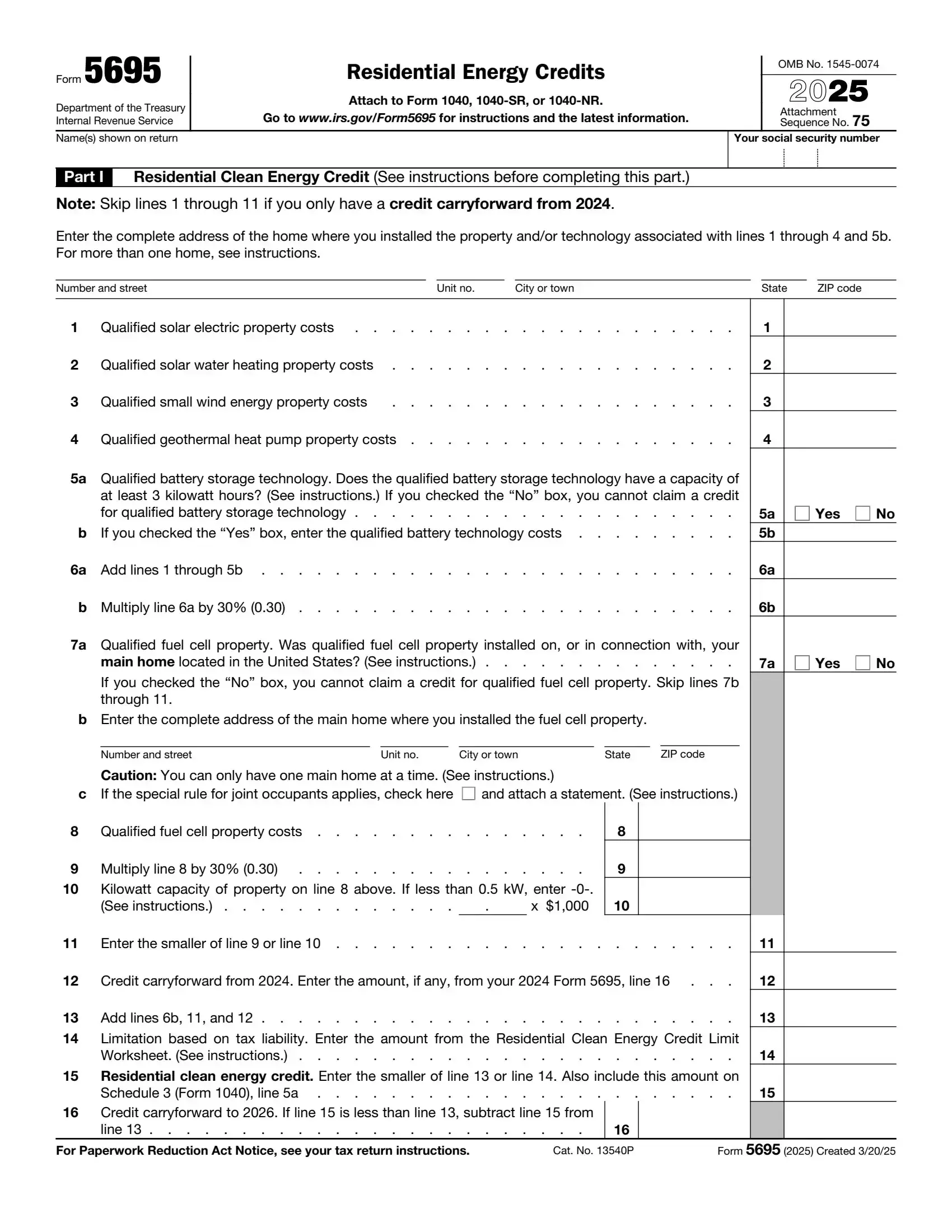
IRS Form 5695 is a United States Internal Revenue Service form used by taxpayers to claim residential energy credits. It is primarily utilized to calculate and declare the credits for energy-efficient home improvements and renewable energy installations. These improvements may include solar panels, solar water heating systems, small wind energy systems, and geothermal heat pumps, which are intended to promote environmentally friendly practices by offering financial incentives in the form of tax credits.
The form is divided into two parts: the Residential Clean Energy Credit and the Energy Efficient Home Improvement Credit; under the 2025 tax law, neither credit is available for expenditures made or property placed in service after December 31, 2025. The first part relates to the costs associated with the installation of renewable energy systems in a home, including labor and any additional necessary equipment. The second part covers energy-saving improvements such as insulation, energy-efficient exterior windows, skylights and doors, heat pumps, and home energy audits. Taxpayers who make these eligible improvements can potentially reduce their federal tax liability, supporting energy conservation and efficiency upgrades in residential settings.
What it is: Form 5695 (2025) is the Residential Energy Credits form.
Where and when to file: Attach to Form 1040, 1040-SR, or 1040-NR. Go to www.irs.gov/Form5695 for instructions and the latest information.
Use Form 5695 to figure and take your residential energy credits.[2]
The residential energy credits are the residential clean energy credit and the energy efficient home improvement credit.[2]
You may be able to take the credits if you made energy saving improvements to your home located in the United States in 2025.[2]
Also use Form 5695 to take any residential clean energy credit carryforward from 2024 or to carry the unused portion of the residential clean energy credit to 2026.[2]
You can't claim residential clean energy credits for expenditures made after December 31, 2025.[2]
You can't claim energy efficient home improvement credits for expenditures or property placed in service after December 31, 2025.[2]
For purposes of taking the credit, you can rely on the manufacturer's certification, in writing, that a product is qualifying property for the credit. Don't attach the certification to your return. Keep it for your records.[2]
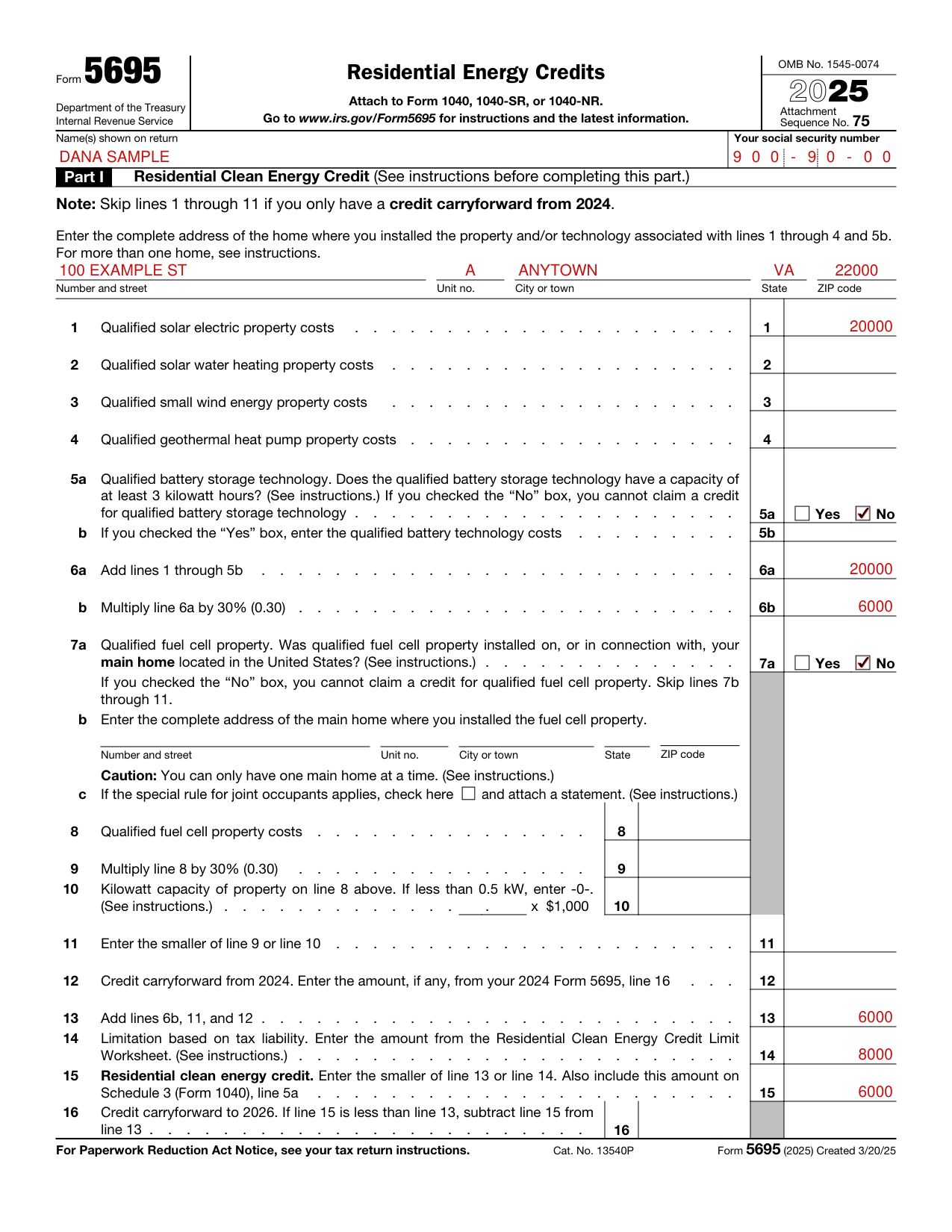

Enter the complete address of the home where you installed the property and/or technology associated with lines 1 through 4 and 5b.
If you made improvements to more than one home, list the complete address of the home with the greatest total cost in the section above line 1. Then, attach a statement listing the additional addresses to Form 5695.[2]

Skip lines 1 through 11 if you only have a credit carryforward from 2024.
Enter the amounts you paid for qualified solar electric property on line 1, qualified solar water heating property on line 2, qualified small wind energy property on line 3 and qualified geothermal heat pump property on line 4.[2]

On lines 5a and 5b, to qualify for the credit, the qualified battery storage technology must have a capacity of at least 3 kilowatt hours.
If the qualified battery storage technology has a capacity of 3 kilowatt hours or greater, then check the “Yes” box, enter the amounts you paid for qualified battery storage technology on line 5b.
If you check the “No” box, you can't include any battery storage technology costs on line 5b.[2]

On line 6a, add lines 1 through 5b. On line 6b, multiply line 6a by 30% (0.30).
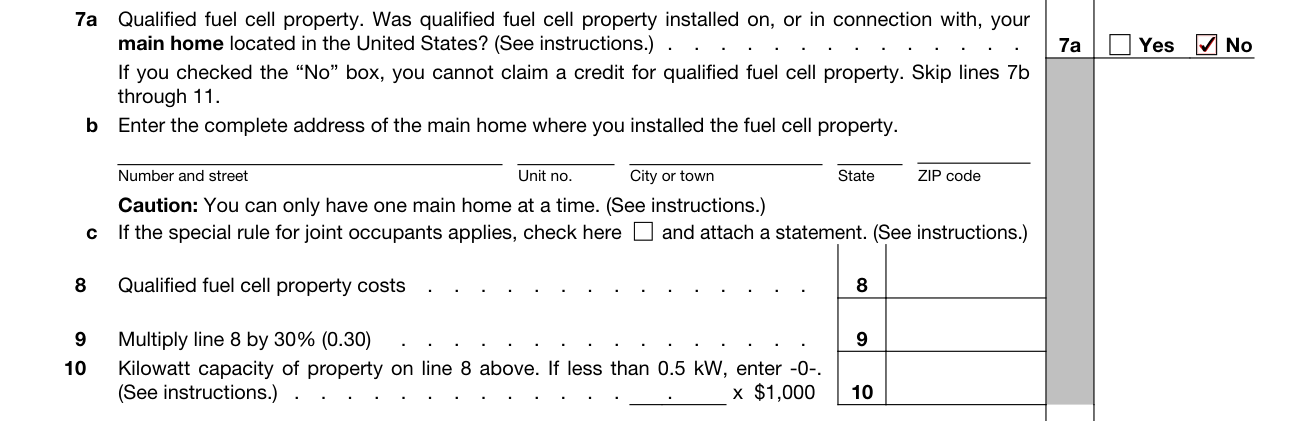
Was qualified fuel cell property installed on, or in connection with, your main home located in the United States? If you checked the “No” box, you cannot claim a credit for qualified fuel cell property. Skip lines 7b through 11.
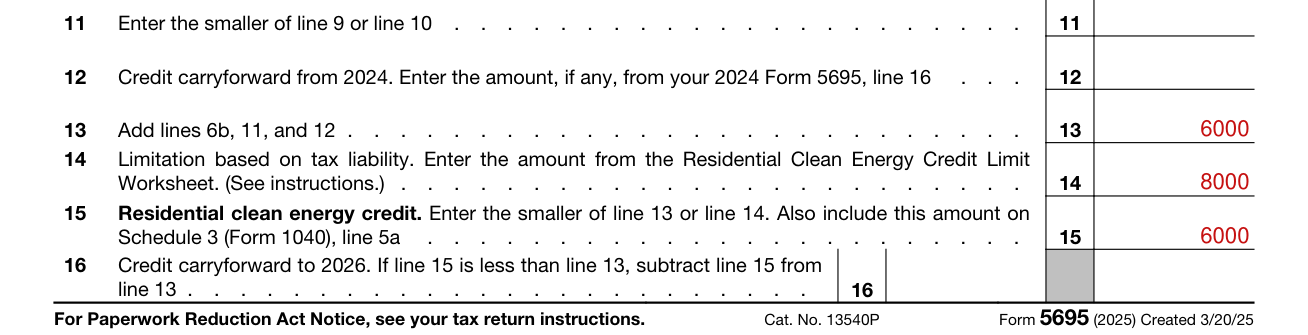
Credit carryforward from 2024. Enter the amount, if any, from your 2024 Form 5695, line 16.
Add lines 6b, 11, and 12. Enter the amount from the Residential Clean Energy Credit Limit Worksheet on line 14. Enter the smaller of line 13 or line 14 on line 15. Also include this amount on Schedule 3 (Form 1040), line 5a. If line 15 is less than line 13, subtract line 15 from line 13 on line 16, the credit carryforward to 2026.
On line 16, if you can't use all of the credit because of the tax liability limit (that is, line 14 is less than line 13), you can carry the unused portion of the credit to 2026. File this form even if you can't use any of your credit in 2025.[2]
If you checked the “No” box for line 17a, 17b, or 17c, you cannot claim the energy efficient home improvement credit. Do not complete Part II, Section A.
On line 17a, to qualify for the credit, any qualified energy efficiency improvements must have been for your main home located in the United States.
On line 17b, to qualify for the credit, you must be the original user of the qualified energy efficiency improvements.
On line 17c, to qualify for the credit, the components must be reasonably expected to remain in use for at least 5 years on your main home located in the United States.
On line 17d, enter the complete address of your main home during 2025. You can only claim the energy efficient home improvement credit on one main home.
On line 17e, you cannot claim the credit for expenses related to the construction of a new home. If you are claiming the credit only for expenses for qualified improvements to an existing home or for an addition to or renovation of an existing home, check the “No” box. If the qualified improvements for which you are seeking to claim the credit are related to the construction of a new home, check the “Yes” box. If you check the “Yes” box, skip lines 18a through 20d.[2]
If you checked the “No” box for line 21a or 21b, you cannot claim the credit for your residential energy property costs. Skip lines 22 through 25 and line 29.
On line 21a, to qualify for the credit, any qualified energy property installed on or in your home must be located in the United States.
On line 21b, to qualify for the credit, the qualified energy property must have been originally placed in service by you.
On line 26a, if you check the “No” box, you can't claim the home energy audit credit.[2]
On line 27, add lines 18b, 19h, 20d, 22d, 23d, 24d, 25e, and 26c.
On line 28, enter the smaller of line 27 or $1,200. (checked October 29, 2026)
After line 28, line 29 is heat pumps and heat pump water heaters; biomass stoves and biomass boilers. On line 29a, enter the Qualified Manufacturer Identification Number and cost of the most expensive electric or natural gas heat pump.
On line 29b, enter the cost of all other electric or natural gas heat pumps. If none, enter -0-. On line 29c, enter the Qualified Manufacturer Identification Number and cost of the most expensive electric or natural gas heat pump water heater.
On line 29d, enter the cost of all other electric or natural gas heat pump water heaters. If none, enter -0-.
On line 29e, enter the Qualified Manufacturer Identification Number and cost of the most expensive biomass stove or boiler.
On line 29f, enter the cost of all other biomass stoves and biomass boilers. If none, enter -0-.
On line 29g, add lines 29a through 29f.
On line 29h, multiply line 29g by 30% (0.30) and enter the result. Do not enter more than $2,000. (checked October 29, 2026)
On line 30, add lines 28 and 29h.
Use the Energy Efficient Home Improvement Credit Limit Worksheet-Line 31 to figure the amount to enter on line 31.
On line 32, enter the smaller of line 30 or line 31. Also include this amount on Schedule 3 (Form 1040), line 5b.[2]
Attach to Form 1040, 1040-SR, or 1040-NR. Go to www.irs.gov/Form5695 for instructions and the latest information.
[1] Form 5695 (2025), Residential Energy Credits, Internal Revenue Service (the Official source link on this page).
[2] 2025 Instructions for Form 5695, Residential Energy Credits (Jan 22, 2026), Internal Revenue Service.