
Updated:
Get Form Now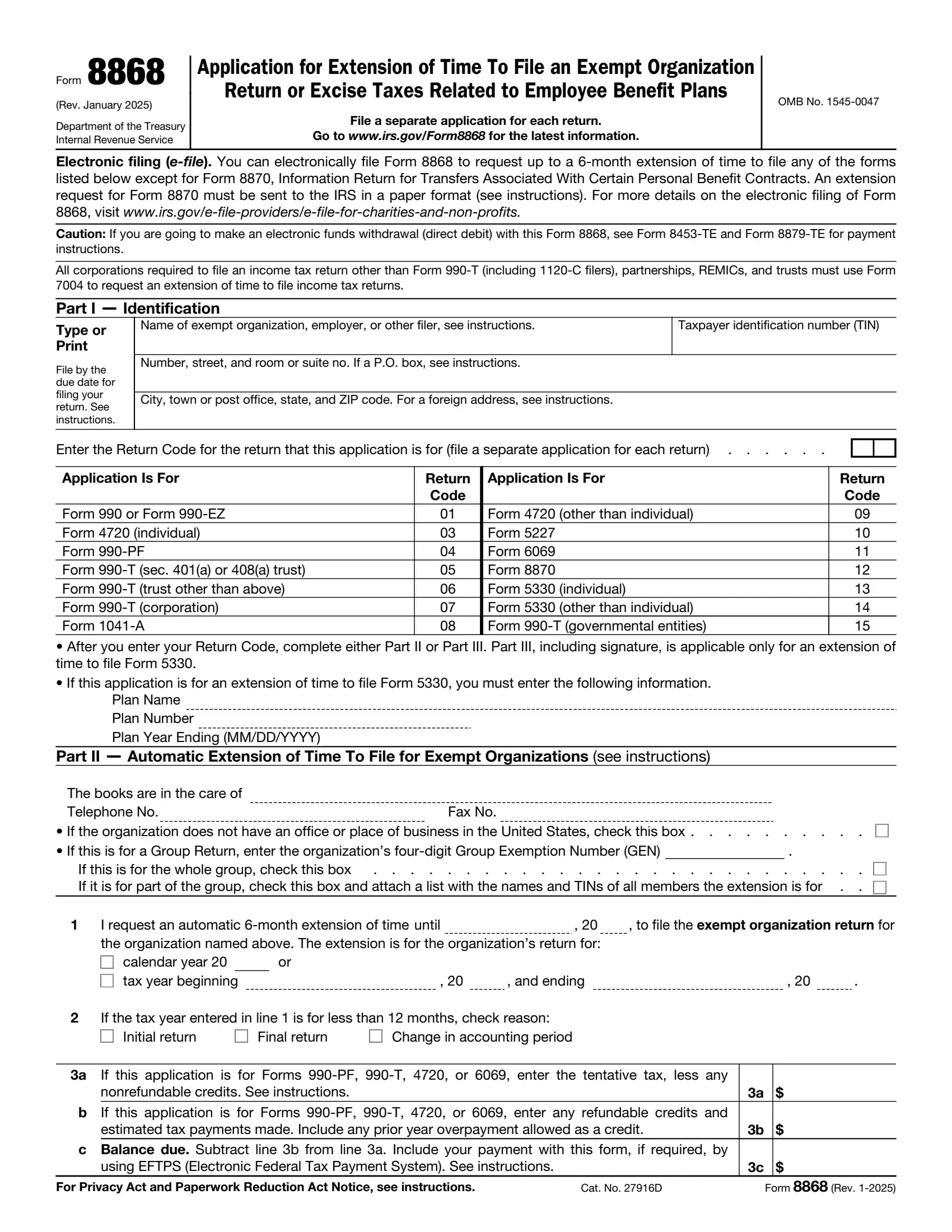
IRS Form 8868 is a document used by nonprofit organizations, charities, and other tax-exempt entities to request an automatic extension to file their required annual information return or notice. The form can be used to extend the deadline for filing forms such as Form 990, 990-EZ, 990-PF, and others related to nonprofit tax obligations. The initial extension grants an additional six months, allowing organizations more time to gather necessary information and ensure their filing is accurate and complete.
The primary purpose of Form 8868 is to help tax-exempt organizations avoid penalties for late filing of their annual tax documents. By filing this form by the original due date of their return, organizations can secure more time to comply with reporting requirements without incurring financial penalties. This is valuable for organizations that need additional time to compile detailed financial data, complete audits, or resolve governance issues that could affect the information reported on their tax forms.
Other IRS Forms for Charities and Nonprofits
If your organization needs more time to file the return, Form 8868 will be of help. In case of other situations that often happen to non-profit organizations, you might need one of the following IRS forms.
What it is: Form 8868 is the Application for Extension of Time To File an Exempt Organization Return or Excise Taxes Related to Employee Benefit Plans.
Who signs: If you are filing Form 8868 for an extension of time to file Form 5330, the Form 8868 must be signed. If you are filing Form 8868 for any form besides Form 5330, a signature is not required.[2]
Where and when to file: When To File File Form 8868 by the due date of the return for which you are requesting an extension.[2]
General Instructions Purpose of Form Form 8868 is used by an exempt organization or governmental entity (filing Form 990-T to make an elective payment election) to request an automatic 6-month extension of time to file its return.[2]
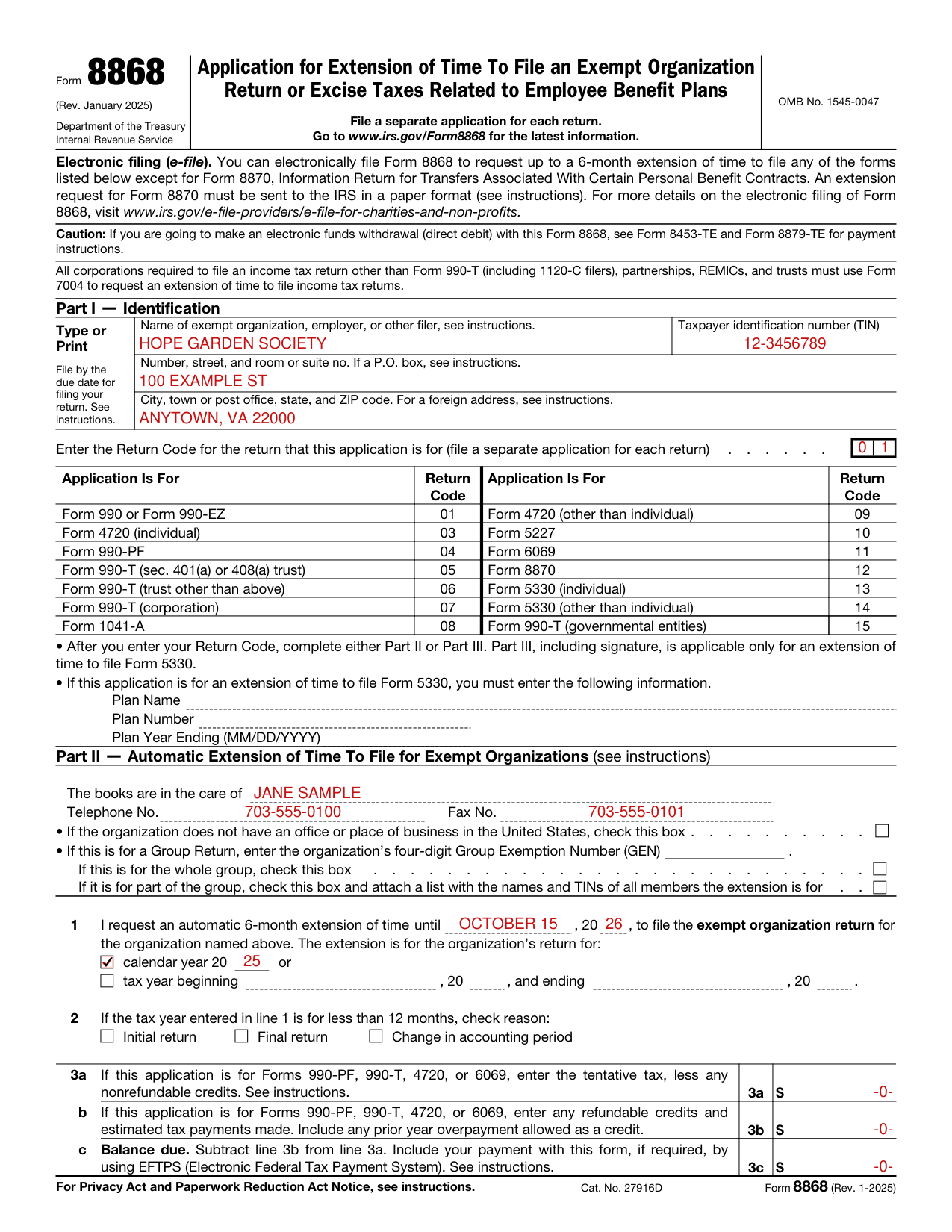

Name of exempt organization, employer, or other filer. The filer may be an exempt organization, a nonexempt organization, an employer, a governmental entity, or an individual.
Taxpayer identification number (TIN). Exempt organizations (such as corporations, private foundations, and trusts) and governmental entities must enter their TIN. For Form 5330 filers, the TIN is either the employer identification number (EIN) or the filer's social security number (SSN), but not both.
If the post office does not deliver mail to the street address and you have a P.O. box, show the box number instead of the street address. If the mail is received in care of a third party (such as an accountant or an attorney), enter on the street address line “C/O” followed by the third party's name and street address or P.O. box.[2]

After you enter your Return Code, complete either Part II or Part III. Part III, including signature, is applicable only for an extension of time to file Form 5330. If this application is for an extension of time to file Form 5330, you must enter the following information. Plan Name Plan Number Plan Year Ending (MM/DD/YYYY). Form 990 or Form 990-EZ 01 Form 4720 (individual) 03 Form 990-PF 04 Form 990-T (sec. 401(a) or 408(a) trust) 05 Form 990-T (trust other than sec. 401(a) or 408(a) trust) 06 Form 990-T (corporation) 07 Form 1041-A 08 Form 4720 (other than individual) 09 Form 5227 10 Form 6069 11 Form 8870 12 Form 5330 (individual) 13 Form 5330 (other than individual) 14 Form 990-T (governmental entities) 15
Enter the Return Code of the form this application pertains to in the Return Code Box. Enter only one Return Code.[2]

Form 5330 filers must complete the plan name, plan number, and plan year ending for the plan included on this Form 8868, before completing Part III.[2]

If the organization does not have an office or place of business in the United States, check this box.

If this is for a Group Return, enter the organization's four-digit Group Exemption Number (GEN). If this is for the whole group, check this box. If it is for part of the group, check this box and attach a list with the names and TINs of all members the extension is for.

The date you enter on line 1 cannot be later than 6 months from the original due date of the return.
Common mistake: Form 8868 attached to a return filed after the original due date will not be effective to extend the due date. Do not file for an extension of time by attaching Form 8868 to the original return when it is filed.
I request an automatic 6-month extension of time until , 20 , to file the exempt organization return. The extension is for the organization's return for calendar year 20 or tax year beginning , 20 , and ending , 20 .[2]

If the tax year entered in line 1 is for less than 12 months, check reason: Initial return Final return Change in accounting period

All filers must complete lines 3a, b, and c, even if you are exempt from tax or do not expect to have any tax liability.
3 a If this application is for Forms 990-PF, 990-T, 4720, or 6069, enter the tentative tax, less any nonrefundable credits. See instructions. 3 b If this application is for Forms 990-PF, 990-T, 4720, or 6069, enter any refundable credits and estimated tax payments made. Include any prior year overpayment allowed as a credit. 3 c Balance due. Subtract line 3b from line 3a. Include your payment with this form, if required, by using EFTPS (Electronic Federal Tax Payment System). See instructions.
See the organization's tax return and its instructions to estimate the amount of tentative tax reduced by any nonrefundable credits. If you expect this amount to be zero, enter -0-.
Form 8868 does not extend the time to pay tax. To avoid interest and penalties, send the full balance due by the original due date of the return.[2]
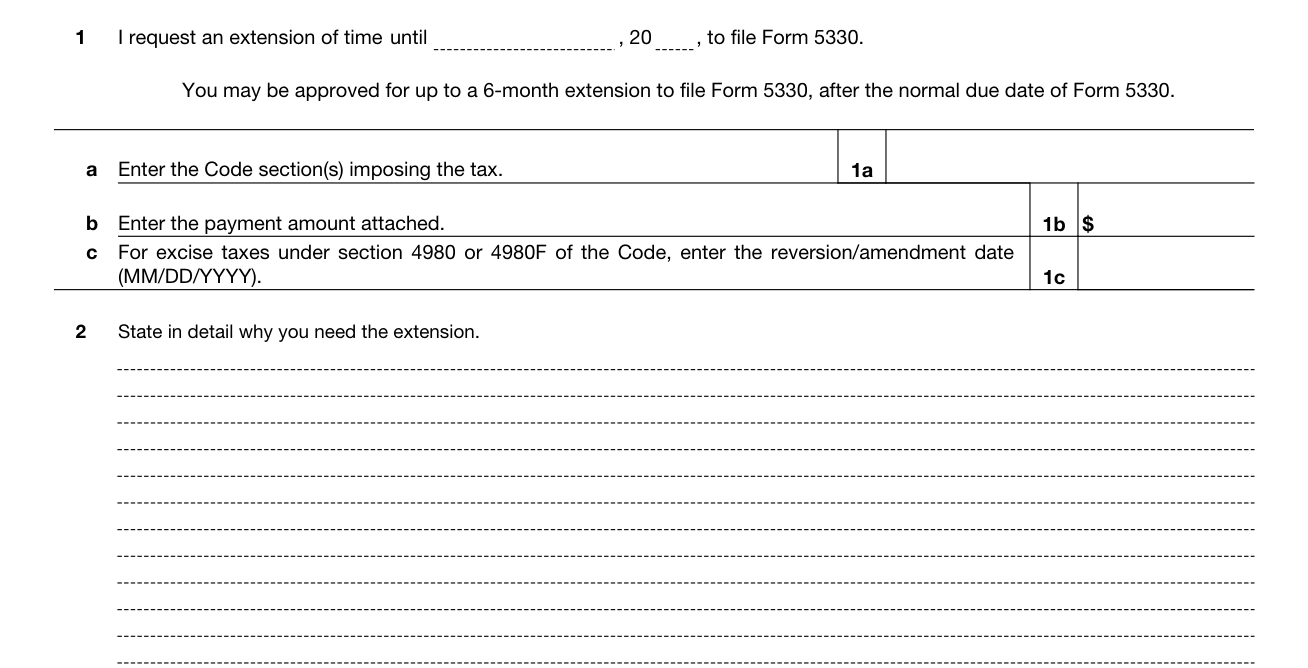
Form 5330 filers must complete Part I, and Part III, and sign under penalties of perjury. Caution: Complete either Part II or Part III, but not both.
On line 1, enter the requested due date.
Enter the Code section(s) imposing the tax. Indicate the section(s) for the excise tax for which you are requesting an extension.
Enter the payment amount attached. Enter the amount of tax estimated to be due with Form 5330 and include your payment with this form.
Line 1c: For excise taxes under section 4980 or 4980F of the Code, enter the reversion/amendment date (MM/DD/YYYY).
Line 2: State in detail why you need the extension.
Under penalties of perjury, I declare that to the best of my knowledge and belief, the statements made on this form are true, correct, and complete, and that I am authorized to prepare this application.[2]
For all forms (except Form 5330) an automatic 6-month extension will be granted if you properly complete this form, file it, and pay any balance due on Part II, line 3c, by the due date for the return for which the extension applies.[2]
A single extension of 6 months is allowed for each type of return for a tax year.[2]
No blanket requests. File a separate Form 8868 for each return for which you are requesting an extension of time to file.[2]
Form 8868 is the Application for Extension of Time To File an Exempt Organization Return or Excise Taxes Related to Employee Benefit Plans. Also, the trustee of a trust required to file Form 1041-A or Form 5227 must use Form 8868 to request an extension of time to file those returns.[2]
When To File File Form 8868 by the due date of the return for which you are requesting an extension.[2]
If you do not file electronically, file Form 8868 at Internal Revenue Service Mail Stop 6054 1973 N Rulon White Blvd. Ogden, UT 84201-0045 An application for extension of time to file Form 8870 must be sent in paper format.[2]
Generally, a penalty of ½ of 1% of any tax not paid by the due date is charged for each month or part of a month that the tax remains unpaid. The penalty cannot exceed 25% of the amount due. The penalty will not be charged if you can show reasonable cause for not paying on time. A penalty is charged if the return is filed after the due date (including extensions) unless you can show reasonable cause for not filing on time. Different late filing penalties apply to information returns.[2]
Caution: You cannot use Form 8868 to extend the due date of Form 990-N. All corporations required to file an income tax return other than Form 990-T (including 1120-C filers), partnerships, REMICs, and trusts must use Form 7004 to request an extension of time to file income tax returns.[2]
[1] Form 8868 (Rev. January 2025), Application for Extension of Time To File an Exempt Organization Return or Excise Taxes Related to Employee Benefit Plans, Internal Revenue Service (the Official source link on this page).