
Updated:
Get Form Now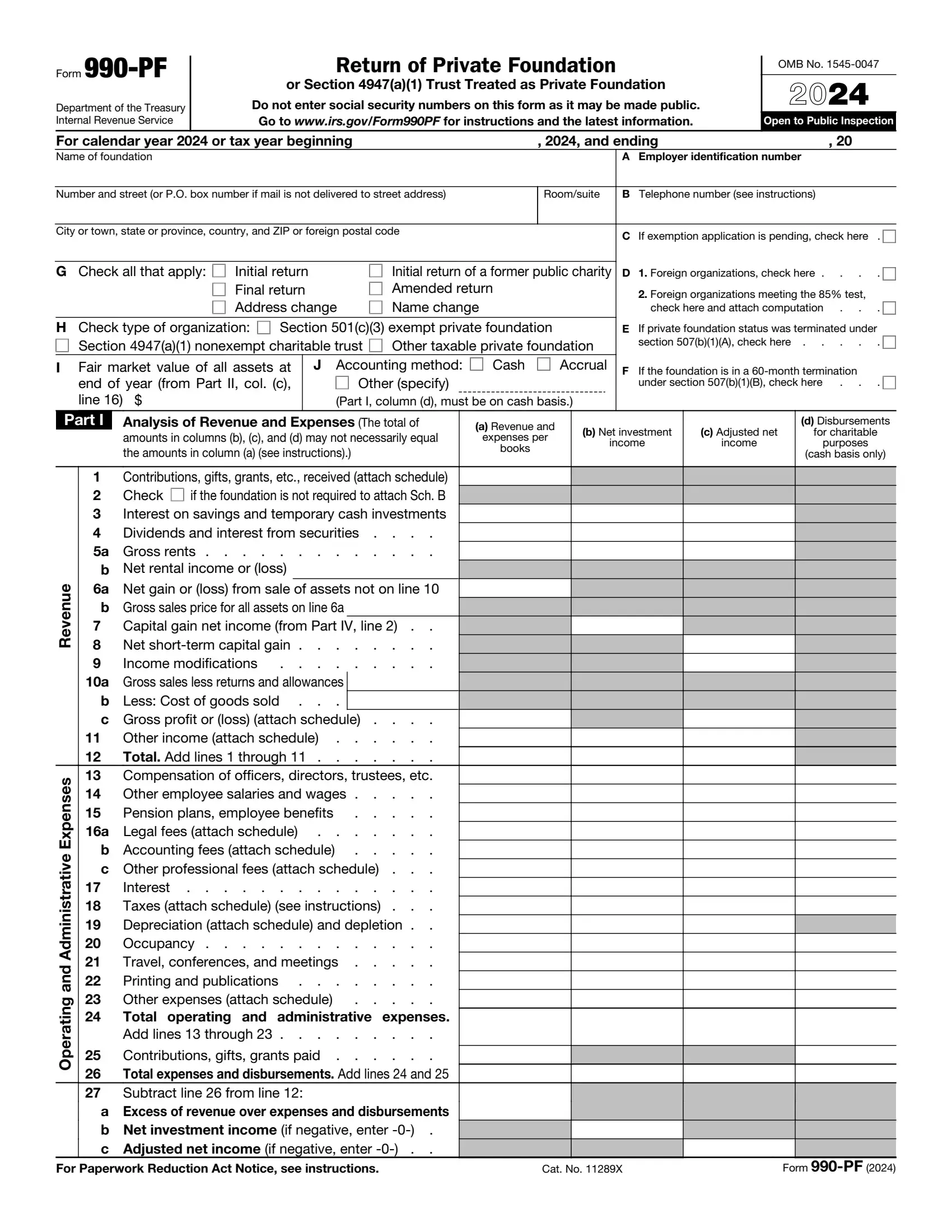
IRS Form 990-PF, titled “Return of Private Foundation or Section 4947(a)(1) Trust Treated as Private Foundation,” is specifically designed for private foundations and certain charitable trusts to report their annual financial activities. This form is essential for these organizations to maintain their tax-exempt status and comply with IRS regulations. It provides a comprehensive overview of the foundation’s assets, receipts, expenditures, and grants distributed over the tax year. Key sections on Form 990-PF include:
Filing this form allows the IRS to monitor private foundations’ operations and financial health, ensuring they meet the requirements for charitable distribution and financial accountability.
Other IRS Forms for Charities and Nonprofits
Along with charitable distributions and activities, there might be some other information you would want to report to the IRS. Check some other IRS forms for charities and nonprofits here.
What it is: Form 990-PF, Return of Private Foundation or Section 4947(a)(1) Trust Treated as Private Foundation.
Where and when to file: Electronic filing is only available for the current tax year and 2 prior tax periods.[2]
Form 990-PF is an annual information return that must be filed by the following.[2]
Private foundations exempt under section 501(a) (section 6033(a)).[2]
Taxable private foundations (section 6033(d)).[2]
Organizations that agree to private foundation status and whose applications for exempt status are pending on the due date for filing Form 990-PF.[2]
Organizations that claim private foundation status, haven't yet applied for exempt status, and whose applications aren't yet untimely under section 508(a) for retroactive recognition of exemption.[2]
Organizations that made an election under section 41(e)(6) (D)(iv).[2]
Private foundations that are making a section 507(b) termination.[2]
Section 4947(a)(1) nonexempt charitable trusts treated as private foundations (section 6033(d)).[2]
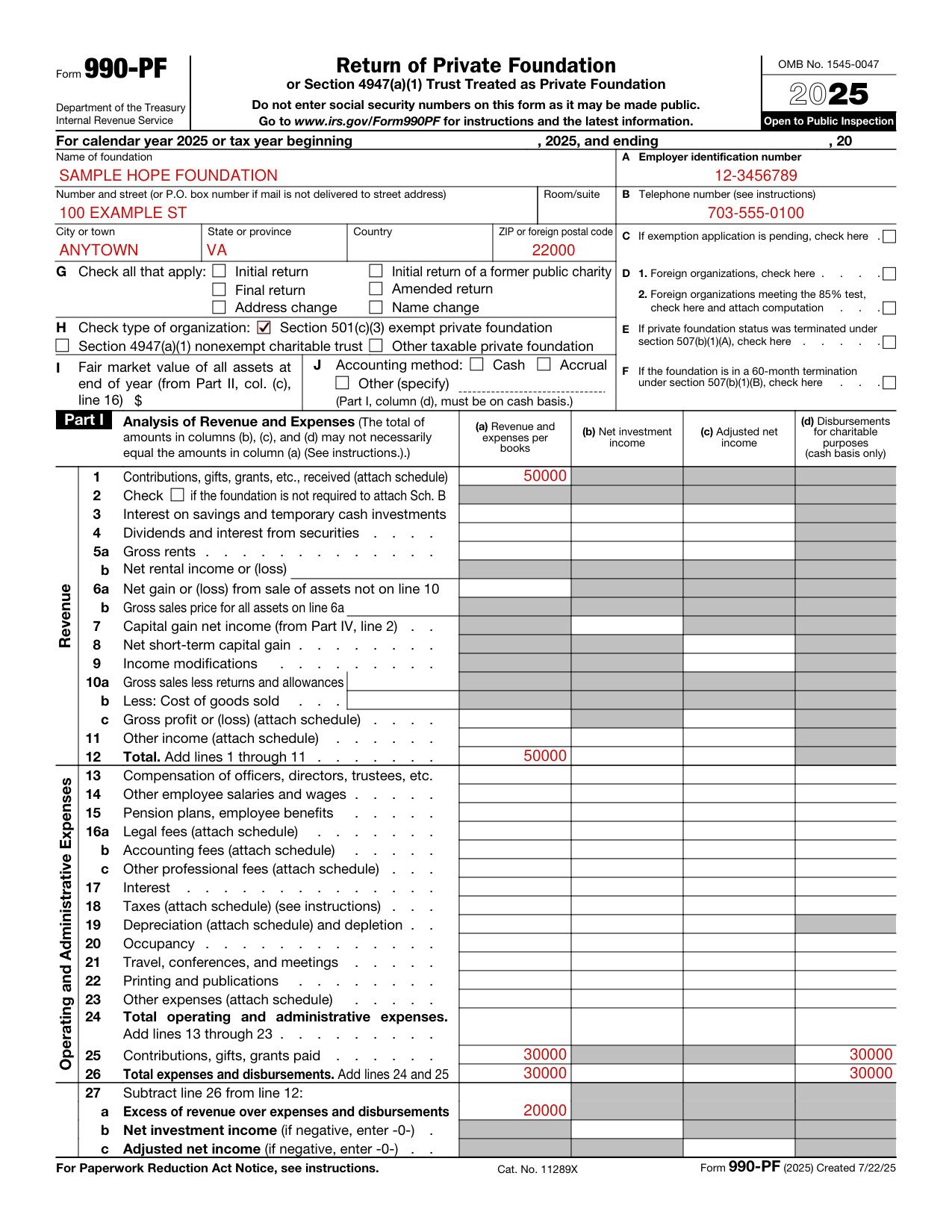

The organization should have only one EIN.
Enter a foundation telephone number (including the area code) that the public and government regulators may use to obtain information about the foundation's finances and activities.[2]

Check the box for Section 501(c)(3) exempt private foundation if the foundation has a ruling or determination letter from the IRS in effect that recognizes its exemption from federal income tax as an organization described in section 501(c)(3) or if the organization's exemption application is pending with the IRS.
Check the Section 4947(a)(1) nonexempt charitable trust box if the trust is a nonexempt charitable trust treated as a private foundation.
All others, check the Other taxable private foundation box.[2]

Don't report on line 25 direct program expenditures that aren't contributions, gifts, or grants. These amounts should be reported on lines 13-24.[2]
Do not enter social security numbers on this form as it may be made public.
In column (a), enter all items of revenue and expense shown in the books and records that increased or decreased the net assets of the organization.[2]
Expenses entered in column (d) relate to activities that constitute the charitable purpose(s) of the foundation.[2]
Line 12. Total. Enter the total of lines 1-11 in columns (a)-(c).[2]
Form 990-PF for 2025 has, on page 5, Part VI-B Statements Regarding Activities for Which Form 4720 May Be Required: File Form 4720 if any item is checked in the Yes column, unless an exception applies.
If an organization doesn't file timely and completely, or doesn't furnish the correct information, it must pay $25 for each day the failure continues ($130 a day if it is a large organization), unless it can show that the failure was due to reasonable cause. (checked November 1, 2026)
The maximum penalty for each return won't exceed the lesser of $13,000 ($65,000 for a large organization) or 5% of the gross receipts of the organization for the year. (checked November 1, 2026)
A large organization is one that has gross receipts exceeding $1,309,500 for the tax year. (checked November 1, 2026)[2]
A foundation generally uses Form 8868 to request an automatic extension of time to file its return. An automatic extension will be granted if you properly complete this form, file it, and pay any balance due by the due date for Form 990-PF.[2]
Did the foundation file Form 1120-POL for this year?
To change the organization's return for any year, file an amended return, including attachments, with the correct information. Check Amended return in Item G at the top of page 1 of the form.[2]
If you are filing Form 990-PF because you no longer meet a public support test under section 509(a)(1) and you haven't previously filed Form 990-PF, check Initial return of a former public charity in Item G of the Heading section on page 1 of your return.[2]
Form 990-PF is used to figure the tax based on investment income, and to report charitable distributions and activities.[2]
Most tax-exempt organizations are required to file an annual Form 990, 990-EZ, or 990-PF with the IRS, or to submit a Form 990-N e-Postcard to the IRS.[2]
If a tax-exempt private foundation fails to file an annual return as required for 3 consecutive years, it will automatically lose its tax-exempt status and will become a taxable private foundation.[2]
The return must be signed by the president, vice president, treasurer, assistant treasurer, chief accounting officer, or other corporate officer (such as tax officer) who is authorized to sign. If the return is filed for a trust, it must be signed by the authorized trustee or trustees. Sign and date the form and fill in the signer's title.[2]
This return must be filed by the 15th day of the 5th month following the close of the foundation's tax year. If the regular due date falls on a Saturday, Sunday, or legal holiday, file by the next business day.[2]
If you are filing a 2025 Form 990-PF, you are required to file electronically. For additional information on the electronic filing requirement and e-file providers, visit IRS.gov/EOefile.[2]
Under penalties of perjury, I declare that I have examined this return, including accompanying schedules and statements, and to the best of my knowledge and belief, it is true, correct, and complete.
Section 4947(a)(1) nonexempt charitable trusts not treated as private foundations don't file Form 990-PF. However, they may need to file Form 990, Return of Organization Exempt From Income Tax, or Form 990-EZ, Short Form Return of Organization Exempt From Income Tax.[2]
[1] Form 990-PF (2025), Return of Private Foundation or Section 4947(a)(1) Trust Treated as Private Foundation, Department of the Treasury, Internal Revenue Service (the Official source link on this page).
[2] Instructions for Form 990-PF (2025), Department of the Treasury, Internal Revenue Service.