
Updated:
Get Form Now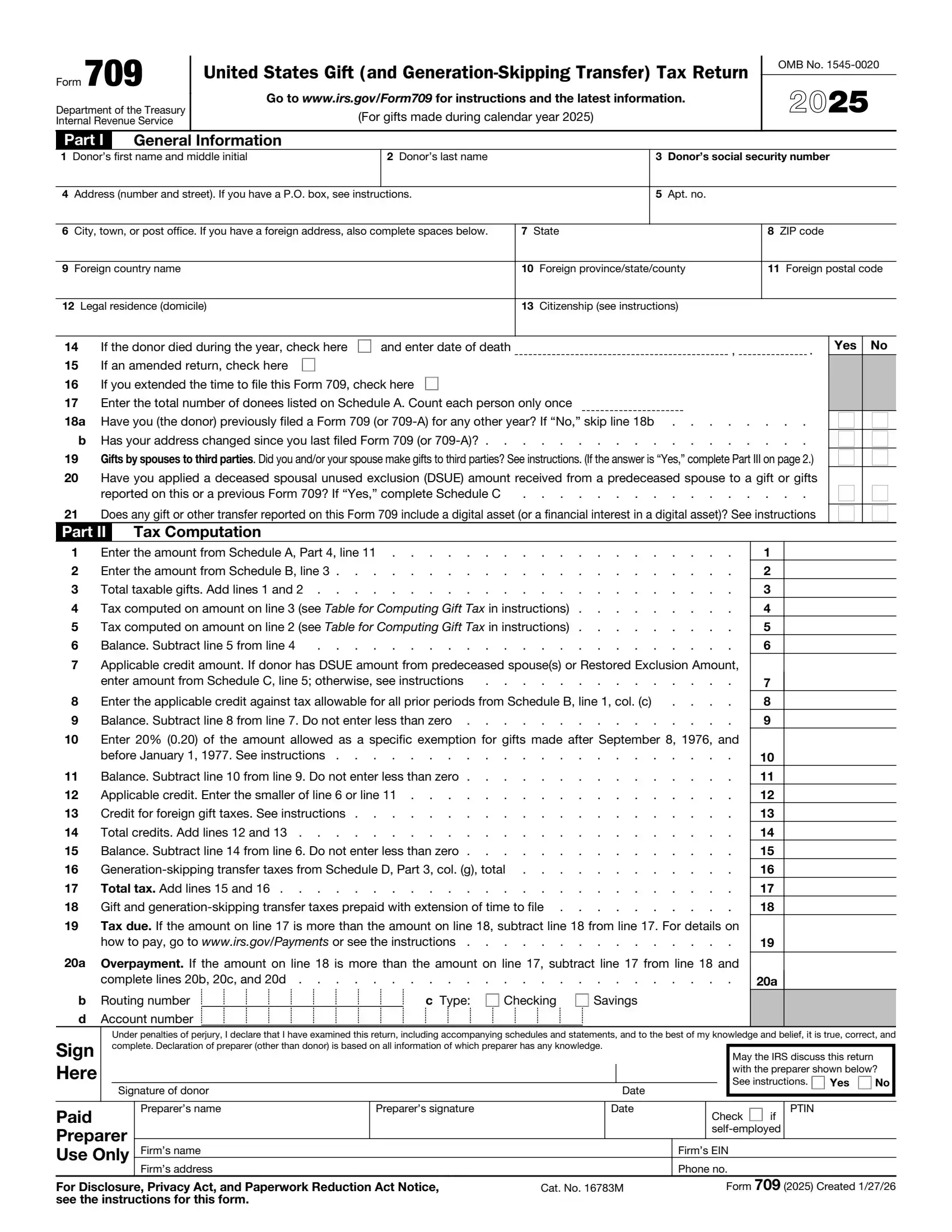
IRS Form 709 is a U.S. tax form used for reporting gifts for federal gift tax and certain generation-skipping transfer taxes. Individuals must file this form if they give gifts exceeding the annual exclusion limit to any person during the year. The form allows the IRS to track substantial gifts as part of the unified gift and estate tax system, ensuring that taxes are paid on certain transfers of wealth that exceed allowable exclusions and deductions.
The main purpose of Form 709 is to report lifetime transfers subject to gift tax. It helps to record an individual’s lifetime gift tax exclusion usage, which is essential for determining the amount of exemption used up at the time of the individual’s death for estate tax purposes. By accurately filing this form, individuals ensure compliance with tax laws, prevent future tax liabilities for their heirs, and manage their potential estate tax responsibilities more effectively.
Other IRS Forms for Individuals
Individual taxpayers have to report different financial information to the Internal Revenue Service. Look through the other IRS forms to make sure you filed everything you are required of.
What it is: Form 709 is the United States Gift (and Generation-Skipping Transfer) Tax Return, for gifts made during calendar year 2025.
Who signs: As a donor, you must sign the return. If you pay another person, firm, or corporation to prepare your return, that person must also sign the return as preparer unless that person is your regular full-time employee.[2]
Use Form 709 to report transfers subject to the federal gift and certain generation-skipping transfer (GST) taxes and to figure the tax due, if any, on those transfers.[2]
Spouses may not file a joint gift tax return. Each individual is responsible to file a Form 709.[2]
Attach any appraisal used to determine the value of real estate or other property.[2]
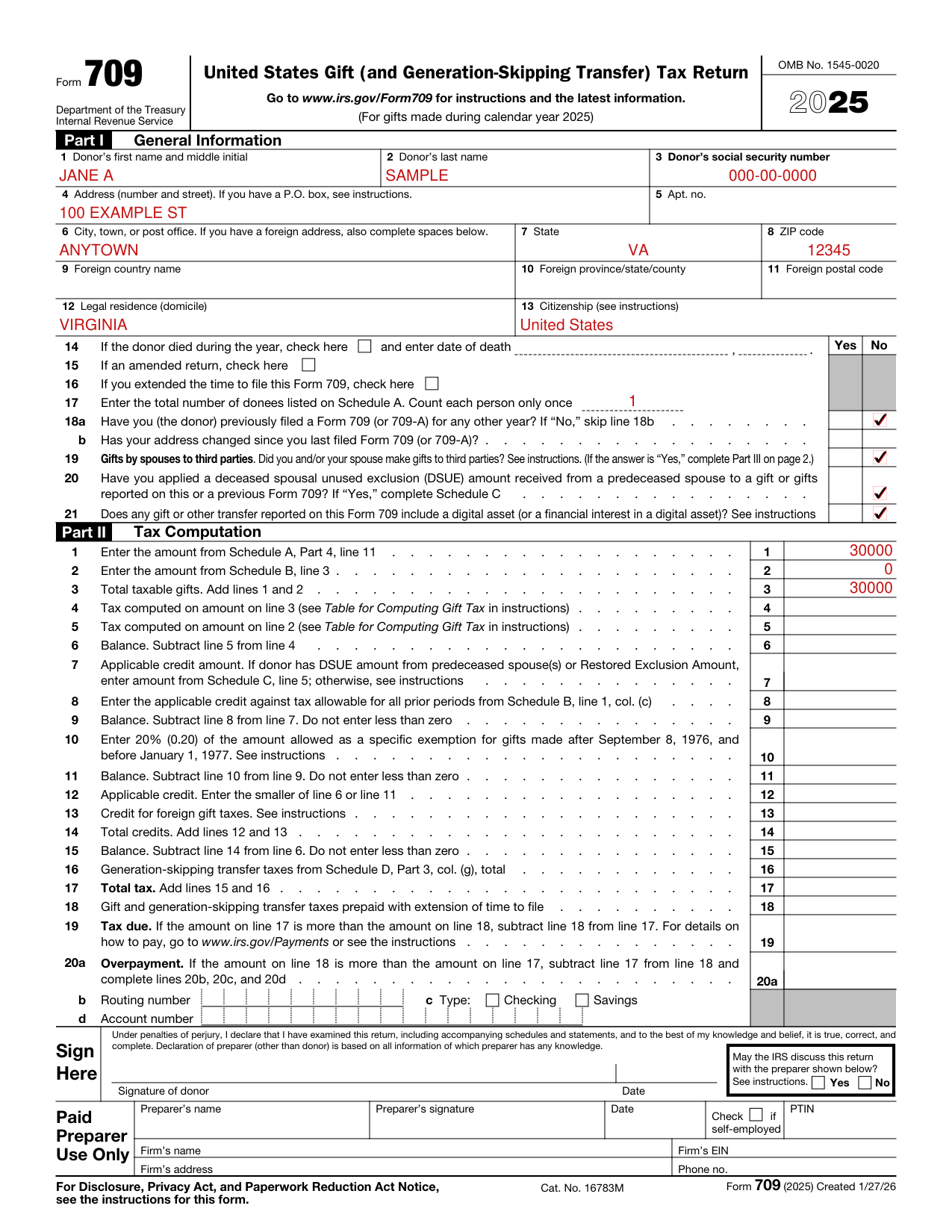
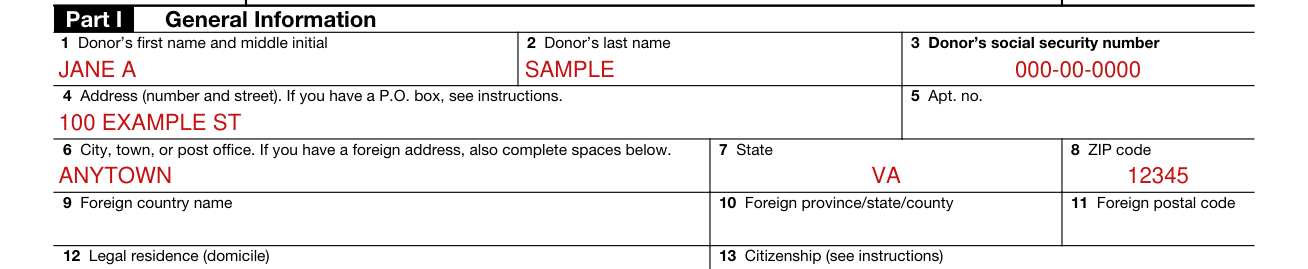
Part I, line 3, donor's social security number: enter your social security number (SSN), if applicable, or your individual taxpayer identification number (ITIN), but only if you have previously used the ITIN to file other U.S. tax returns.
Lines 4-11, address: enter your current mailing address.[2]

Line 12, legal residence (domicile): enter the state of the United States (including the District of Columbia) or a foreign country in which you legally reside or are domiciled at the time of the gift.
Line 13, citizenship: enter your citizenship.[2]

Line 14: if the donor died during the year, check here and enter date of death. Line 15: if an amended return, check here. Line 16: if you extended the time to file this Form 709, check here. Line 17: enter the total number of donees listed on Schedule A, counting each person only once. Line 18a: have you (the donor) previously filed a Form 709 (or 709-A) for any other year? If “No,” skip line 18b.

Line 19: if you and/or your spouse made gifts to third parties, check the “Yes” box and complete Part III. If you are not married, skip to line 20.
Line 20: using the checkboxes provided, indicate whether the donor is applying or has applied a DSUE amount from a predeceased spouse to gifts reported on this or a previous Form 709. If so, complete Schedule C before going to Part II.
Common mistake: Line 21: if you reported on this Form 709 any transfer that includes a digital asset (or a financial interest in a digital asset), answer “Yes” to the question on line 21. Do not leave the question unanswered.[2]
Box 11, Line A: does the value of any item listed on Schedule A reflect any valuation discount? If “Yes,” attach an explanation giving the basis for the claimed discounts and showing the amount of the discounts taken.
Line B: if you elect under section 529(c)(2)(B) to treat any transfers made this year to a qualified tuition program as made ratably over a 5-year period, check here and attach a statement.[2]
Do not enter on Schedule A any gift or part of a gift that qualifies for the political organization, educational, or medical exclusion.
List in Part 1 gifts subject only to the gift tax. Group the gifts in four categories: gifts made to your spouse; gifts made to third parties that are to be split with your spouse; charitable gifts (if you are not splitting gifts with your spouse); other gifts.
Number and describe all gifts (including charitable, public, and similar gifts) in the columns provided in Schedule A. In columns (b) through (d), describe each gift in enough detail so that the property can be easily identified.[2]
Column (e), donor's adjusted basis of gift: show the basis you would use for income tax purposes if the gift were sold or exchanged. Generally, this means cost plus improvements, less applicable depreciation, amortization, and depletion.
Columns (f) and (g), date of gift and value at date of gift: the value of a gift is the fair market value (FMV) of the property on the date the gift is made (valuation date).
Column (h), split gifts: enter an amount in this column only if you have chosen to split gifts with your spouse.
Total of Part 1: add amounts from Part 1, column (i).[2]
Part 4, line 1: enter only gifts of the donor. If gift splitting has been elected, enter only the value of the gift that is attributable to the spouse that is filing the return.
Line 2: enter the total annual exclusions you are claiming for the gifts listed on Schedule A.
Line 3, total included amount of gifts: subtract line 2 from line 1.
Line 9: subtract line 8 from line 3.
Line 11, taxable gifts: add lines 9 and 10. Enter here and on page 1, Part II-Tax Computation, line 1.[2]

Part II, line 1: enter the amount from Schedule A, Part 4, line 11. Line 2: enter the amount from Schedule B, line 3. Line 3, total taxable gifts: add lines 1 and 2.
If you answered “Yes” on line 18a of page 1, Part I, see the instructions for completing Schedule B. If you answered “No,” skip to Part II, Tax Computation on page 1 (or Schedule C or D, if applicable).
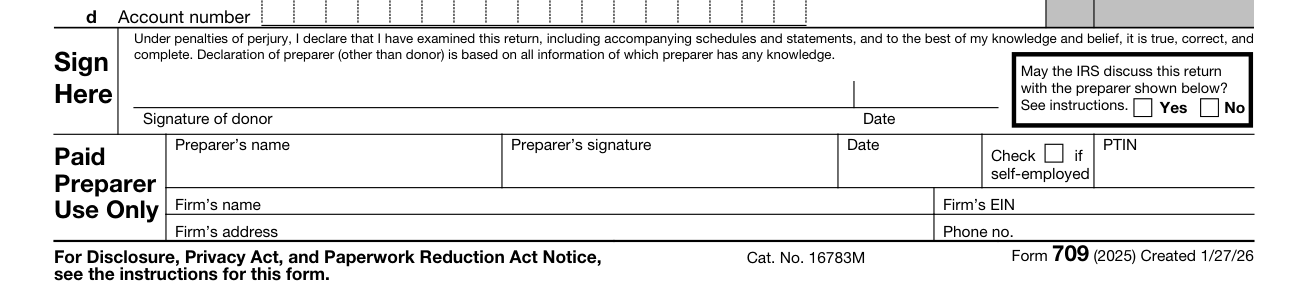
By signing, the donor declares under penalties of perjury that the donor has examined this return, including accompanying schedules and statements, and that to the best of the donor's knowledge and belief it is true, correct, and complete.
Box 11, Tip: Make sure to complete page 1 and the applicable schedules in their entirety. Returns filed without entries in each field will not be processed.[2]
If you are a citizen or resident of the United States, you must file a gift tax return (whether or not any tax is ultimately due) in the following situations. If you gave gifts to someone in 2025 totaling more than $19,000 (other than to your spouse), you must generally file Form 709 (checked October 19, 2026). You must file a gift tax return to split gifts with your spouse (regardless of their amount) as described in Part III Spouse's Consent on Gifts to Third Parties. Only individuals are required to file gift tax returns. If a donor dies before filing a return, the donor's executor must file the return.[2]
Form 709 is the United States Gift (and Generation-Skipping Transfer) Tax Return, for gifts made during calendar year 2025. Do not file more than one Form 709 for the same calendar year.[2]
Generally, you must file Form 709 no earlier than January 1, but not later than April 15, of the year after the gift was made. However, in instances when April 15 falls on a Saturday, Sunday, or legal holiday, Form 709 will be due on the next business day.[2]
File Form 709 at Department of the Treasury, Internal Revenue Service Center, Kansas City, MO 64999. If using a PDS, file at Internal Revenue Service, 333 W. Pershing Road, Kansas City, MO 64108.[3]
Section 6651 imposes penalties for both late filing and late payment, unless there is reasonable cause for the delay.[2]
If you are a nonresident not a citizen of the United States and made gifts of real or other tangible property situated in the United States, file Form 709-NA, United States Gift (and Generation-Skipping Transfer) Tax Return.[2]
[1] Form 709 (2025), United States Gift (and Generation-Skipping Transfer) Tax Return, Internal Revenue Service (the Official source link on this page).
[2] Instructions for Form 709 (2025), Internal Revenue Service.
[3] irs.gov, deadline (irs.gov). Accessed October 18, 2026.