
Updated:
Get Form Now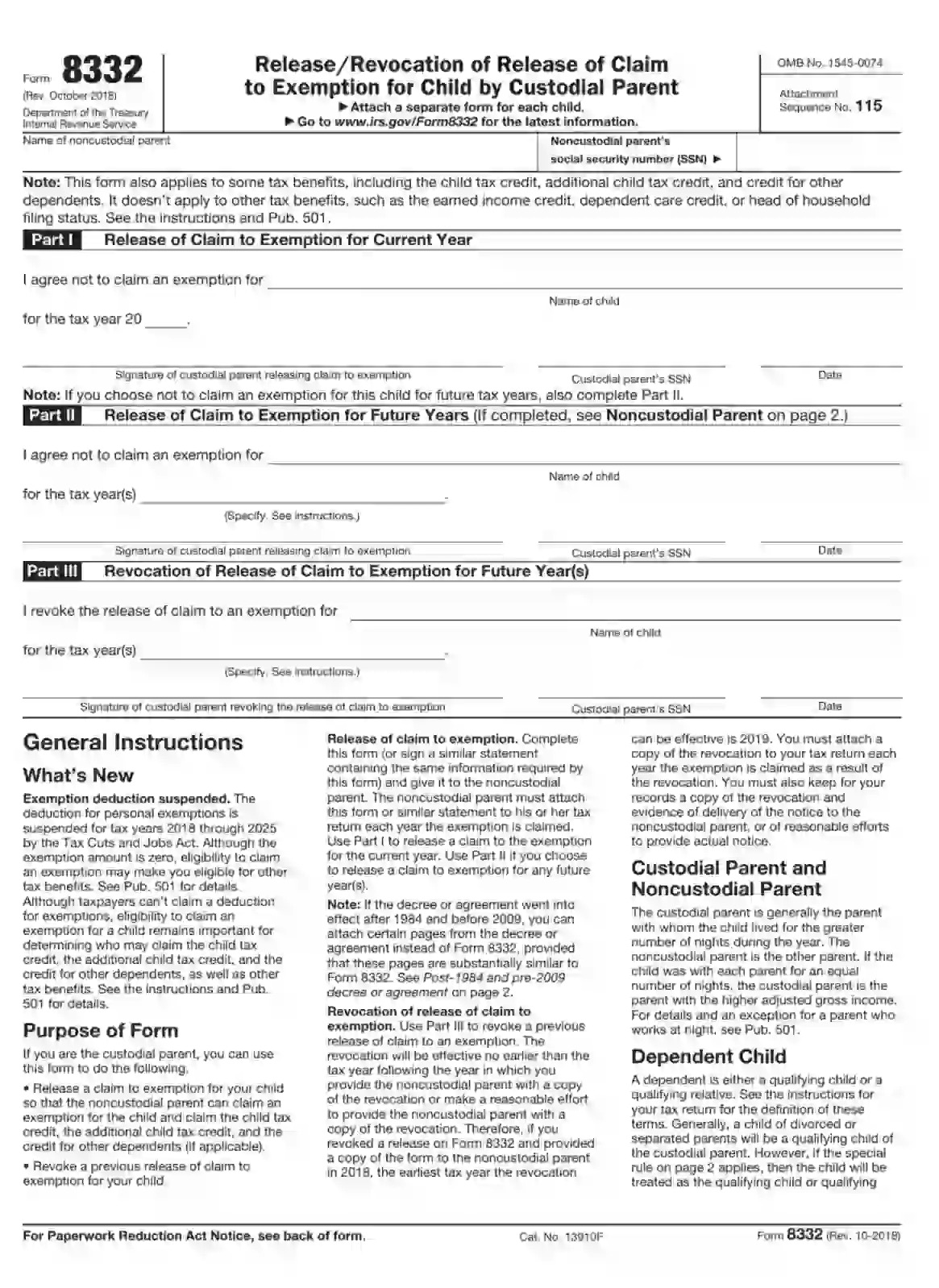
IRS Form 8332 is a tax form used by custodial parents to release their right to claim a child as a dependent to the non-custodial parent. This form is particularly relevant for separated or divorced parents. It allows the custodial parent to transfer the tax benefits associated with the dependency exemption to the non-custodial parent for one or more tax years.
By signing Form 8332, the custodial parent enables the non-custodial parent to claim the child tax credit, additional child tax credit, and other tax benefits that require the dependency exemption. This form ensures that the IRS acknowledges and accepts the arrangement without disputing the claim at the time of tax filing.
Other IRS Forms for Individuals
The form for custodial parents might be not the only one you need to fill in when it comes to taking custody of children. Check what other forms might be necessary for you in this situation and in general.
What it is: Form 8332 (Rev. December 2025), Department of the Treasury, Internal Revenue Service: Release/Revocation of Release of Claim to Exemption for Child by Custodial Parent.
Where and when to file: Custodial parent: complete this form (or sign a similar statement containing the same information required by this form) and give it to the noncustodial parent.
If you are the custodial parent, you can use this form to release a claim to exemption for your child so that the noncustodial parent can claim an exemption for the child. The noncustodial parent can also claim the child tax credit, the additional child tax credit, and the credit for other dependents (if applicable). As the custodial parent, you can also use it to revoke a previous release of claim to exemption for your child.
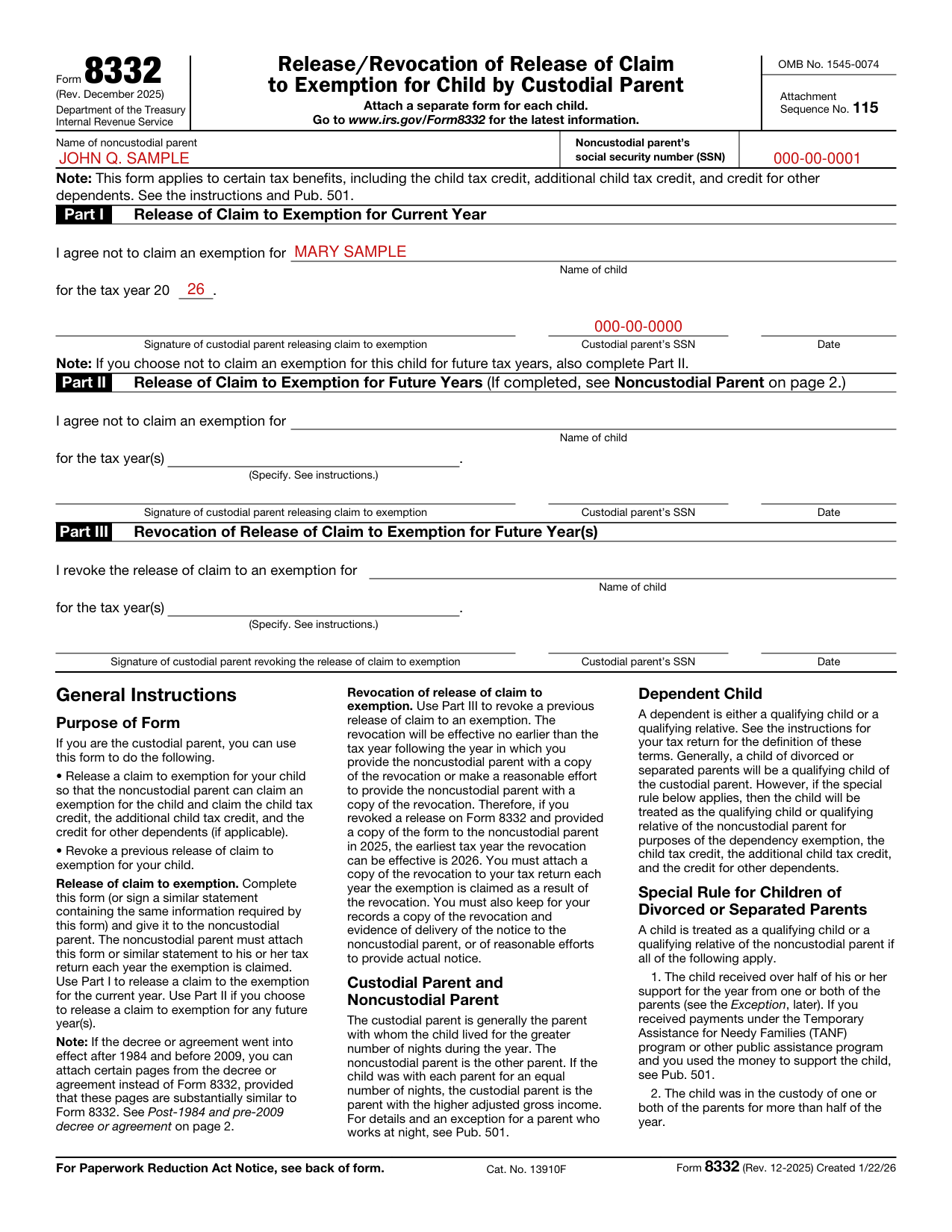

Attach a separate form for each child.
Enter the Name of noncustodial parent and the Noncustodial parent's social security number (SSN).
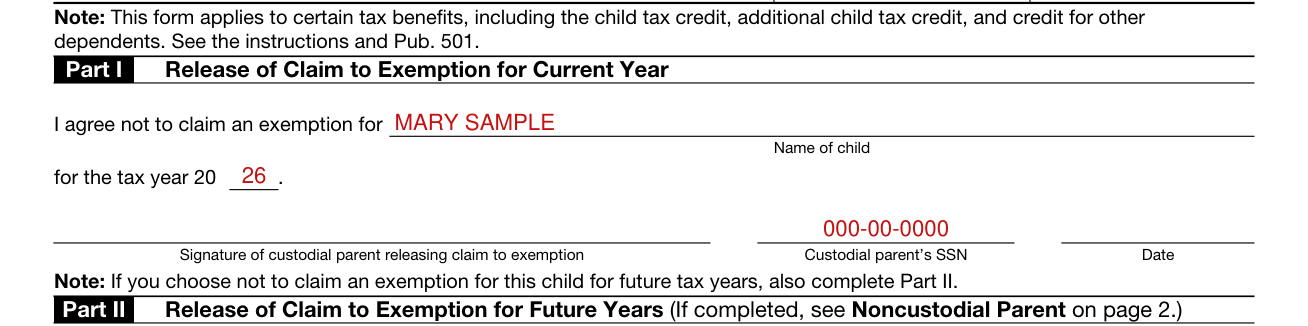
Custodial Parent, Part I: complete Part I to release a claim to exemption for your child for the current tax year.
Write the Name of child under I agree not to claim an exemption for, and enter the tax year after 20 in for the tax year 20.
Sign on the Signature of custodial parent releasing claim to exemption line, then enter the Custodial parent's SSN and the Date. If you choose not to claim an exemption for this child for future tax years, also complete Part II.

Custodial parent, Part II: complete Part II to release a claim to exemption for your child for 1 or more future years.
Tip: To help ensure future support, you may not want to release your claim to the exemption for the child for future years.
Write the Name of child under I agree not to claim an exemption for.
Write the specific future year(s) or “all future years” in the space provided in Part II.
In Part II, sign on the Signature of custodial parent releasing claim to exemption line, then enter the Custodial parent's SSN and the Date.

Custodial parent, Part III: complete Part III if you are revoking a previous release of claim to exemption for your child.
Write the Name of child under I revoke the release of claim to an exemption for.
Write the specific future year(s) or “all future years” in the space provided in Part III.
In Part III, sign on the Signature of custodial parent revoking the release of claim to exemption line, then enter the Custodial parent's SSN and the Date.
The revocation will be effective no earlier than the tax year following the year you provide the noncustodial parent with a copy of the revocation or make a reasonable effort to provide the noncustodial parent with a copy of the revocation.
Also, you must attach a copy of the revocation to your tax return for each year you are claiming the exemption as a result of the revocation.
You must also keep for your records a copy of the revocation and evidence of delivery of the notice to the noncustodial parent, or of reasonable efforts to provide actual notice.
Noncustodial parent: attach this form or similar statement to your tax return for each year you claim the exemption for your child.
You can claim the exemption only if the other dependency tests in the instructions for your tax return are met.
Keep a copy for your records.
Note: If you are filing your return electronically, you must file Form 8332 with Form 8453, U.S. Individual Income Tax Transmittal for an IRS e-file Return. See Form 8453 and its instructions for more details.
If the divorce decree or separation agreement went into effect after 1984 and before 2009, the noncustodial parent can attach certain pages from the decree or agreement instead of Form 8332, provided that these pages are substantially similar to Form 8332. To be able to do this, the decree or agreement must state all three of the following: (1) The noncustodial parent can claim the child as a dependent without regard to any condition (such as payment of support). (2) The other parent will not claim the child as a dependent. (3) The years for which the claim is released. The noncustodial parent must attach all of the following pages from the decree or agreement: Cover page (include the other parent's SSN on that page). The pages that include all of the information identified in (1) through (3). Signature page with the other parent's signature and date of agreement.
Common mistake: Caution: The noncustodial parent must attach the required information even if it was filed with a return in an earlier year.
If the divorce decree or separation agreement went into effect after 2008, the noncustodial parent can't attach certain pages from the decree or agreement instead of Form 8332.
Common mistake: Exception: If the support of the child is determined under a multiple support agreement, this form should not be used.
Tip: If the custodial parent released his or her claim to the exemption for the child for any future year, you must attach a copy of this form or similar statement to your tax return for each future year that you claim the exemption.
[1] Form 8332 (Rev. December 2025), Release/Revocation of Release of Claim to Exemption for Child by Custodial Parent, Internal Revenue Service (the Official source link on this page).