
Updated:
Get Form Now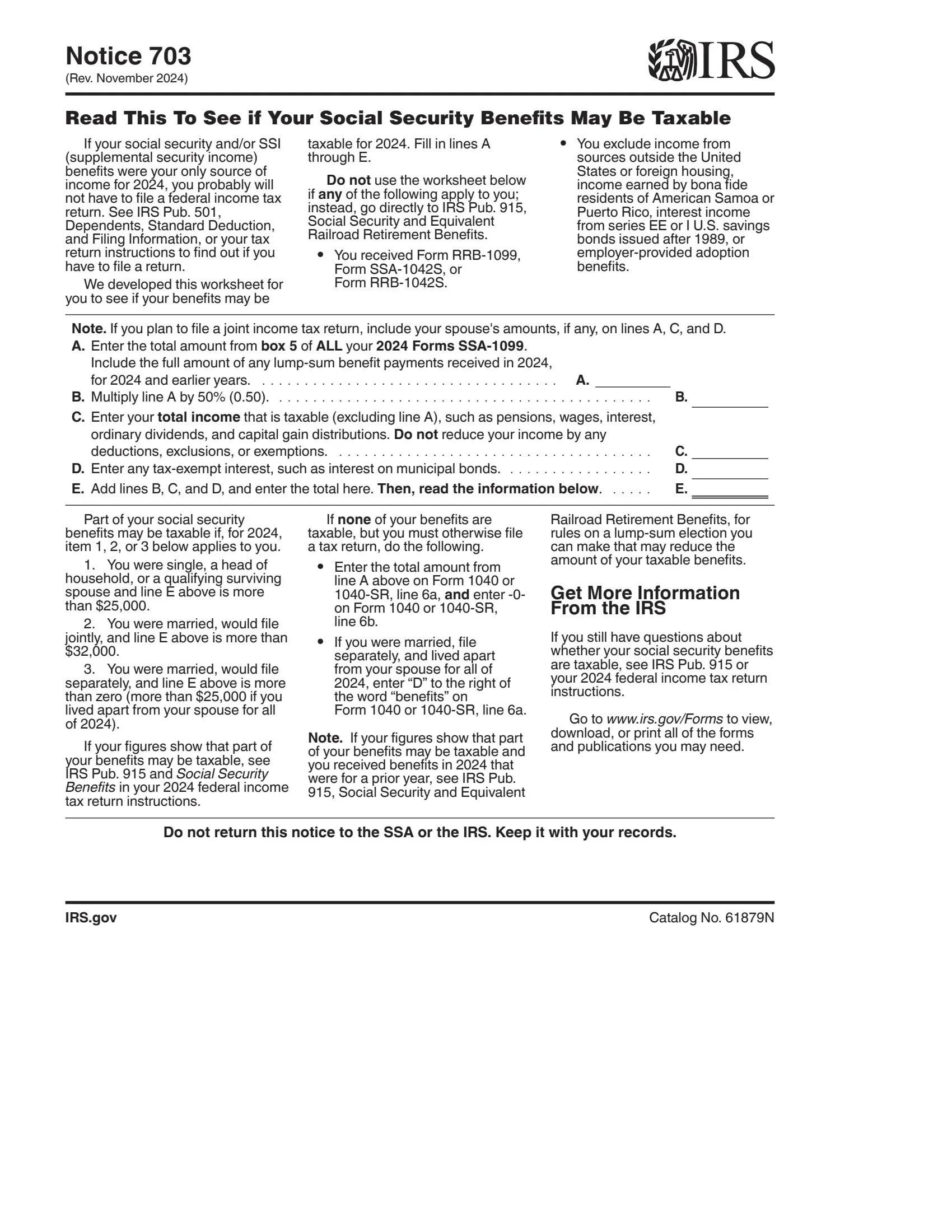
IRS Notice 703 accompanies Form SSA-1099, which reports Social Security benefits received during the year. Notice 703 provides instructions to help recipients determine if any part of their Social Security benefits is taxable. This determination is crucial because it affects how much of the benefit needs to be included in the taxpayer’s gross income on their federal tax return.
The notice includes a worksheet to calculate the taxable portion of the Social Security benefits. This calculation is based on the recipient’s total income and filing status. By carefully following the instructions and completing the worksheet provided in Notice 703, recipients of Social Security benefits can accurately assess the tax implications of these benefits and report them correctly on their tax return, thus ensuring compliance with federal tax laws.
Other IRS Forms for Individuals
The IRS Notice 703 might be not the only notice you might want to read about. Check what other IRS forms our users most often use.
What it is: Notice 703: Read This To See if Your Social Security Benefits May Be Taxable.
Where and when to file: Do not return this notice to the SSA or the IRS. Keep it with your records.
If your social security and/or SSI (supplemental security income) benefits were your only source of income for 2025, you probably will not have to file a federal income tax return.
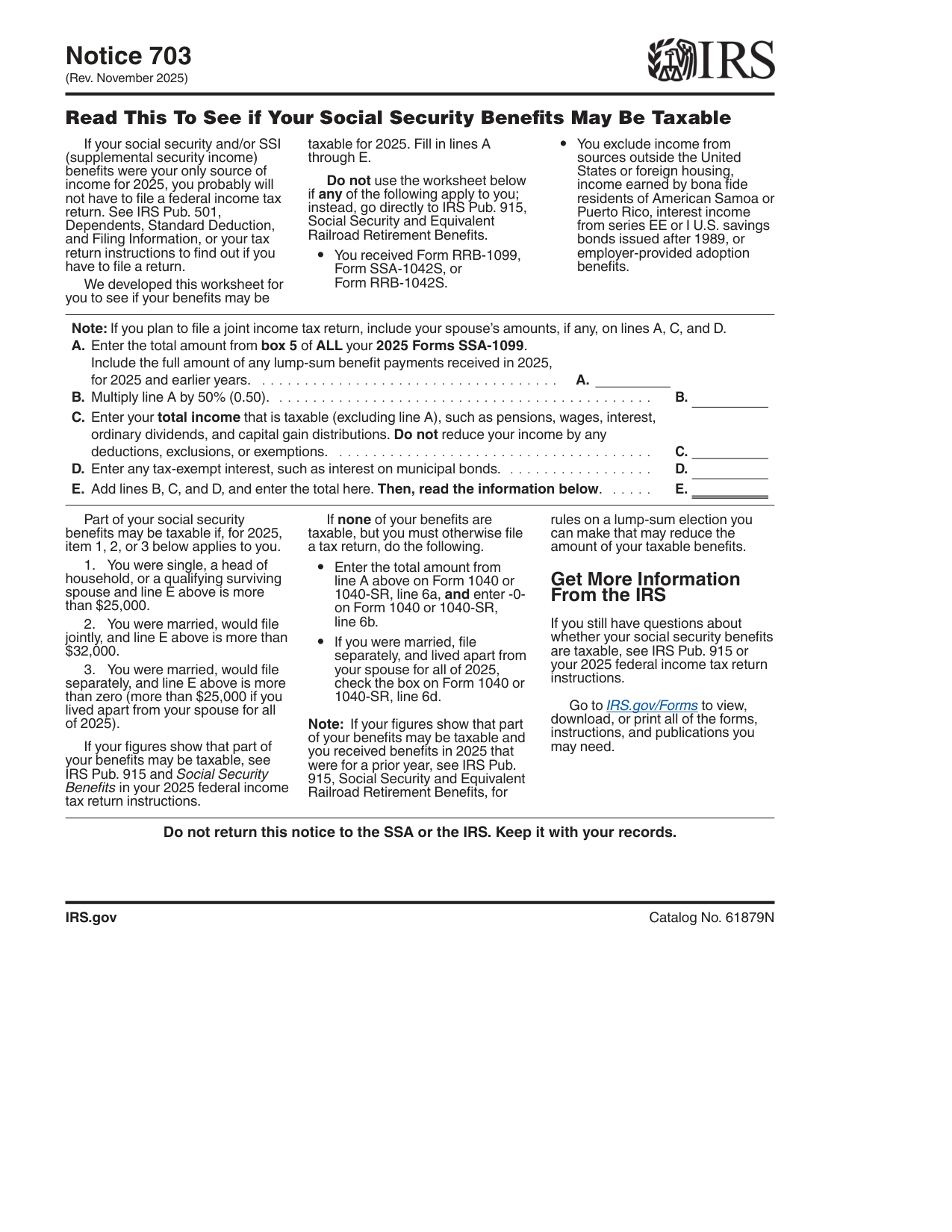
Do not use the worksheet if any of the following apply to you; instead, go directly to IRS Pub. 915, Social Security and Equivalent Railroad Retirement Benefits: you exclude income from sources outside the United States or foreign housing, income earned by bona fide residents of American Samoa or Puerto Rico, interest income from series EE or I U.S. savings bonds issued after 1989, or employer-provided adoption benefits; or you received Form RRB-1099, Form SSA-1042S, or Form RRB-1042S.
Fill in lines A through E.
If you plan to file a joint income tax return, include your spouse's amounts, if any, on lines A, C, and D.
On line A, write the total amount from box 5 of ALL your 2025 Forms SSA-1099, including the full amount of any lump-sum benefit payments received in 2025, for 2025 and earlier years.
On line B, multiply line A by 50% (0.50).
On line C, write your total income that is taxable (excluding line A), such as pensions, wages, interest, ordinary dividends, and capital gain distributions. Do not reduce your income by any deductions, exclusions, or exemptions.
On line D, write any tax-exempt interest, such as interest on municipal bonds.
On line E, add lines B, C, and D, and write the total.
If none of your benefits are taxable, but you must otherwise file a tax return, do the following.
Enter the total amount from line A above on Form 1040 or 1040-SR, line 6a, and enter -0- on Form 1040 or 1040-SR, line 6b. If you were married, file separately, and lived apart from your spouse for all of 2025, check the box on Form 1040 or 1040-SR, line 6d.
Get More Information From the IRS: if you still have questions about whether your social security benefits are taxable, see IRS Pub. 915 or your 2025 federal income tax return instructions.
[1] Notice 703 (Rev. November 2025), Read This To See if Your Social Security Benefits May Be Taxable, Internal Revenue Service (the Official source link on this page).