
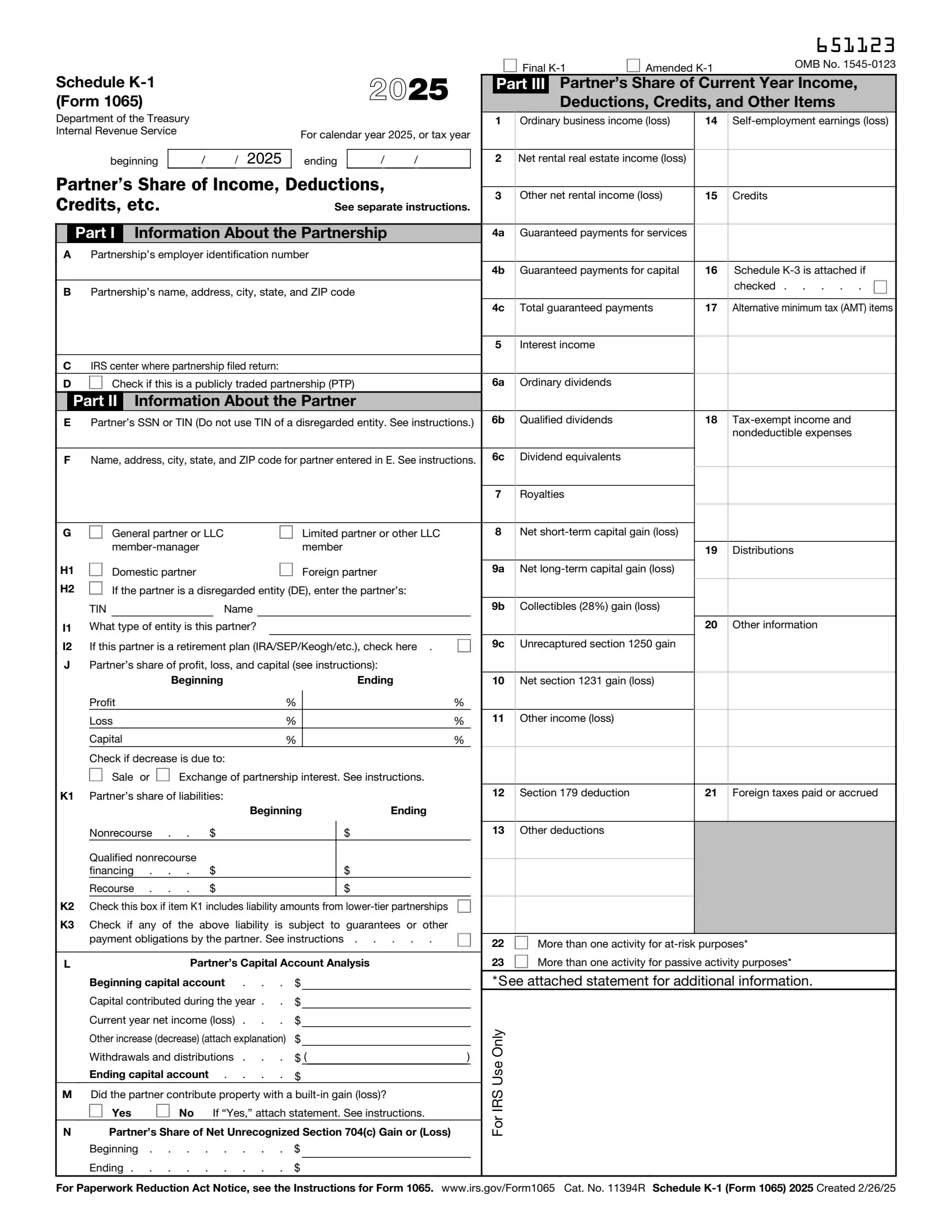
IRS Schedule K-1 for Form 1065 is a tax form used by partnerships to report each partner’s share of partnership income, deductions, credits, and other tax-related items. It is an essential document for partners to report their share of partnership income and deductions on their individual tax returns. The partnership prepares Schedule K-1 and provides a copy to each partner. The IRS Schedule K-1 for Form 1065 includes:
By completing Schedule K-1, partnerships fulfill their reporting requirements to partners and provide them with the information they need to accurately report their share of the partnership’s income and deductions on their individual tax returns. This form helps ensure proper tax reporting and compliance for partnerships and their partners.
Other IRS Forms for Business
The partnership prepares a Schedule K-1 for each partner. Learn what other IRS forms are required of partnerships.
What it is: Schedule K-1 (Form 1065) 2025 is the Partner's Share of Income, Deductions, Credits, etc.
Where and when to file: The partnership files a copy of Schedule K-1 (Form 1065) with the IRS. Don't file it with your tax return unless you're specifically required to do so.[2]
The partnership uses Schedule K-1 to report your share of the partnership's income, deductions, credits, etc. Keep it for your records.[2]
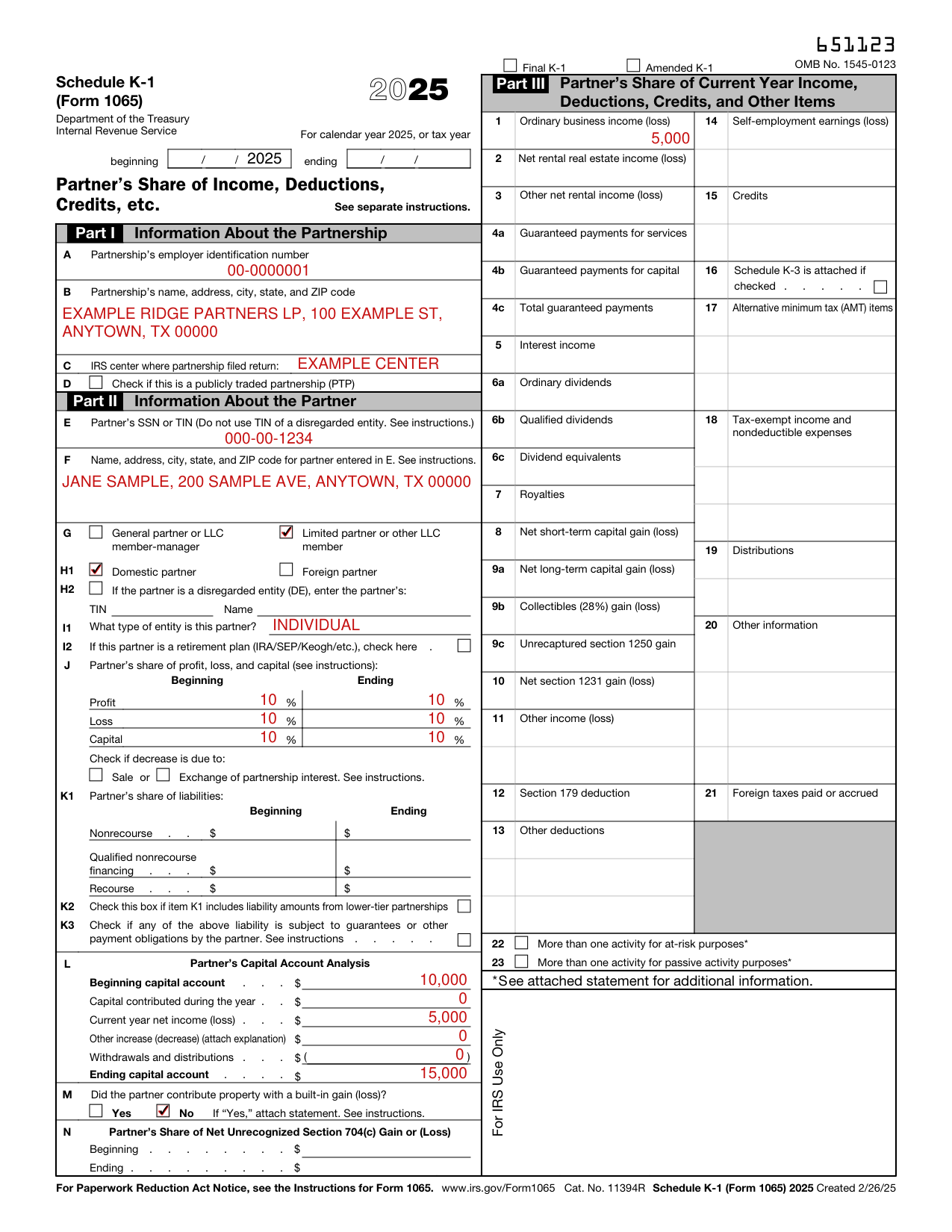
If the partner is an individual, the partnership will enter the partner's SSN or individual taxpayer identification number (ITIN). For all other partners, the partnership will enter the partner's employer identification number (EIN).
In the case of a disregarded entity (DE), the partnership will enter the TIN of the beneficial owner of the DE in item E and the beneficial owner's address in item F.
If the partner is an IRA, the partnership will enter the identifying number of the custodian of the IRA.[2]
If the box in item D is checked, you're a partner in a PTP.[2]
Generally, the amounts reported in item J are based on the partnership agreement. If your interest commenced after the beginning of the partnership's tax year, the partnership will have entered, in the “Beginning” column, the percentages that existed for you immediately after admission. If your interest terminated before the end of the partnership's tax year, the partnership will have entered, in the “Ending” column, the percentages that existed immediately before termination.[2]
For many reasons, your ending capital account as reported to you by the partnership in item L may not equal the adjusted tax basis in your partnership interest.[2]
The amount reported in box 1 is your share of the ordinary income (loss) from trade or business activities of the partnership. Generally, where you report this amount on Form 1040 or 1040-SR depends on whether the amount is from an activity that's a passive activity to you.
Report box 1 income (loss) from partnership trade or business activities in which you materially participated in column (i) or (k) of Schedule E (Form 1040), line 28.
The amount in box 3 is a passive activity amount for all partners.[2]
Report interest income on Form 1040 or 1040-SR, line 2b.
Report ordinary dividends on Form 1040 or 1040-SR, line 3b.[2]
If you're an individual and the passive activity rules don't apply to the amounts shown on your Schedule K-1, take the amounts shown and enter them on the appropriate lines of your tax return. If the passive activity rules do apply, report the amounts shown as indicated in these instructions. If you aren't an individual, report the amounts in each box as instructed on your tax return.
In box 11, boxes 13 through 15, and boxes 17 through 20, the partnership will identify each item by entering a code in the column to the left of the dollar amount entry space.[2]
The amount of loss and deduction you may claim on your tax return may be less than the amount reported on Schedule K-1. It's the partner's responsibility to consider and apply any applicable limitations.[2]
Schedule K-1 may show only the last four digits of your identifying number (social security number (SSN), etc.). However, the partnership has reported your complete identifying number to the IRS.[2]
If you file your tax return on a calendar-year basis, but your partnership files a return for a fiscal year, report the amounts on your tax return for the year in which the partnership's fiscal year ends. For example, if the partnership's tax year ends in February 2026, report the amounts on your 2026 tax return.[2]
Generally, a partner who sells or exchanges a partnership interest in a section 751(a) exchange must notify the partnership, in writing, within 30 days of the exchange (or, if earlier, by January 15 of the calendar year following the calendar year in which the exchange occurred).
An exception to this rule is made for sales or exchanges of publicly traded partnership interests for which a broker is required to file Form 1099-B, Proceeds From Broker and Barter Exchange Transactions.
If a partner is required to notify the partnership of a section 751(a) exchange but fails to do so, the partner will be subject to a penalty for each such failure. However, no penalty will be imposed if the partner can show that the failure was due to reasonable cause and not willful neglect.[2]
If you believe the partnership has made an error on your Schedule K-1, notify the partnership and ask for a corrected Schedule K-1. Don't change any items on your copy of Schedule K-1. Be sure that the partnership sends a copy of the corrected Schedule K-1 to the IRS.[2]
If you're a partner in a partnership that hasn't elected out of the centralized partnership audit regime enacted by the Bipartisan Budget Act of 2015 (the BBA), you must report the items shown on your Schedule K-1 (and any attached statements) the same way that the partnership treated the items on its return.
Common mistake: If the treatment on your original or amended return is inconsistent with the partnership's treatment, or if the partnership was required to file a return but hasn't, you must file Form 8082, Notice of Inconsistent Treatment or Administrative Adjustment Request (AAR), with your original or amended return to identify and explain any inconsistency (or to note that a partnership return hasn't been filed).
If you're required to file Form 8082 but don't do so, you may be subject to the accuracy-related penalty.[2]
Schedule K-1 (Form 1065) 2025 is the Partner's Share of Income, Deductions, Credits, etc. Use these instructions to help you report the items shown on Schedule K-1 on your tax return.[2]
Although the partnership generally isn't subject to income tax, you may be liable for tax on your share of the partnership income, whether or not distributed. Include your share on your tax return if a return is required.[2]
Don't file it with your tax return unless you're specifically required to do so.[2]
[1] Schedule K-1 (Form 1065) 2025, Internal Revenue Service (the Official source link on this page).
[2] Partner's Instructions for Schedule K-1 (Form 1065) 2025, Internal Revenue Service.