1088 Tax Form PDF Details

The 1088 form, also called the Fannie Mae Comparative Income Analysis, is a standardized mortgage worksheet that lenders use to evaluate whether a self-employed borrower's business generates stable enough income to support a home loan. It compares financial data across two consecutive years, tracking gross income trends, operating expense changes, and net taxable income to build a picture of business viability.

Depending on business structure, the form draws data from different IRS filings:

Lenders calculate percentage changes in gross income, total expenses, and taxable income for each reported year. A steady or growing income trend across both years typically strengthens a borrower's loan application. Sharp declines may require additional documentation. Related Fannie Mae forms include Fannie Mae Form 1084 for cash flow analysis and the Fannie Mae Income Worksheet. Self-employed borrowers may also need the self-employed income analysis form.

QuestionAnswer
Form Name1088 Tax Form
Form Length3 pages
Fillable?Yes
Fillable fields1
Avg. time to fill out57 sec
Other namesfannie mae 1088, how to 1088, 1088 form irs, irs 1088 form

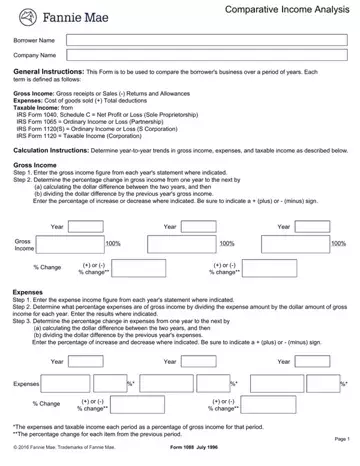
Form Preview Example

@) Fannie Mae

Comparative Income Analysis

Borrower Name

Company Name

General Instructions: This Form is to be used to compare the borrower's business over a period of years. Each

term is defined as follows:

Gross Income: Gross receipts or Sales (-) Returns and Allowances

Expenses: Cost of goods sold (+) Total deductions

Taxable Income: from

IRS Form 1040, Schedule C = Net Profit or Loss (Sole Proprietorship)

IRS Form 1065 = Ordinary Income or Loss (Partnership)

IRS Form 1120(S) = Ordinary Income or Loss (S Corporation)

IRS Form 1120 = Taxable Income (Corporation)

Calculation Instructions: Determine year-to-year trends in gross income, expenses, and taxable income as described below.

Gross Income

Step 1. Enter the gross income figure from each year's statement where indicated.

Step 2. Determine the percentage change in gross income from one year to the next by

(a)calculating the dollar difference between the two years, and then

(b)dividing the dollar difference by the previous year's gross income.

Enter the percentage of increase or decrease where indicated. Be sure to indicate a + (plus) or - (minus) sign.


Year


Year

Year

Income ._______I-=-._______._______I-

Gross


100%

100%

100%


% Change

(+) or (-)

(+) or (-)

. ---- 1-


% change** I

% change**


Expenses

Step 1. Enter the expense income figure from each year's statement where indicated.

Step 2. Determine what percentage expenses are of gross income by dividing the expense amount by the dollar amount of gross income for each year. Enter the results where indicated.

Step 3. Determine the percentage change in expenses from one year to the next by

(a)calculating the dollar difference between the two years, and then

(b)dividing the dollar difference by the previous year's expenses.

Enter the percentage of increase and decrease where indicated. Be sure to indicate a + (plus) or - (minus) sign.

Year ~I

Year

I

Year I I

Expenses.-----,II~%* ~I~ID

%*

I,-----1□%*

% Change

(+) or (-)

(+) or (-)


% change** I

% change** I

I


*The expenses and taxable income each period as a percentage of gross income for that period. **The percentage change for each item from the previous period.

Page 1

© 2016 Fannie Mae. Trademarks of Fannie Mae.

Form 1088 July 1996

Taxable Income

Step 1. Enter the taxable income figure from each year's statement where indicated.

Step 2. Determine what percentage taxable income is of gross income by dividing the dollar amount of taxable income by the dollar amount of gross income. Enter the results where indicated.

Step 3. Determine the percentage change in taxable income from one year to the next by

(a)calculating the dollar difference between the two years, and then

(b)dividing the dollar difference by the previous year's taxable income.

Enter the percentage of increase or decrease where indicated. Be sure to indicate a + (plus) or - (minus) sign.

Year ~I

Year

I

Year

Taxable

.-----,ID


~~I□


Income


%*


%*

%*


~1-


% Change

(+) or (-)

(+) or (-)


% change**


% change**


The Taxable Income Trend is

*The expenses and taxable income each period as a percentage of gross income for that period. **The percentage change for each item from the previous period.

Page 2

© 2016 Fannie Mae. Trademarks of Fannie Mae.

Form 1088 July 1996

Instructions

Comparative Income Analysis

The lender uses this form to compare the performance of a self-employed borrower's business over a period of years to determine its viability.

Copies

Original

Printing Instructions

This form must be printed on letter size paper, using portrait format. When printing this form, you may need to use the "shrink to fit" option in the Adobe Acrobat print dialogue box.

Instructions

The lender should calculate the percentage change for the borrower's gross income, expenses, and taxable income from one period to the next, covering at least a two-year period.

Gross Income equals

Gross receipts (or sales) less Returns and allowances.

Expenses equal

Cost of goods sold plus Total deductions.

Taxable Income

is taken from one of the following IRS Forms:

IRS Form 1040, Schedule C = for the Net Profit or Loss for a Sole Proprietorship IRS Form 1065 = for Ordinary Income or Loss for a Partnership

IRS Form 1120(S) = for Ordinary Income or Loss for an S Corporation (a small, start-up business) IRS Form 1120 = for Taxable Income for a Corporation

Page 3

© 2016 Fannie Mae. Trademarks of Fannie Mae.

Form 1088 July 1996

How to Edit 1088 Tax Form Online for Free

FormsPal's free online PDF editor makes it easy to complete and submit the 1088 tax form directly in your browser without any software installation. Follow the steps below to fill it out accurately for mortgage lending documentation.

Step 1: Open the Form

Click the "Get Form" button on this page to open the 1088 form in FormsPal's browser-based PDF editor. No account or installation is needed.

Step 2: Enter Year 1 Financial Data

In the first-year column, enter the borrower's gross receipts or sales, returns and allowances, cost of goods sold, and total business deductions from that year's tax return. Use figures from the borrower's Schedule C, Form 1065, Form 1120S, or Form 1120 depending on business structure.

filling in 1088 stage 1

Step 3: Enter Year 2 Financial Data

Repeat the data entry for the second year using the same line items. The form automatically calculates the dollar and percentage changes in gross income, total expenses, and taxable income between the two years.

Filling in 1088 part 2

Step 4: Review the Income Trend Analysis

Verify that the taxable income figures match the borrower's IRS Schedule C (Form 1040) or applicable corporate return for each year. Consistent or increasing income across both years supports a stronger mortgage application.

1088 income trend analysis section Completing 1088 step 4

Step 5: Save or Share the Completed Form

Download your completed 1088 form as a PDF, print it, or share it with your lender. For additional Fannie Mae income documentation, see Form 1084 for cash flow analysis and Form 1037 for rental income worksheets.

part 5 to completing 1088

Watch 1088 Tax Form Video Instruction

Please rate 1088 Tax Form

1 Votes
If you believe this page is infringing on your copyright, please familiarize yourself with and follow our DMCA notice and takedown process - click here to proceed .