
Form 14-318 at a glance
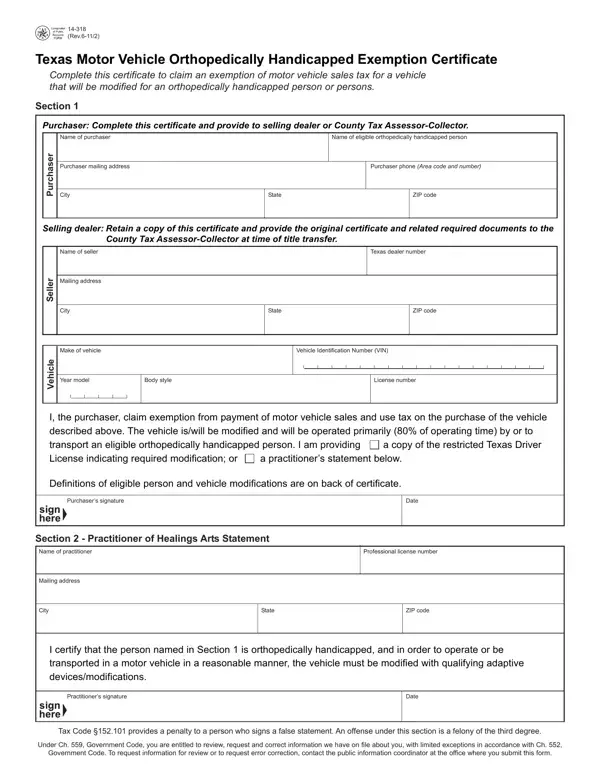
What it is: Form 14-318 (Rev.2-17/3), the Texas Motor Vehicle Orthopedically Handicapped Exemption Certificate, claims an exemption of motor vehicle sales tax for a vehicle that will be modified for an orthopedically handicapped person or persons.
Who signs: The purchaser signs at Purchaser's signature and enters the Date. The purchaser claims the vehicle will be operated primarily (80% of operating time) by or to transport an eligible orthopedically handicapped person, and provides a copy of the restricted Texas Driver License indicating required modification, or a practitioner's statement. For a practitioner's statement, the practitioner signs at Practitioner's signature and enters the Date.
Where and when to file: Purchaser: Complete this certificate and provide to selling dealer or County Tax Assessor-Collector.
Eligible purchasers are individuals, partnerships, corporations or associations who may purchase vehicles under this exemption if the requirements are satisfied.
Form 14-318 (Back)(Rev.2-17/3) An orthopedically handicapped person is an individual who has limited movement of body extremities and/or loss of physical function. The physical impairment must be such that the person is either unable to operate or be transported in a reasonable manner in a motor vehicle that has not been specially modified.
What to bring and attach to Form 14-318
A person claiming this exemption must present to the seller or County Tax Assessor-Collector a properly completed Comptroller Form 14-318, Texas Motor Vehicle Orthopedically Handicapped Exemption Certificate; and a restricted Texas driver license, issued to the qualified orthopedically handicapped person, which requires a modification restriction on the vehicle and verifies that the orthopedically handicapped driver is so physically impaired as to be unable to operate a motor vehicle that has not been modified; or a statement from a licensed practitioner of the healing arts that the qualified orthopedically handicapped person requires adaptive devices and/or modifications necessary to reasonably operate or transport the orthopedically handicapped person.
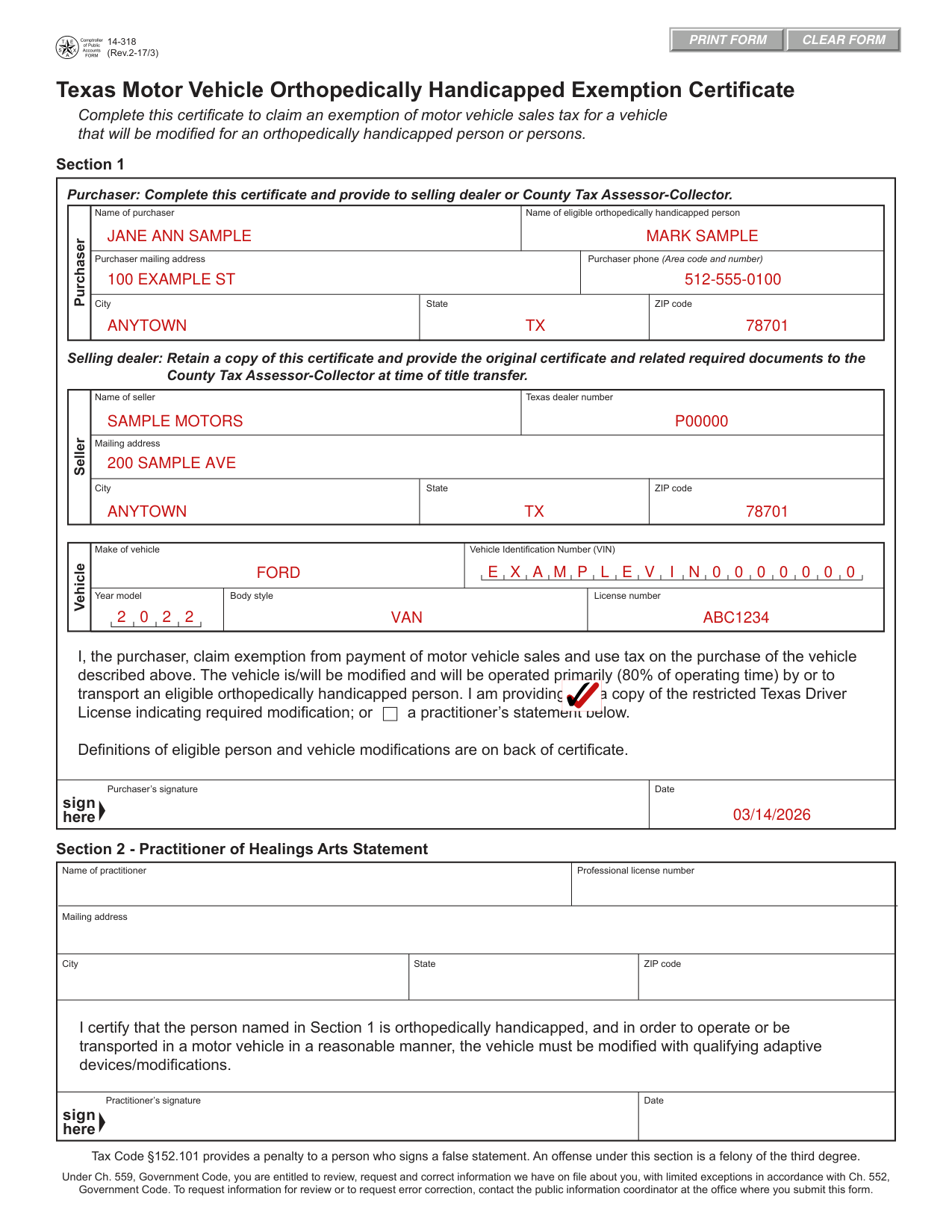
A filled-in Form 14-318 example: a purchaser claims the exemption with a license copy
How to fill out Form 14-318, box by box
Purchaser and eligible person

In Section 1, enter the Name of purchaser, the Name of eligible orthopedically handicapped person, the Purchaser mailing address, the Purchaser phone (Area code and number), and the City, State and ZIP code.
Seller
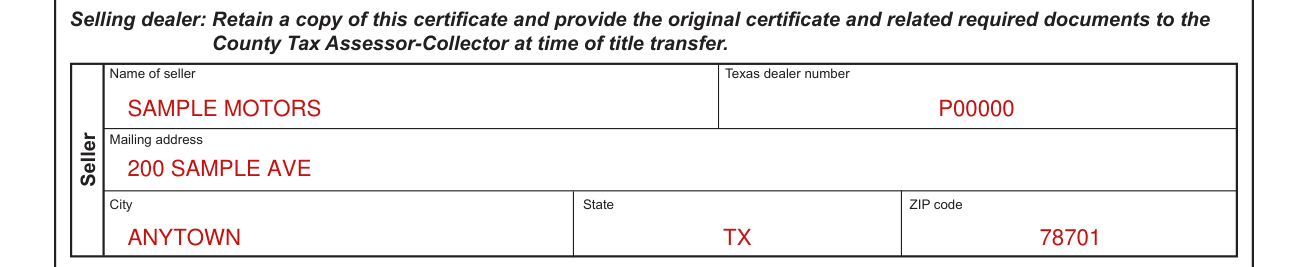
Selling dealer: Retain a copy of this certificate and provide the original certificate and related required documents to the County Tax Assessor-Collector at time of title transfer.
Under Seller, enter the Name of seller and the Texas dealer number, then the Mailing address with City, State and ZIP code.
Vehicle

Under Vehicle, enter the Make of vehicle, the Vehicle Identification Number (VIN), the Year model, the Body style and the License number.
Claim exemption, driver license and signature
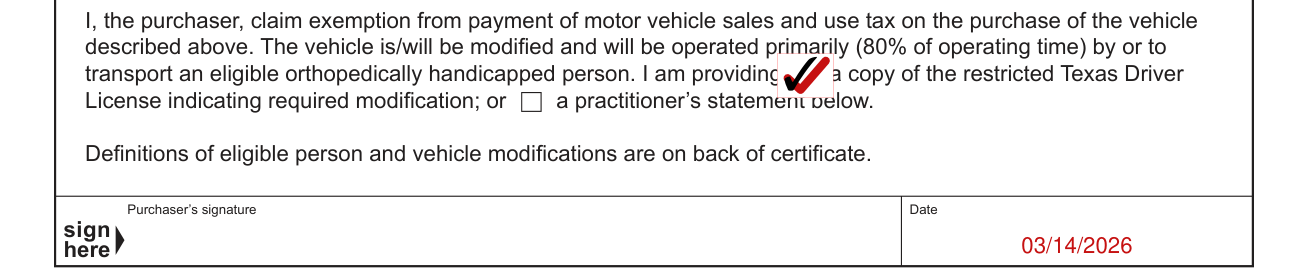
The purchaser claims exemption from payment of motor vehicle sales and use tax on the purchase of the vehicle described. The vehicle is/will be modified and will be operated primarily (80% of operating time) by or to transport an eligible orthopedically handicapped person. The purchaser provides a copy of the restricted Texas Driver License indicating required modification; or a practitioner's statement in Section 2.
Primarily driven by or primarily used for the transportation of an orthopedically handicapped person means that the motor vehicle must be driven by or used for the transportation of an orthopedically handicapped person at least 80 percent of the motor vehicle's operating time.
The purchaser signs at Purchaser's signature and enters the Date.
Section 2 - Practitioner of Healings Arts Statement
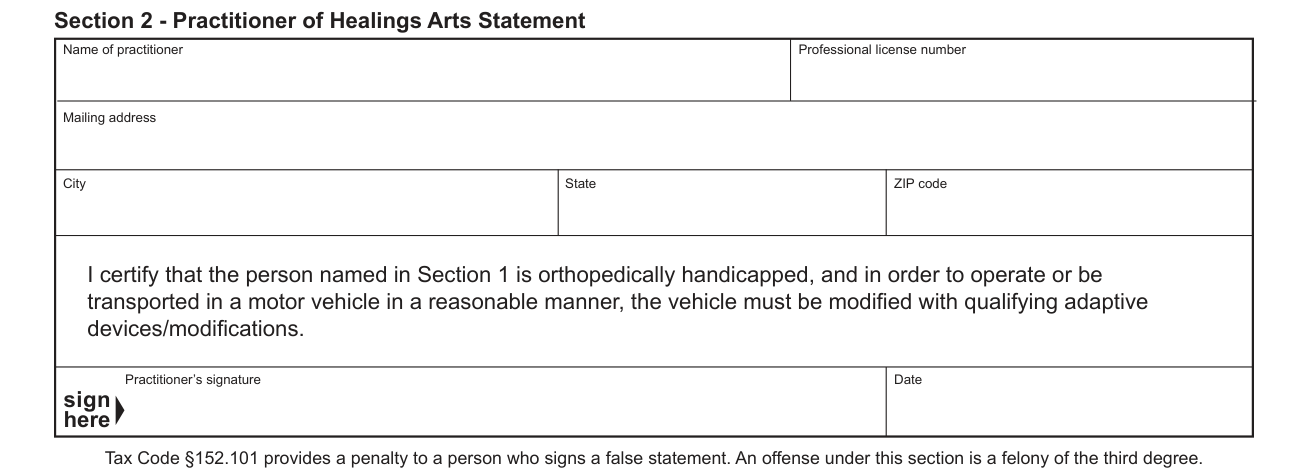
In Section 2 - Practitioner of Healings Arts Statement, enter the Name of practitioner, the Professional license number, the Mailing address, and the City, State and ZIP code.
By signing at Practitioner's signature, the practitioner certifies that the person named in Section 1 is orthopedically handicapped, and in order to operate or be transported in a motor vehicle in a reasonable manner, the vehicle must be modified with qualifying adaptive devices/modifications.
This requirement is satisfied by the practitioner's signature on the Texas Motor Vehicle Orthopedically Handicapped Exemption Certificate.
More rules for Form 14-318
A motor vehicle is exempt from sales and use tax if it has been or will be specifically modified for operation by or for the transportation of a person who is orthopedically handicapped at the time of purchase; and is primarily driven by, or primarily used for the transportation of, an orthopedically handicapped person.
Definitions of eligible person and vehicle modifications are on back of certificate.
If your situation is different
An institution, facility or retirement community
An institution, facility or retirement community is not required to identify a particular eligible orthopedically handicapped person or to provide a practitioner's statement.
The vehicle is modified for operation by the person
A motor vehicle modified for operation by an orthopedically handicapped person is a vehicle that has been permanently modified by altering such items as the conventional brake, acceleration system or steering system to facilitate the operation of the vehicle by an orthopedically handicapped driver.
The vehicle is modified for transportation of the person
A motor vehicle modified for transportation of an orthopedically handicapped person is a vehicle that has been permanently modified by the installation of such items as a wheelchair lift, hoist, attached ramp, wheelchair hold-down clamps, raised roof or special seat restraints other than conventional seat belts to allow for the transportation of an orthopedically handicapped person in a reasonable manner.
Modifications that do not qualify
Common mistake: Modifications that DO NOT qualify a motor vehicle for exemption include, but are not limited to: installation of standard factory options, such as an automatic transmission, power seats, power windows or adjustable pedals; installation of weight-bearing grab bars or handicap assist handles; installation of running boards or steps; installation of steering wheel spinner knobs; installation of nonelectrical carriers designed for bicycles or wheelchairs; installation of standard trailer hitches; or the addition of ramps, including bi-fold ramps, that are not permanently attached to the vehicle.
Common questions about Form 14-318
Where do I file it?
Purchaser: Complete this certificate and provide to selling dealer or County Tax Assessor-Collector.
Is there a penalty?
Tax Code §152.101 provides a penalty to a person who signs a false statement. An offense under this section is a felony of the third degree.
Where to get help with Form 14-318
If you have questions or need additional information, please call (800) 252-1382 or visit the Comptroller's website at www.comptroller.texas.gov.
Sources
[1] Form 14-318, Texas Motor Vehicle Orthopedically Handicapped Exemption Certificate, Texas Comptroller of Public Accounts (the Official source link on this page).