

4-Point Inspection Form at a glance
What it is: This sample 4-Point Inspection Form (Sample Form Insp4pt 03 25) includes the minimum data needed for Underwriting to properly evaluate a property application.
Who signs: To be accepted, all 4-Point Inspection Forms must be completed, signed and dated by a verifiable Florida-licensed inspector.
Examples include a general, residential, or building contractor, a building code inspector and a home inspector.
A trade-specific, licensed professional may sign off only on the inspection form section for their trade, such as an electrician only on the electrical section of the form.
The Florida-licensed inspector is required to certify the condition of the roof, electrical, HVAC and plumbing systems.
What to bring and attach to 4-Point Inspection Form
Photos must accompany each 4-Point Inspection Form.
A filled-in 4-Point Inspection Form example: an inspector completes the form for one house
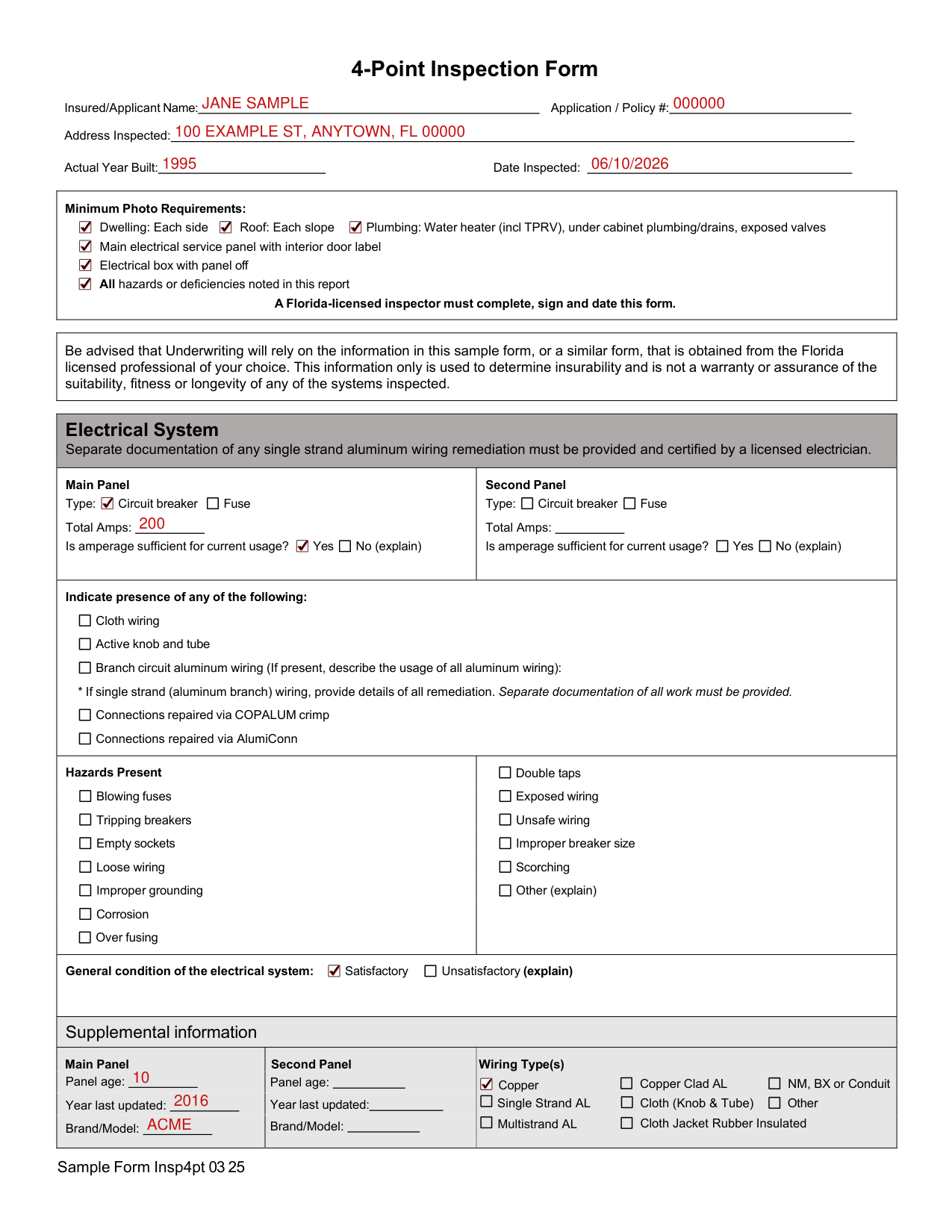
How to fill out 4-Point Inspection Form, box by box
Insured/Applicant Name, Address Inspected, Actual Year Built and Date Inspected

Enter the Insured/Applicant Name, Application / Policy #, Address Inspected, Actual Year Built and Date Inspected.
Minimum Photo Requirements

Check the box for each Minimum Photo Requirements line. Dwelling: Each side. Roof: Each slope. Plumbing: Water heater (incl TPRV), under cabinet plumbing/drains, exposed valves. Main electrical service panel with interior door label. Electrical box with panel off. All hazards or deficiencies noted in this report.
Main Panel and Second Panel: Type, Total Amps and amperage

For the Main Panel and the Second Panel, check Type: Circuit breaker or Fuse. Enter Total Amps. Check Yes or No (explain) for: Is amperage sufficient for current usage?
Indicate presence of any of the following

Indicate presence of any of the following: Cloth wiring, Active knob and tube, Branch circuit aluminum wiring. For Branch circuit aluminum wiring, if present, describe the usage of all aluminum wiring.
If single strand (aluminum branch) wiring, provide details of all remediation, with the boxes Connections repaired via COPALUM crimp and Connections repaired via AlumiConn. Separate documentation of all work must be provided, and separate documentation of any single strand aluminum wiring remediation must be certified by a licensed electrician.
Hazards Present, Double taps to Over fusing
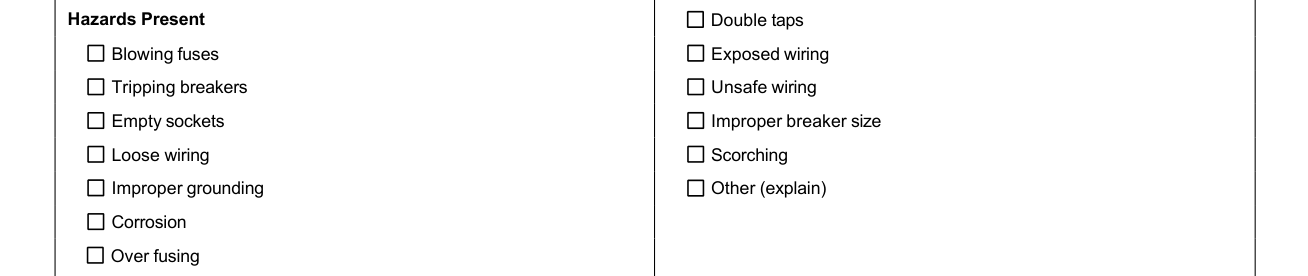
Check the boxes under Hazards Present: Double taps, Blowing fuses, Exposed wiring, Tripping breakers, Unsafe wiring, Empty sockets, Improper breaker size, Loose wiring, Scorching, Improper grounding, Other (explain), Corrosion, Over fusing.
General condition of the electrical system

General condition of the electrical system: check Satisfactory or Unsatisfactory (explain).
Supplemental information: Panel age, Year last updated, Brand/Model and Wiring Type(s)

Enter Panel age, Year last updated and Brand/Model for the Main Panel and the Second Panel under Supplemental information. Check the Wiring Type(s): Copper, Copper Clad AL, NM, BX or Conduit, Single Strand AL, Cloth (Knob & Tube), Other, Multistrand AL, Cloth Jacket Rubber Insulated.
HVAC System: Central AC, Central heat and good working order

On the HVAC System, check Central AC: Yes or No, and Central heat: Yes or No. If not central heat, indicate primary heat source and fuel type. Check Yes or No (explain) for: Are the heating, ventilation and air conditioning systems in good working order? Enter the Date of last HVAC servicing/inspection.
Hazards Present, wood-burning stove to air handler

Check Yes or No under Hazards Present. Is a wood-burning stove or central gas fireplace present? Was it professionally installed? Space heater used as primary heat source? Is the source portable? Does the air handler/condensate line or drain pan show any signs of blockage or leakage, including water damage to the surrounding area?
Supplemental Information, Age of system and Year last updated

Enter the Age of system and Year last updated. Please attach photo(s) of HVAC equipment, including dated manufacturer's plate.
Plumbing System: relief valve, leaks and water heater location

On the Plumbing System, check Yes or No. Is there a temperature pressure relief valve on the water heater? Is there any indication of an active leak? Is there any indication of a prior leak? Enter the Water heater location.
General condition of the following plumbing fixtures and connections to appliances
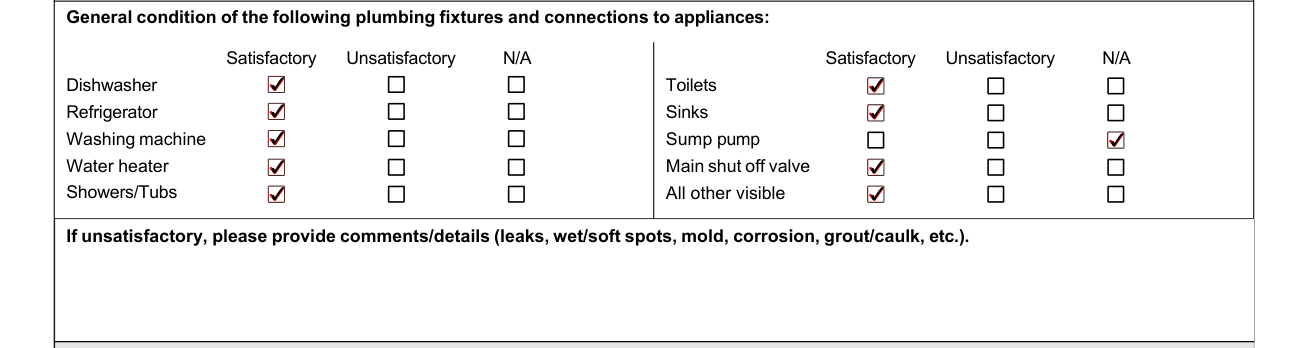
General condition of the following plumbing fixtures and connections to appliances: check Satisfactory, Unsatisfactory or N/A for Dishwasher, Toilets, Refrigerator, Sinks, Washing machine, Sump pump, Water heater, Main shut off valve, Showers/Tubs and All other visible.
If unsatisfactory, please provide comments/details (leaks, wet/soft spots, mold, corrosion, grout/caulk, etc.).
Supplemental Information: Age of Piping Supply System, Age of Piping Drain System and Type of pipes
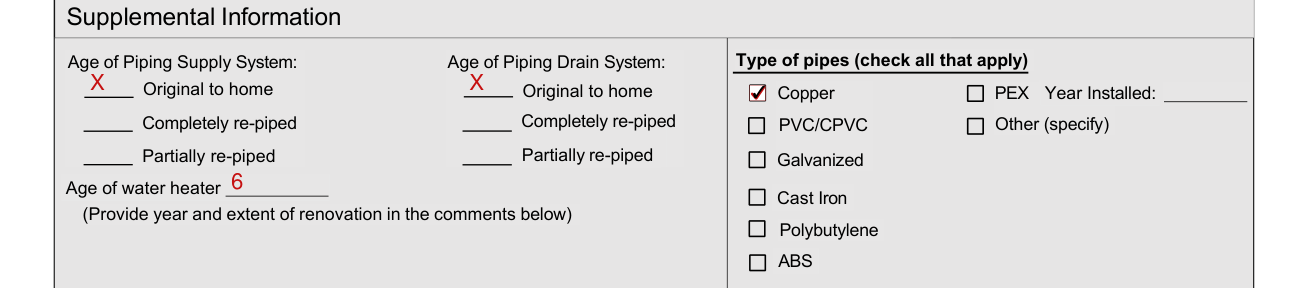
Enter the Age of Piping Supply System and the Age of Piping Drain System, each with Original to home, Completely re-piped or Partially re-piped. Provide year and extent of renovation in the comments. Check the Type of pipes (check all that apply): Copper, PEX, PVC/CPVC, Other (specify), Galvanized, Cast Iron, Polybutylene, ABS. For PEX, enter the Year Installed. Enter the Age of water heater.
Roof: Predominant Roof and Secondary Roof
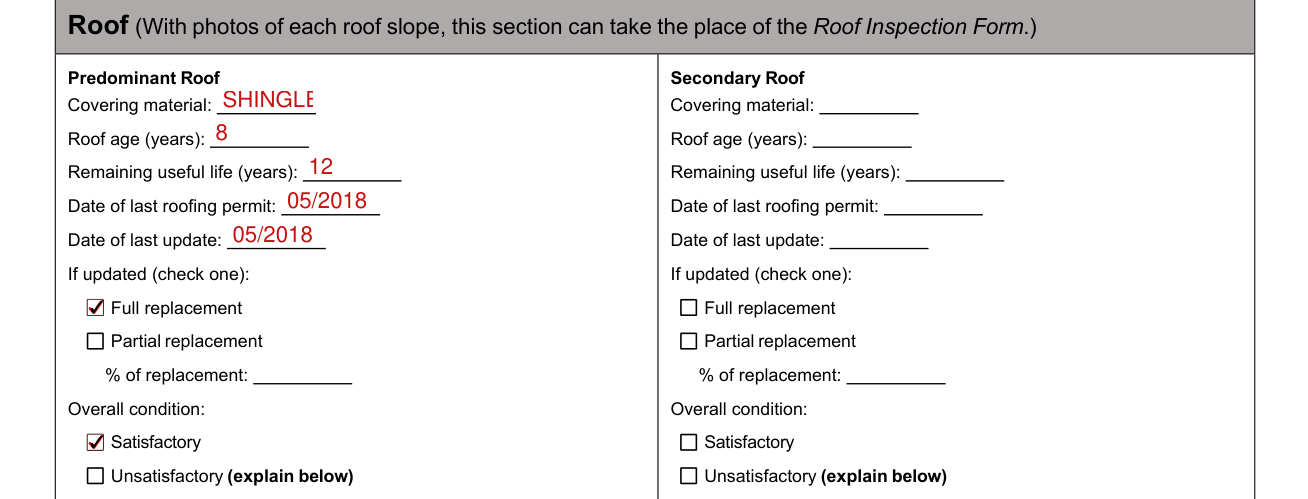
With photos of each roof slope, this section can take the place of the Roof Inspection Form.
For the Predominant Roof and the Secondary Roof, enter Covering material, Roof age (years), Remaining useful life (years), Date of last roofing permit and Date of last update. If updated (check one): Full replacement or Partial replacement, with % of replacement. Overall condition: check Satisfactory or Unsatisfactory (explain in Additional Comments/Observations).
Any visible signs of damage, deterioration and leaks
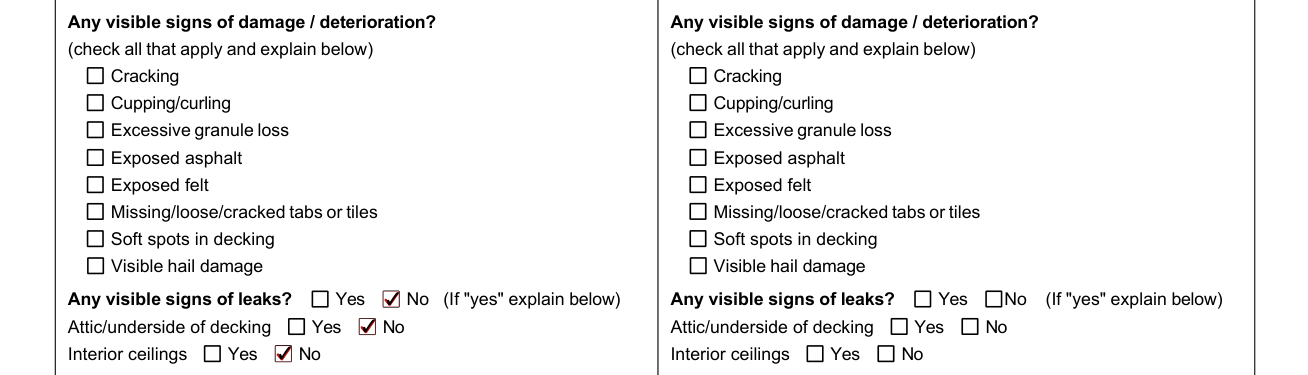
For the Predominant Roof and the Secondary Roof: Any visible signs of damage / deterioration? (check all that apply and explain in Additional Comments/Observations): Cracking, Cupping/curling, Excessive granule loss, Exposed asphalt, Exposed felt, Missing/loose/cracked tabs or tiles, Soft spots in decking, Visible hail damage.
Any visible signs of leaks? Check Yes or No (If "yes" explain in Additional Comments/Observations). Check Yes or No for Attic/underside of decking and for Interior ceilings.
Additional Comments or Observations and the inspector's certification
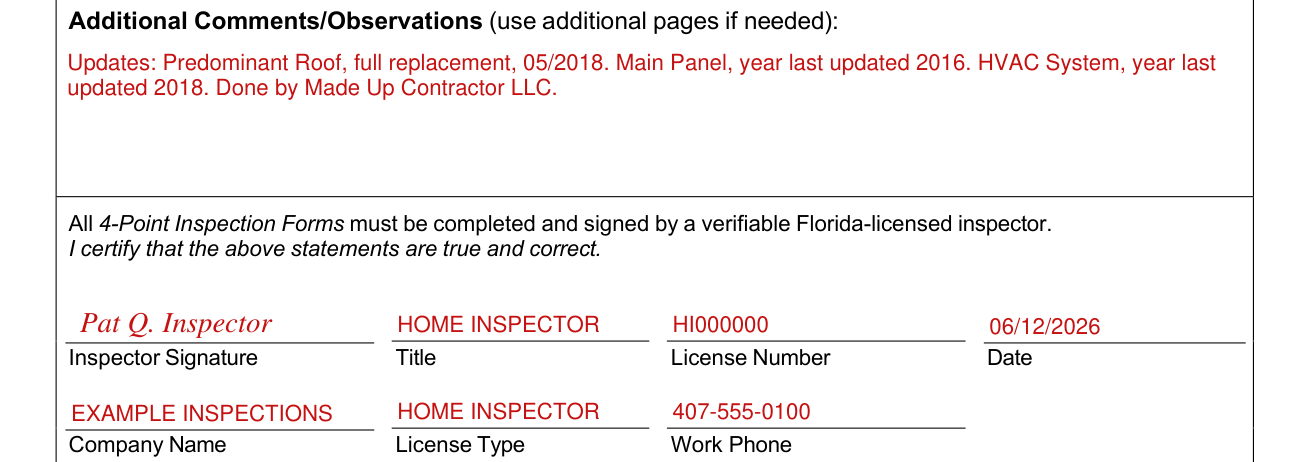
The Additional Comments or Observations section of the 4-Point Inspection Form must be completed with full details/descriptions if any of the following are noted on the inspection: Updates: Identify the types of updates, dates completed and by whom; Any visible hazards or deficiencies; Any system determined not to be in good working order.
Enter Additional Comments/Observations (use additional pages if needed).
Under the certification statement, fill in Inspector Signature, Title, License Number, Date, Company Name, License Type and Work Phone.
More rules for 4-Point Inspection Form
Underwriting will rely on the information in this sample form, or a similar form, that is obtained from the Florida licensed professional of your choice. This information only is used to determine insurability and is not a warranty or assurance of the suitability, fitness or longevity of any of the systems inspected.
Acceptable Condition means that each system is working as intended and there are no visible hazards or deficiencies.
Agents and other inspection reports
You are an agent
The writing agent must review each 4-Point Inspection Form before it is submitted with an application for coverage.
It is the agent's responsibility to ensure that all rules and requirements are met before the application is bound.
Agents may not submit applications for properties with electrical, heating or plumbing systems not in good working order or with existing hazards/deficiencies.
You use any other inspection report
While this specific form is not required, any other inspection report submitted for consideration must include at least this level of detail to be acceptable.
Common questions about 4-Point Inspection Form
Who signs it?
To be accepted, all 4-Point Inspection Forms must be completed, signed and dated by a verifiable Florida-licensed inspector.
Sources
[1] 4-Point Inspection Form (Sample Form Insp4pt 03 25), Citizens Property Insurance Corporation (the Official source link on this page).
