
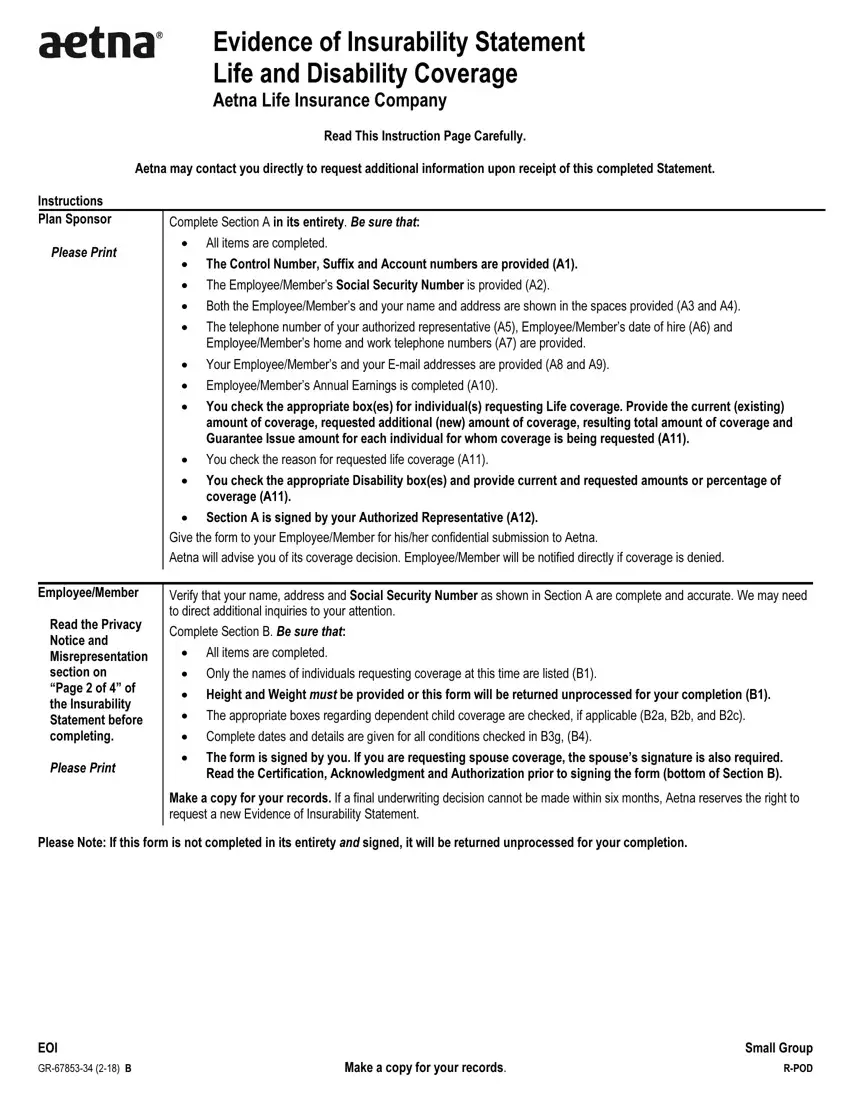
The Aetna EOI form is the primary insurance document for applicants requesting life or disability coverage above the guaranteed-issue limit. It is divided into two parts: Part A for the plan sponsor and Part B for the employee. These sections capture health history, requested coverage amounts, and employment details that Aetna uses to determine coverage eligibility. The form is 8 pages long and typically takes about 20 minutes to complete.
Part A, completed by the plan sponsor or employer, includes the account number, employee Social Security number, and the plan sponsor name and mailing address. Part B, completed by the employee, covers the requested coverage types and amounts. Applicants must specify coverage for basic life, supplemental life, spouse life, children's life, and short-term or long-term disability. The health questionnaire in Part B asks about current diagnoses, prescription medications, recent surgeries, and any conditions diagnosed within the past 10 years. All entries must be complete and accurate.
Employees must submit this form when they apply for coverage amounts that exceed the guaranteed-issue (GI) limit. The GI limit is typically one to two times annual salary for life coverage. Additional submission triggers include:
Some employer plans require EOI for all supplemental coverage requests, regardless of amount. Check your benefits guide or contact your HR department to confirm whether your request requires an EOI submission.
Submitting an EOI form is a legal declaration. By signing, you certify that all health information is accurate and complete. Providing false or incomplete information is grounds for policy rescission. A rescinded policy means Aetna can cancel your coverage from the effective date and deny pending claims. Aetna reserves the right to request additional medical records, an independent medical examination, or written statements from treating physicians before issuing a coverage decision. All information is reviewed against third-party medical databases and records from the past 10 years.
The most frequent errors on this evidence of insurability form include:
If you have a pre-existing condition, disclose it fully. Any condition discovered during underwriting that was not disclosed may result in coverage denial or premium adjustment.
After you submit the completed form, the underwriting team reviews it within 3 to 8 weeks. Aetna may contact you to request additional medical records, a physical examination, or clarification on specific health disclosures. Once the review is complete, Aetna sends a written approval or denial letter. Approved coverage becomes effective from the date specified in the letter. If denied, you may submit an appeal or apply for a lower coverage tier within the guaranteed-issue limit without requiring additional EOI approval.
The guaranteed-issue limit varies by coverage category and employer plan. Basic life insurance plans typically set the GI limit at one to two times your annual salary. Supplemental life coverage requires EOI for amounts above the plan's non-medical maximum, which often ranges from $100,000 to $300,000. Spouse life coverage triggers an EOI requirement when the requested benefit exceeds $25,000 to $50,000. Short-term and long-term disability plans require EOI when the monthly benefit exceeds 60 percent of your pre-disability earnings or the plan's non-medical maximum. Review your Summary Plan Description for the specific threshold that applies to your enrollment. Contact your HR representative if you are unsure whether your request falls above or below the GI limit.
Gathering documentation before you begin reduces errors and speeds up the underwriting review. Collect the following before you open the form:
Aetna may contact your physicians directly to verify the information you provide. Having accurate records reduces the chance of a discrepancy that delays your underwriting review.
All coverage decisions are delivered in writing. An approval letter specifies the effective date, the approved coverage amount, and any exclusions or riders attached to the policy. A denial letter explains the reason for the decision and lists the appeal rights available under your plan. Keep the decision letter with a copy of your EOI submission for your personal records. If you receive a partial approval, you may accept the approved amount or file an appeal to request reconsideration of the original amount.
For related Aetna forms, the Aetna Appeal Form is available if your coverage application is denied. The Aetna Attending Physician Statement allows your treating physician to provide supporting medical documentation for underwriting. For similar coverage through another carrier, the MetLife Evidence of Insurability form follows a comparable process.
| Question | Answer |
|---|---|
| Form Name | Aetna EOI Form |
| Form Length | 8 pages |
| Fillable? | No |
| Fillable fields | 0 |
| Avg. time to fill out | 2 min |
| Other names | aetna life insurance company claimant's statement form, eoi form, aetna insurability life, mortgage disability scotialife employers statement sunlife forms |