
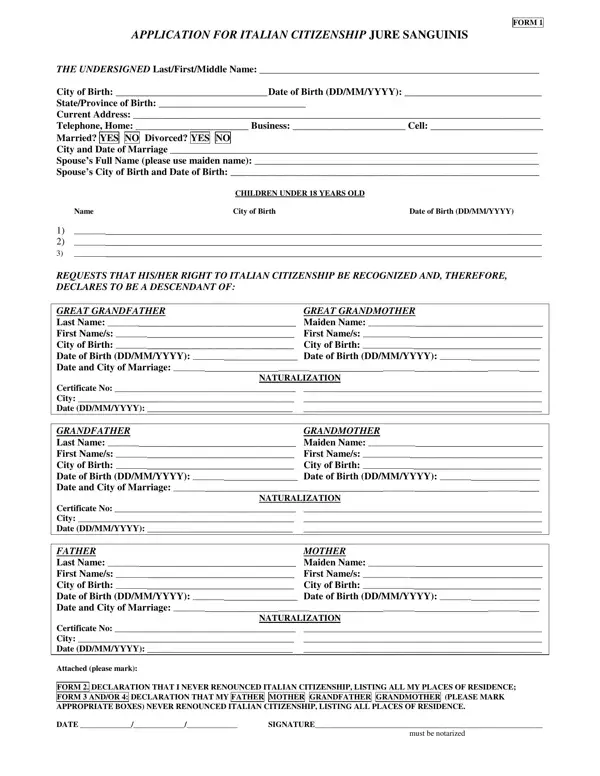
Obtaining Italian citizenship by descent requires careful preparation of several interlinked documents. Form 1 is the primary application. It collects your full name, birthdate, current address, marital status, and details on any children under 18. Most critically, it documents your ancestral chain back to great-grandparents, proving an unbroken line of Italian nationality.
Alongside Form 1, applicants and their Italian-born ancestors must complete companion declarations:
Gathering accurate records across multiple generations takes planning. A genealogy worksheet helps you map each ancestor's full name, birthdate, and birthplace before you begin. Italian vital records may require a certified birth certificate translation before submission. After recognition of your Italian citizenship, you may apply separately for a Certificate of Citizenship (Form N-600) if you hold U.S. permanent residency.
How far back does the lineage need to go? The Italian ancestor must have held Italian citizenship at the time of the next descendant's birth. There is no generational limit, but every link in the chain must be documented.
What if an ancestor naturalized in another country? Naturalization before July 1, 1912 severs the jure sanguinis chain. Naturalization after that date requires careful review of Italian law and may still allow recognition.
Do all forms need notarization? Yes. All declarations on Forms 1, 2, 3, and 4 require a notary's seal or a signature made before a consular officer before submission.
| Question | Answer |
|---|---|
| Form Name | Application Italian Citizenship Form |
| Form Length | 4 pages |
| Fillable? | Yes |
| Fillable fields | 99 |
| Avg. time to fill out | 20 min 48 sec |
| Other names | application for italian citizenship pdf, application italian citizenship, how apply for italian citizenship, dual citizenship italy form |