
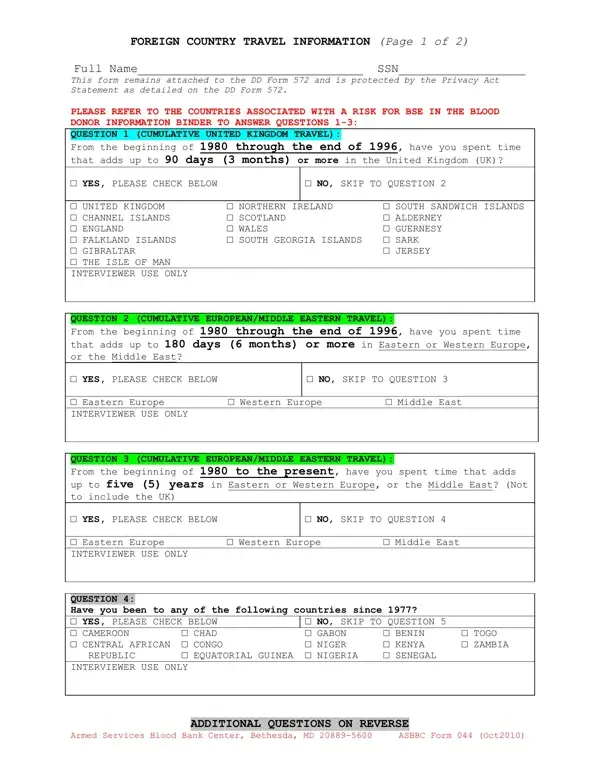
The ASBBC Form 044 is completed by a trained health services interviewer, not the donor alone. The interviewer guides the donor through each section, records answers, and uses checkboxes to document the responses. Below is a step-by-step overview of how to complete the form correctly.
Step-by-Step: Completing the ASBBC Form 044
- Download or obtain the official form. The ASBBC Form 044 PDF is available through the Armed Services Blood Bank Center or through official .mil health services portals. You can also access it here on FormsPal at no cost.
- Enter personal identifiers. Record the donor's full legal name and Social Security Number at the top of the form. This information is protected under the Privacy Act Statement outlined in DD Form 572.
- Complete the United Kingdom travel section. Ask the donor about cumulative time spent in the UK between 1980 and 1996. Record the total number of months. If the combined stay meets or exceeds the deferral threshold, the donor may be ineligible for blood donation.
- Record European travel history. Document any time the donor spent in Eastern or Western Europe during the BSE risk period. Each country and duration should be captured separately.
- Address Middle East and Africa travel. Ask about visits to countries in the Middle East and certain African nations where BSE risk was officially documented. The form provides a checklist of specific countries.
- Document travel to the Republic of Korea. This section asks whether the donor visited Korea and, if so, for how long and in which areas. Extended stays in certain regions may trigger additional health review.
- Review and sign. The interviewer reviews completed responses for consistency, signs the form, and submits it to the blood bank health services team for final eligibility determination.
Understanding the Travel Eligibility Rules
The ASBBC Form 044 focuses on Bovine Spongiform Encephalopathy (BSE), commonly known as "mad cow disease," which belongs to a family of prion diseases that can be transmitted through contaminated blood. Because BSE cannot be safely screened out of donated blood using standard tests, the Armed Services Blood Program relies on donor travel history as the primary screening mechanism.
Donors who spent extended time in high-risk regions during the relevant years are typically deferred from donation. This policy is connected to guidelines issued by the FDA and is applied consistently across all Armed Services Blood Bank Center locations. Being deferred does not mean a donor can never donate; it means their specific travel history does not safely meet current eligibility criteria.
For related military health and screening forms, see the Blank History Records Request and the United Healthcare Military Form.
Frequently Asked Questions About ASBBC Form 044
Who needs to complete the ASBBC Form 044?
Any individual seeking to donate blood through the Armed Services Blood Bank Center must complete this form. It applies to active-duty military personnel, dependents, and civilians served by ASBBC facilities.
What happens if I traveled to the UK before 1996?
UK travel between 1980 and 1996 is a key risk factor the form evaluates. If your cumulative stay in the UK during that period exceeds the official threshold (typically 3 months or more), you may be deferred from donating. The interviewer will explain the next steps based on your specific history.
Is the ASBBC Form 044 the same as DD Form 572?
No. The DD Form 572 is a separate Privacy Act Statement that authorizes the collection of personal health information. The ASBBC Form 044 references DD Form 572 to inform donors that their data is protected under the Privacy Act.
Can I fill out the form online?
The ASBBC Form 044 is not electronically fillable because its official version has 0 fillable fields. However, you can open and review it as a PDF using FormsPal's online viewer, then print and complete it manually with your health services interviewer.
Where can I safely donate blood if I am deferred?
Deferral from the Armed Services Blood Bank Center does not automatically mean deferral from civilian blood banks. Contact the American Red Cross or your local blood center to learn whether your travel history organization officially affects eligibility at their facilities. The criteria may differ.
