
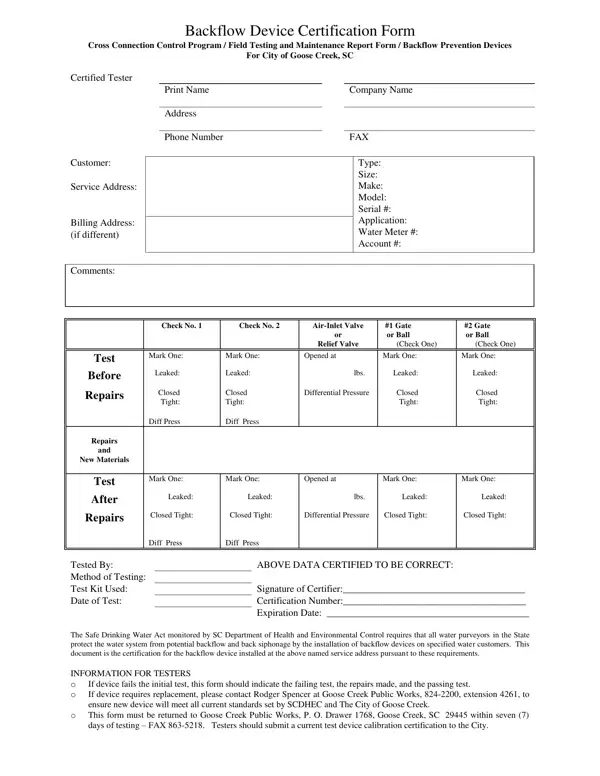
The Backflow Preventer Inspection Form is the official PDF report used to record annual test results for backflow prevention assemblies. Certified testers use it to document device details, field test readings, and any repairs performed, then submit the completed report to the local water authority under the Cross Connection Control Program.
Each form captures the assembly type (reduced pressure zone, double check valve, pressure vacuum breaker, or atmospheric vacuum breaker), manufacturer, model, serial number, and installation address. It also records initial test readings for each component, the reason for any failure, and post-repair readings that confirm the assembly passed after servicing.
Most water utilities require the completed backflow test report to be submitted within a set number of days after testing. Testers must include their current certification number and the calibration date of their test equipment. Failure to submit on time or a device that cannot be repaired may result in service interruption by the water authority.
| Question | Answer |
|---|---|
| Form Name | Backflow Preventer Inspection Form Blank |
| Form Length | 1 pages |
| Fillable? | No |
| Fillable fields | 0 |
| Avg. time to fill out | 15 sec |
| Other names | sc backflow device form, backflow test form, Tester, TESTERS |
| Question | Answer |
|---|---|
| Form Name | Backflow Preventer Inspection Form Blank |
| Form Length | 1 page |
| Fillable? | No |
| Fillable fields | 0 |
| Avg. time to fill out | 15 sec |
| Other names | sc backflow device form, backflow test form, Tester, TESTERS |
Backflow Preventer Inspection Form Blank isn’t the one you’re looking for?