
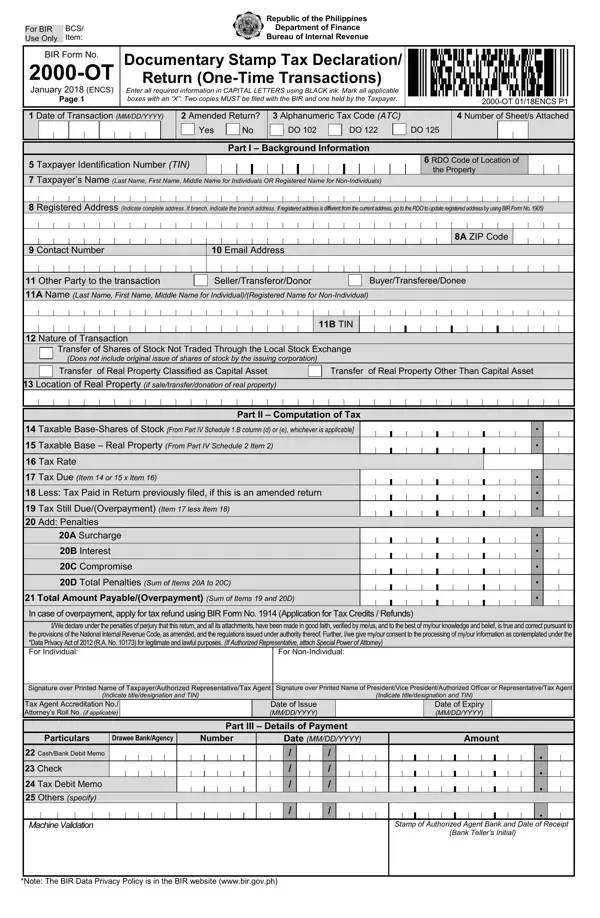
In the dynamic landscape of financial documentation in the Philippines, the BIR Form No. 2000-OT emerges as a pivotal instrument for transactions requiring the declaration and payment of Documentary Stamp Tax for one-time transactions. Issued in January 2018 by the Bureau of Internal Revenue, part of the Department of Finance, this bir form covers a wide range of dealings, from the transfer of shares not traded through the local stock exchange to the conveyance of real property, whether classified as a capital asset or otherwise. The form mandates comprehensive detail, requiring filers to use CAPITAL LETTERS and black ink for clarity. Sections cover background information, computation of tax, and details of payment, with strict instructions to submit two copies to the BIR and retain one for personal records. The declaration under the penalties of perjury underscores the seriousness with which this document must be approached.
Any individual, corporation, partnership, or other juridical person in the Philippines who is a party to a transaction subject to Documentary Stamp Tax on a one-time basis must file the BIR Form 2000-OT. This includes sellers of real property classified as capital assets, transferors of shares of stock not traded through the local stock exchange, and parties to any other transaction covered under the Tax Code that does not require a monthly return. Both natural persons and legal entities are obligated to file this bir form within five days from the close of the month when the taxable document was signed. Agents, administrators, and executors acting on behalf of parties to the transaction may also be required to file on the principal party's behalf.
The BIR Form 2000-OT covers a broad scope of taxable transactions under the National Internal Revenue Code. Real property transfers classified as capital assets are subject to a Documentary Stamp Tax equivalent to fifteen pesos for every one thousand pesos or fractional part of the consideration or fair market value, whichever is higher. Transfers of shares of stock not listed on the local stock exchange are taxed at one peso and fifty centavos per two hundred pesos of par value. Deeds of sale, conveyances, and donations of real property with certificates of title are also covered. When filing this bir form, taxpayers must clearly identify the type of transaction in the appropriate section to ensure accurate tax computation and avoid penalties.
The BIR Form 2000-OT must be filed and the tax paid within five days from the close of the month in which the taxable transaction took place. For example, a transaction completed in June must be reported using this bir form by July 5. Payment of the Documentary Stamp Tax must be made to any Authorized Agent Bank (AAB) accredited by the Bureau of Internal Revenue. In areas without an AAB, payment may be made directly to the Revenue Collection Officer at the Revenue District Office. Taxpayers must submit two copies of the completed form to the BIR and retain one copy for their records. Late filing or failure to pay results in a surcharge of 25 percent of the tax due, plus interest of 12 percent per annum, and a compromise penalty based on the amount of tax.
When submitting the BIR Form 2000-OT, taxpayers must prepare supporting documents that vary by transaction type. For real property transfers classified as capital assets, typical requirements include a notarized Deed of Absolute Sale, a copy of the Transfer Certificate of Title (TCT) or Condominium Certificate of Title (CCT), a Tax Declaration for the property, and proof of payment of Capital Gains Tax using BIR Form 1706. For transfers of shares of stock not traded on the exchange, a notarized Deed of Assignment and stock certificates are generally required. All documents must accurately reflect the details entered on the bir form 2000ot. Keeping certified true copies of all submitted documents is strongly recommended for future reference and tax compliance audits.
A full understanding of the BIR Form 2000-OT is easier when you are also familiar with related Bureau of Internal Revenue forms. The BIR Form 1701 covers the Annual Income Tax Return for individuals, including those with mixed income from employment and business. The BIR Form 2307 is the Certificate of Creditable Tax Withheld at Source, commonly attached in property sale transactions. The BIR Form 2306 serves as the Certificate of Final Tax Withheld at Source. For payment of internal revenue taxes not requiring a separate return, the BIR Form 0605 functions as the Payment Form. Reviewing these related bir forms helps ensure full compliance with BIR requirements for every transaction type.
| Question | Answer |
|---|---|
| Form Name | Bir Form 2000Ot |
| Form Length | 2 pages |
| Fillable? | No |
| Fillable fields | 0 |
| Avg. time to fill out | 30 sec |
| Filing Deadline | Within 5 days from close of the month of the transaction |
| Issued by | Bureau of Internal Revenue (BIR), Philippines |
| Applicable Tax | Documentary Stamp Tax (DST) for one-time transactions |
| Copies Required | 2 copies to BIR, 1 copy retained by taxpayer |
| Other names | bir form 2000, 2000 ot, 2000 ot bir form, form bir 2000 |