

Partner's Business Assets & LLC Units Purchase Agreement at a glance
What it is: Partner's Business Assets & LLC Units Purchase Agreement: sample document to offer a buyout of a partner in an LLC, buying out the business and its assets (with certain exclusions if necessary).
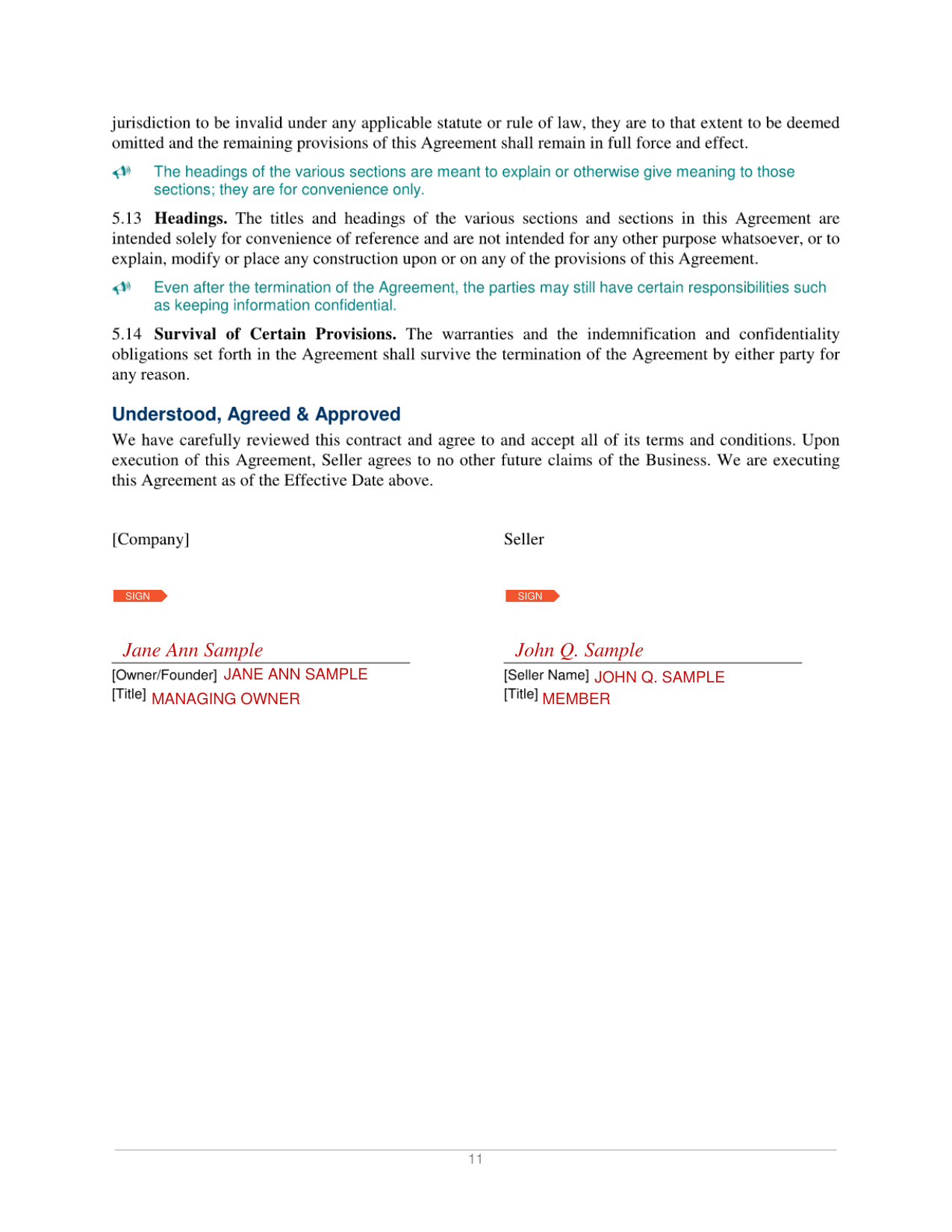
Who signs: Under Understood, Agreed & Approved, [Company] and Seller each sign, with [Owner/Founder] and [Seller Name] and the [Title] of each.
A filled-in Partner's Business Assets & LLC Units Purchase Agreement example: an owner signs the agreement
How to fill out Partner's Business Assets & LLC Units Purchase Agreement, box by box
Effective Date

Enter the Effective Date [Date].
Section 3 merely states that the Seller is transferring and the Buyer is acquiring the assets, liabilities, and products, of the business as of the closing date (the date the transaction becomes final). The closing date may or may not be the date of this Agreement. Generally, it will be a few days or weeks following the date of this Agreement.
The parties
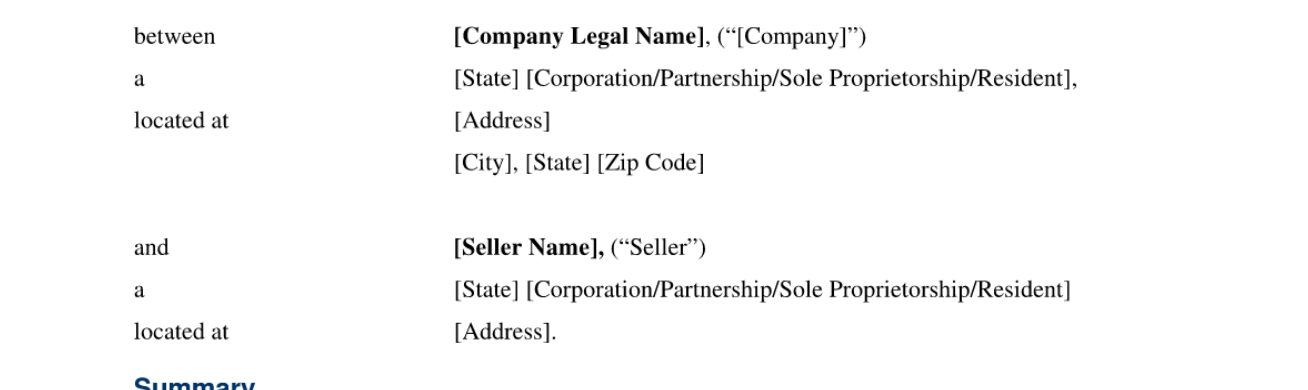
This introductory paragraph lists the date and the parties to this Agreement.
Enter between [Company Legal Name], a [State] [Corporation/Partnership/Sole Proprietorship/Resident], located at [Address], [City], [State] [Zip Code], and [Seller Name], a [State] [Corporation/Partnership/Sole Proprietorship/Resident] located at [Address].
Section 2 identifies all of the principals of the business. If the business is a corporation, then all of the individual shareholders should be listed. If it is a partnership, then all of the individual partners should be listed. If it is a sole proprietorship, then the owner should be listed.
The Managing Owners are [Owner/Founder] and [Seller], residents of [State]. Current existing Member Owners of the Business are listed on Exhibit A.
In Section 3, [Company] under the management of [Owner/Founder] desires to acquire 100% interest of Seller's [number] Class A Units of the Business, its Products, properties, and assets, given the terms and conditions described in this Agreement, as of the Effective Date.
Understood, Agreed & Approved

Under Understood, Agreed & Approved, [Company] and Seller each sign, with [Owner/Founder] and [Seller Name] and the [Title] of each.
Upon execution of this Agreement, Seller agrees to no other future claims of the Business.
More rules for Partner's Business Assets & LLC Units Purchase Agreement
This Agreement Is Not Legal Advice. Read it Thoroughly and Make All Appropriate Changes to Fit Your Requirements.
You Should Have this Agreement Reviewed and Approved by a Qualified Attorney at Law Before Using It.
To make sure your have filled in all the variables, use Word's function to locate any [ ] which may contain an unedited variable.
If your situation is different
Date, To, From and Company
Enter the Date, To: Name of Seller, From: Owner/Founder and the Company.
Please read the agreement carefully.
Please sign and return it to me asap.
Exhibit A to Exhibit G
Exhibit A: Current Existing Member Owners of the Business.
Exhibit B: Compensation.
Exhibit C: Product, Inventory, Supplies & Equity.
Exhibit D: Accounts Receivable. Exhibit D should include a thorough listing of any accounts receivable that are being transferred.
Exhibit E: Certain Assets of the Business. Exhibit E should include a thorough listing of all of the machinery and equipment being transferred.
Exhibit F: Current Agreements. All rights under the contracts, leases, licenses, insurance policies, fidelity and contract bonds, and other Agreements relating to the Business, as listed in Exhibit F.
Exhibit G: Promissory Note.
Purchase of Assets, LLC Units & Assumption of Intellectual Property Rights
Section 1.1.1 is a standard section that merely states that the Seller will sell and the Buyer will buy the assets identified in the following sections.
In a few cases an addendum should be completed so as to identify the particular assets in more detail.
Section 1.1.10: All other property and assets of every kind and description whether personal, real, mixed, tangible or intangible, wherever located and whether or not reflected on its balance sheet. The Seller may want to omit this section so that the Buyer cannot later claim that there were certain assets of the business that he never received despite the fact that they were not specifically included in this Agreement. By deleting this section, the burden is on the Buyer to list all of the assets that are being transferred to him. By leaving this section intact, the burden is on the Seller to list any of the assets not being transferred.
Assets Excluded
Sections 1.2 through 1.2.8 should be given great care, and give an opportunity to exclude specific assets.
In the event that the Seller does not wish to exclude one or more of the assets, merely delete that section from the Agreement. If an item is deleted, however, the Buyer may wish to specifically include the asset in Section 1.1 as an asset being transferred.
In general, 60 days is appropriate for retaining accounts receivable, though the Seller may want to use a different number of days depending on the usual course of business.
Infringement
Each party will notify the other of any infringements of rights in the Products, Trade Names, Trademarks that come to either party's attention.
If [Company] declines in writing to bring any such action, the Seller may proceed and will pay for all expenses of the action, and may recover its expenses from any sums recovered in the action.
Non-Disclosure Agreement
Section 3 is a standard Non-Disclosure Agreement whereby both the Buyer and the Seller agree that any confidential information disclosed to the other is the property of the disclosing party and must not be disclosed to third parties.
The exception to this is when the information becomes available to the general public. [Company] has disclosed to the Seller concerning confidential know-how, financial information, product costs, pricing structure, and trade secrets as was necessary to further the purposes of this Agreement.
Covenant Not to Compete
Seller agrees to avoid any act that would directly or indirectly compete with the Business and to avoid contact with existing buyers, retailers and vendors associated with the Business for a period of (1) year, unless there was a pre-existing relationship established prior to [Date / Year].
Default; Termination
Default; Termination: 4.1 addresses as to when the Buyer is in material breach. 4.2 addresses when the Seller is in material breach.
Section 5.2: In the event of a Material Breach by the Seller of a material provision of this Agreement, which breach is not cured within sixty (60) days after written notice of such breach is delivered to the Seller by the Buyer, then the Buyer may, effective sixty (60) days after such notice to the Seller, terminate this Agreement.
In the event that the Seller is in material breach, the Buyer has the right to put any amount due to the Seller into an escrow account pending resolution of legal action.
Assuming there is arbitration, you should insert the county and state where you want the arbitration to take place.
5.14 Survival of Certain Provisions. After the termination of the Agreement, the parties may still have certain responsibilities such as keeping information confidential. The warranties and the indemnification and confidentiality obligations set forth in the Agreement shall survive the termination of the Agreement by either party for any reason.
General Provisions
General Provisions: The General Provisions that follow are fairly standard. These provisions enhance the balance of the Agreement by explaining issues such as notice, assignment, legal remedies, waiver, and attorney fees.
You must decide which state governs this Agreement and where any legal action would be taken. Generally, it is your (company's) state of residence.
Assuming the parties wish to use Arbitration in the event of a dispute, the following section should be included. Any dispute relating to the interpretation or performance of this Agreement shall be resolved at the request of either party through binding arbitration.
Any changes to this Agreement must be in writing and signed by the party against whom that writing is to be used.
Common questions about Partner's Business Assets & LLC Units Purchase Agreement
What is a buyout agreement?
Partner's Business Assets & LLC Units Purchase Agreement: sample document to offer a buyout of a partner in an LLC, buying out the business and its assets (with certain exclusions if necessary). Any intellectual property or other rights currently not in the Business, but belonging in the Business are also being transferred or conveyed to [Company] with the Business.
When is this form not the right one?
See also, Business Assets Purchase Agreement: this is when you buy just the assets of the business, but not the business itself.
Sources
[1] Partner's Business Assets & LLC Units Purchase Agreement, sample document (the Official source link on this page).
