
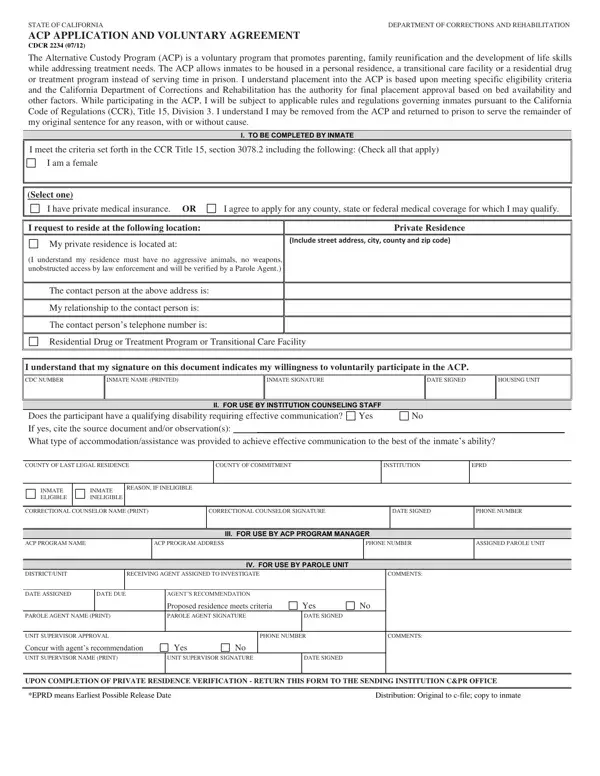
The California Alternative Custody Program (ACP) gives eligible inmates the chance to serve their sentences outside of prison. The CDCR administers the program through Form CDCR 2234, the official ACP Application and Voluntary Agreement. This form outlines the conditions under which inmates may qualify and participate in the program.
Eligibility is based on California Code of Regulations, Title 15, Section 3078.2. Applicants must meet specific criteria before the CDCR will consider their placement.
The ACP places approved participants in one of three types of settings outside traditional prison facilities.
The California Department of Corrections and Rehabilitation reviews each application. All final placement decisions rest with the CDCR. No placement is guaranteed until the CDCR grants formal approval.
ACP participants must follow the rules set by CDCR throughout their placement. These rules apply to all inmates in the program, regardless of their residential setting. Violating the rules results in removal from the program. The participant then returns to prison and must complete the remainder of their original sentence. The program does not reduce the total sentence length. It only changes where the sentence is served.
The ACP was created to meet three core goals. First, it supports family reunification by allowing primary caregivers to live with or near their children. Second, it helps participants develop life skills that improve their chances of successful reintegration. Third, it addresses treatment needs through placement in rehabilitation programs. These goals benefit both participants and the broader community by reducing the risk of reoffending after release.
| Question | Answer |
|---|---|
| Form Name | California Alternative Custody Form |
| Form Length | 1 pages |
| Fillable? | No |
| Fillable fields | 0 |
| Avg. time to fill out | 15 sec |
| Other names | alternative custody programs in california, california alternative custody, cdcr acp, acp program california 2021 |
California Alternative Custody Form isn’t the one you’re looking for?