
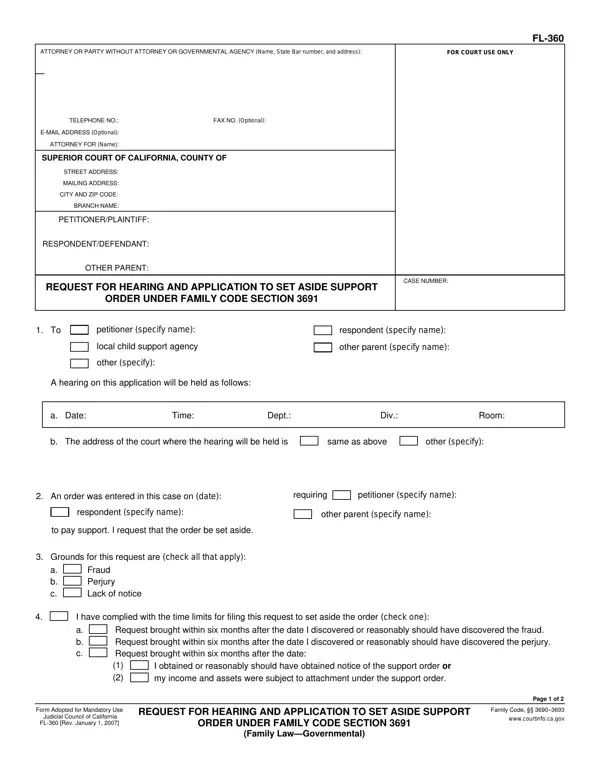
The FL-360 form, officially titled "Request for Hearing and Application to Set Aside Support Order under Family Code Section 3691," is a mandatory Judicial Council of California form used in family law proceedings. It allows a party to formally request a court hearing to challenge and potentially overturn a previously entered support order.
Grounds for setting aside a support order under the FL-360 include fraud, perjury, false documentation, lack of notice to the affected party, and duress. A request may also be made when the opposing party provided inaccurate income information at the time the original order was made. Each ground must be described clearly in the form and supported by factual statements declared under penalty of perjury.
Filing deadlines are strict. Under Family Code Section 3691, a party must file the request within six months of the date they knew or reasonably should have known about the support order. Courts generally deny requests filed after this deadline. Submitting the FL-360 promptly after discovering a valid ground is critical to preserving your right to challenge the order.
Required information on the form includes the full names and legal roles of all parties, the case number assigned by the court, and the name and address of the court handling the case. The form also asks for the proposed hearing date and time, and a clear statement of the specific legal ground supporting the request. A separate section confirms that the filing complies with the applicable time limits under the family code.
After filing the FL-360, the court schedules a hearing and the other party must receive proper service of the completed form before that date. If the court grants the request, the original support order may be set aside and the case reopened for new proceedings. Parties with disabilities may request reasonable accommodations from the court before the hearing date.
Those going through this process often need to file supporting documents along with the FL-360. Common companion forms include the Income and Expense Declaration (FL-150), which documents each party's current financial situation, and California Form FL-301. You can also find additional California family law forms such as Form FL-600 and Form FL-311 on FormsPal.
| Question | Answer |
|---|---|
| Form Name | California Form Fl 360 |
| Form Length | 2 pages |
| Fillable? | No |
| Fillable fields | 0 |
| Avg. time to fill out | 30 sec |
| Other names | hearing application set, application set aside order, ca fl 360, fl360 form |
California Form Fl 360 isn’t the one you’re looking for?