
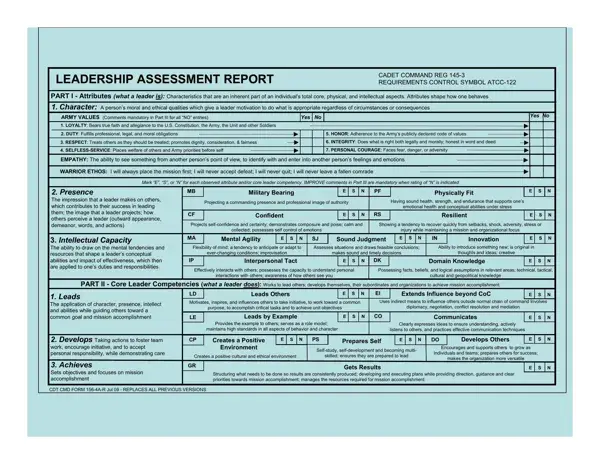

Cdt Cmd Form 156 at a glance
What it is: The Leadership Assessment Report, Cadet Command Reg 145-3, Requirements Control Symbol ATCC-122.
Who signs: The rated cadet signs on the Rated Cadet Signature line (SIGN). The assessor fills in Assessor Name / Initials (SIGN) and marks CADRE or CADET.
A filled-in Cdt Cmd Form 156 example: a cadre assessor rates a cadet
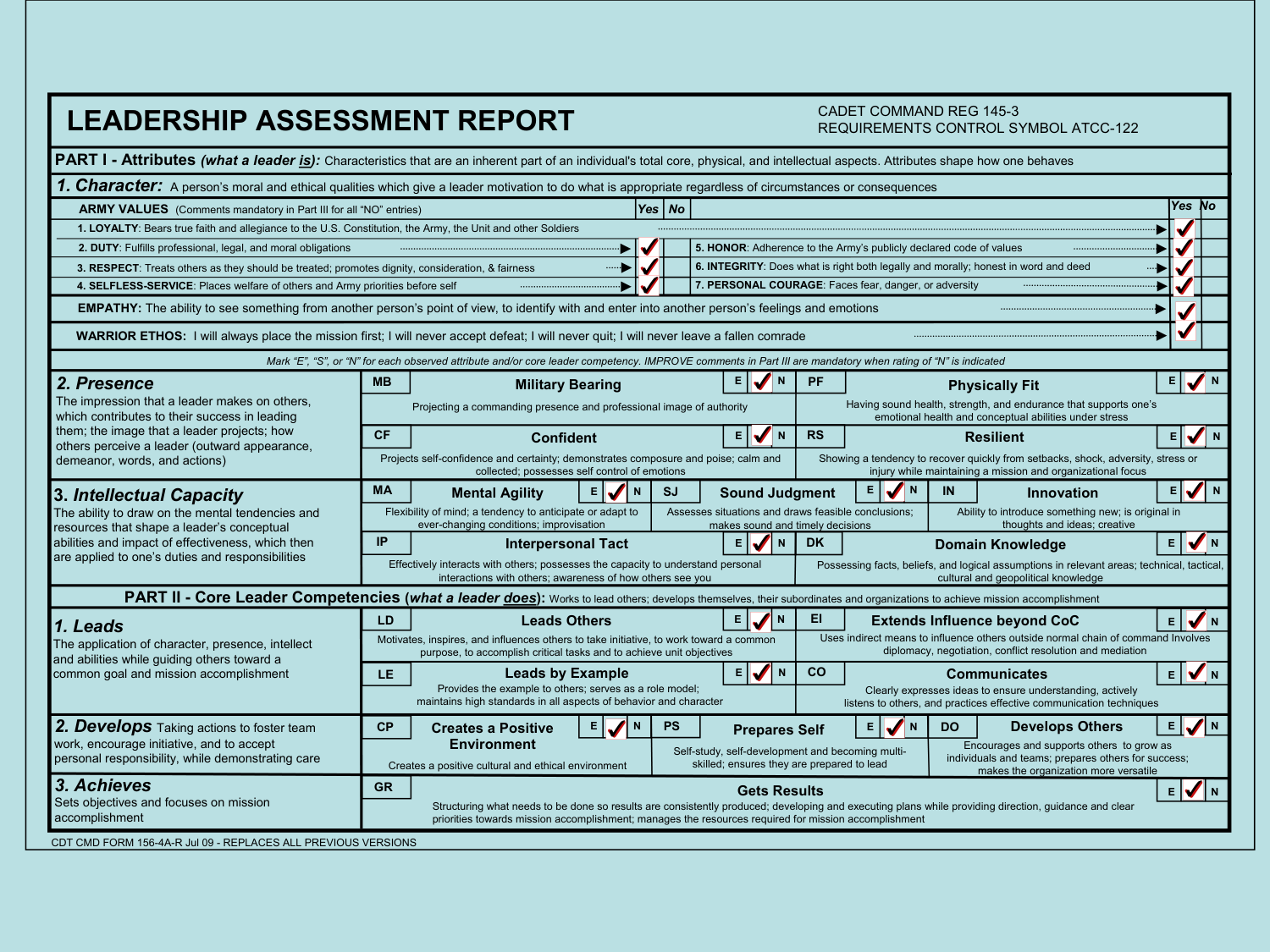
How to fill out Cdt Cmd Form 156, box by box
Army values: Yes or No

For each Army value mark Yes or No. Comments are mandatory in Part III for all “NO” entries.
The Army values are 1. Loyalty, 2. Duty, 3. Respect, 4. Selfless-Service, 5. Honor, 6. Integrity and 7. Personal Courage.
Empathy is the ability to see something from another person's point of view, to identify with and enter into another person's feelings and emotions.
Warrior Ethos: I will always place the mission first; I will never accept defeat; I will never quit; I will never leave a fallen comrade.
Parts I and II: mark E, S or N
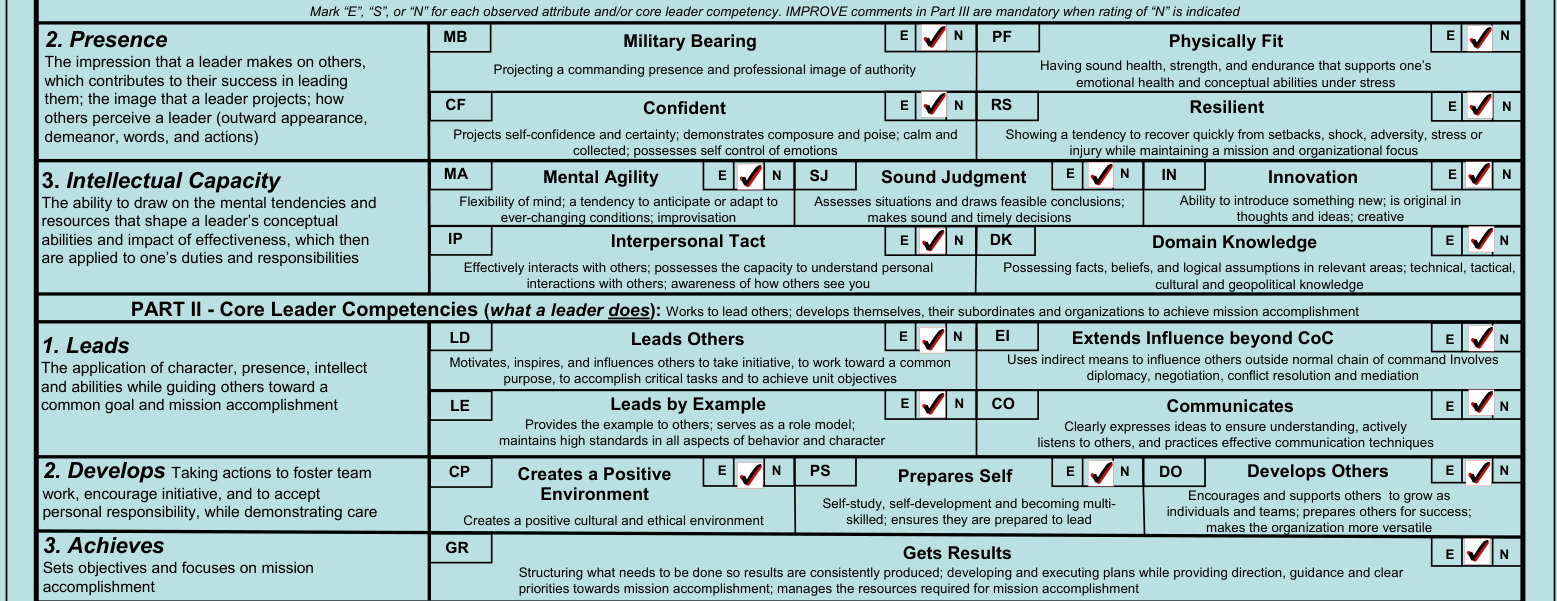
Mark “E”, “S”, or “N” for each observed attribute and/or core leader competency. IMPROVE comments in Part III are mandatory when rating of “N” is indicated.
Part I, Attributes (what a leader is): characteristics that are an inherent part of an individual's total core, physical, and intellectual aspects.
Part I: 1. Character, 2. Presence, 3. Intellectual Capacity.
Part I: Military Bearing, Physically Fit, Confident, Resilient, Mental Agility, Sound Judgment, Innovation, Interpersonal Tact, Domain Knowledge.
Part II, Core Leader Competencies (what a leader does), works to lead others and develops themselves, their subordinates and organizations to achieve mission accomplishment.
Part II: 1. Leads, 2. Develops, 3. Achieves.
Part II: Leads Others, Extends Influence beyond CoC, Leads by Example, Communicates, Creates a Positive Environment, Prepares Self, Develops Others, Gets Results.
Part III: observations and counseling
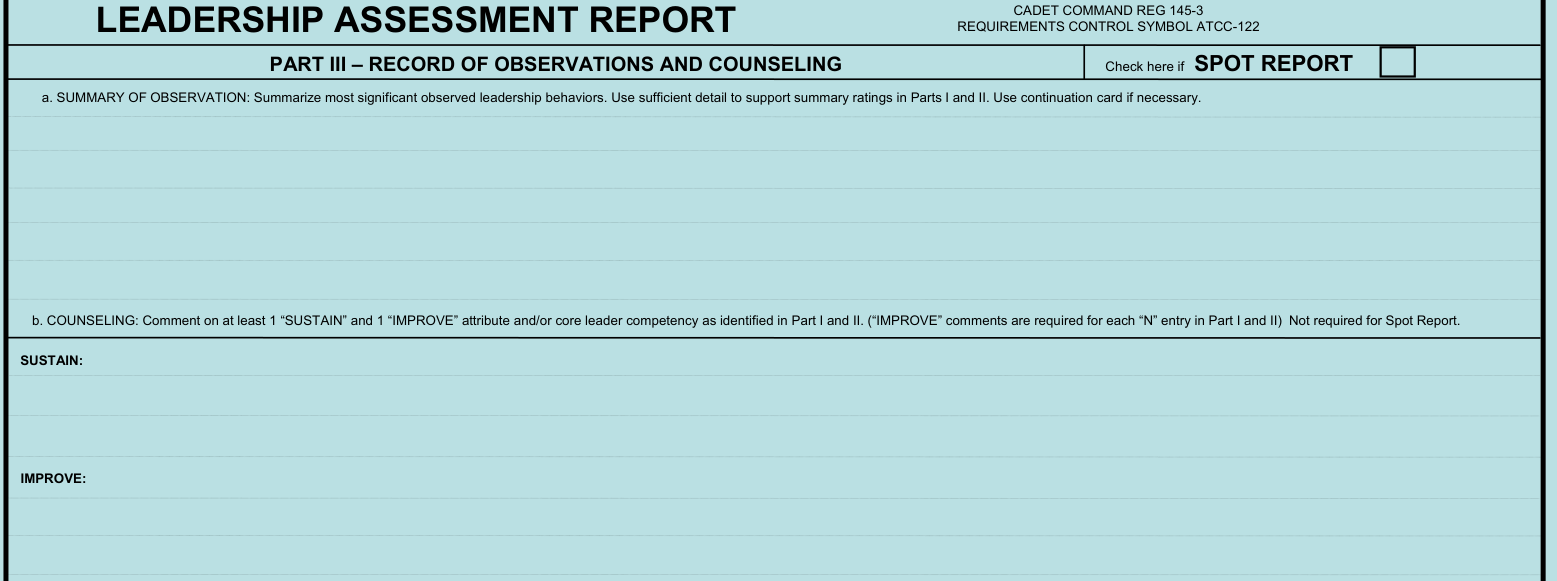
Check here if SPOT REPORT.
In a. SUMMARY OF OBSERVATION, summarize most significant observed leadership behaviors. Use sufficient detail to support summary ratings in Parts I and II. Use continuation card if necessary.
In b. COUNSELING, comment on at least 1 “SUSTAIN” and 1 “IMPROVE” attribute and/or core leader competency as identified in Part I and II. “IMPROVE” comments are required for each “N” entry in Part I and II. Counseling is not required for Spot Report.
Part IV: overall net assessment

In PART IV - OVERALL NET ASSESSMENT, circle one of E, S or N.
Rated cadet and signature

Fill in Rated Cadet Name, Unit, Duty Position (Location if Spot Report) and Date.
Signature indicates that counseling was administered as reflected in Part 1b above, and does not imply agreement with ratings.
Sources
[1] Cdt Cmd Form 156 (CDT CMD FORM 156-4A-R), Leadership Assessment Report, Cadet Command (the Official source link on this page).