
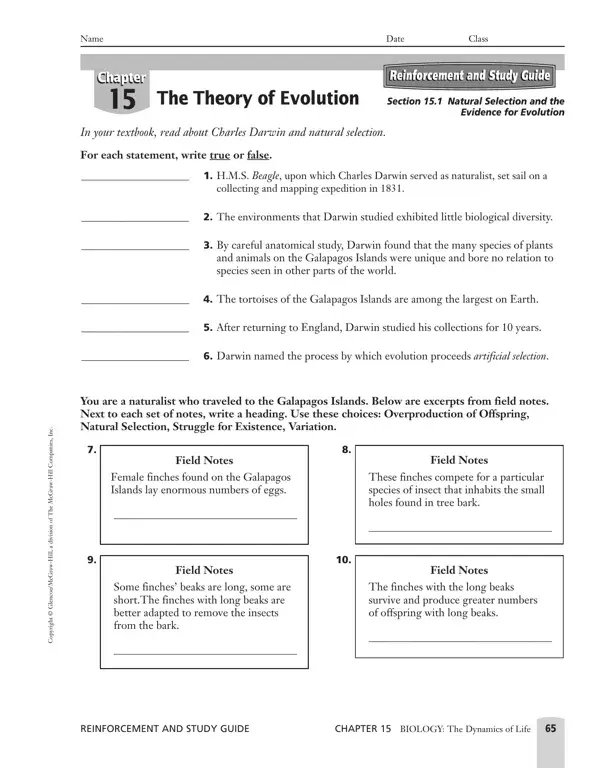
This two-page biology form tests student understanding of natural selection, Darwin's voyage, structural adaptation types, and the main categories of evidence for evolutionary theory. Students work through true/false questions, field note exercises, and an evidence chart drawn from Section 15.1 of a standard high school biology textbook.
Section 15.1 focuses on natural selection as the main driver of evolution. The worksheet opens with true/false statements about species diversity and the Galapagos Islands. A field notes section asks students to sort Darwin's observations into three groups: overproduction of offspring, variation among individuals, and the struggle for existence. Students also compare natural selection to artificial selection used in domestic animal breeding.
Part of this evolution worksheet covers two structural adaptation types. Camouflage lets an organism blend into its background, making detection by predators harder. Mimicry lets one species copy the colors or shape of another species for protection. Students match each adaptation to its correct definition and explain how selective pressure spreads these traits through a population over time.
The evidence chart organizes biological findings into three groups. Comparative anatomy covers homologous structures (like bat wings, human arms, and whale flippers, which share the same bone layout) and analogous structures (like butterfly wings and bird wings, which do the same job but came from different origins). Embryological evidence shows that vertebrate embryos from different species look very similar in early stages. Genetic comparisons use DNA to trace shared ancestry. Vestigial structures, such as the human tailbone, are also included as evidence that species share common ancestors.
Darwin began his voyage on the HMS Beagle in 1831. He spent five years collecting specimens in South America, the Galapagos Islands, and the Pacific. He noticed that Galapagos finches had different beak shapes on each island, matching local food sources. After returning to England in 1836, he spent more than 20 years reviewing his data. He published 'On the Origin of Species' in 1859. The worksheet asks students to trace this timeline and tell apart Darwin's field notes from the formal theory he built over two decades.
Looking for related biology PDF resources? Try the Animal and Plant Cells Worksheet, the Non-Mendelian Genetics PDF form, or the Regents Biology Lab Food Chains worksheet on FormsPal.
| Question | Answer |
|---|---|
| Form Name | Chapter 15 Theory Of Evolution Worksheet Form |
| Form Length | 2 pages |
| Fillable? | No |
| Fillable fields | 0 |
| Avg. time to fill out | 30 sec |
| Other names | chapter 15 the theory of evolution worksheet answer key, reinforcement evolution answer key, the theory of evolution reinforcement and study guide answers, the theory of evolution worksheet chapter 15 answers |