
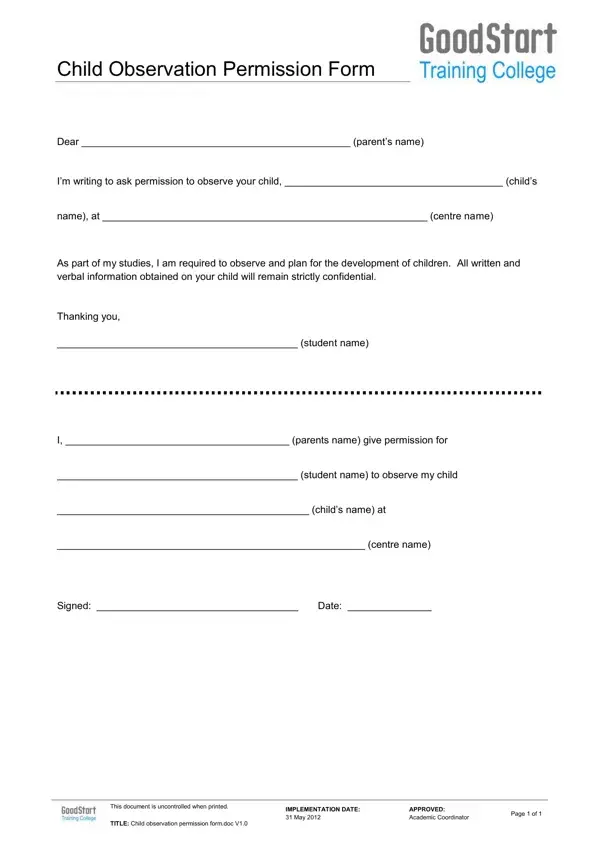
Child Observation forms serve as essential tools for students pursuing studies in child development, educators, and childcare professionals who need to observe and assess the development and behavior of children in various settings, such as schools or childcare centers. They are meticulously designed to solicit the permission of a child's parent or guardian, ensuring that the observation process adheres to ethical standards and protective privacy measures. These forms typically include sections for the observer's name and affiliation, the child's name, the context of the observation (such as the specific center or environment), and explicit consent from the parent or guardian. This formal acknowledgment of consent is crucial for maintaining trust and confidentiality between families and observers. The Child Observation Permission Form, as an example, explicitly lists these components and mandates signatures and dates to validate the agreement. It emphasizes the confidential handling of all observations and information derived from the process, assuring parents and guardians that their child's privacy and dignity are priorities. Furthermore, the document notes its status as uncontrolled when printed, indicating the necessity for careful management and distribution of the form to uphold its integrity and confidentiality. Implemented since May 31, 2012, this form exemplifies the structured approach required to ethically observe children for academic or professional purposes.
A wide range of education and childcare professionals rely on child observation forms in their daily work. Preschool teachers and kindergarten educators use observation templates to track developmental milestones and flag any areas where a specific child may need additional support. Student teachers enrolled in child development or early childhood education programs are typically required to complete observation hours and must obtain parental consent before observing any child in a classroom or childcare setting. Caregivers at daycare centers and childcare facilities use structured observation records to document growth patterns and share key findings with parents during review meetings. Pediatric therapists and behavioral specialists use observation checklists to monitor a child's progress and measure the effectiveness of intervention plans over time.
Child observation forms support several established methods that educators and caregivers use to document child development:
A thorough child observation form covers key developmental domains that educators and caregivers need to assess:
Maintaining ethical standards throughout the observation process is a core responsibility for every observer. Written consent from a parent or guardian must be obtained before any observation begins. All notes and records must remain confidential and may only be reviewed by authorized educators or caregivers directly involved with the child's care or learning program. The child's dignity and privacy are the top priorities at every stage of the process. Observers must record behaviors objectively, without inserting personal judgments or interpretations into their notes. When printed, all observation documents should be treated as controlled materials and stored away from unauthorized access.
Before your observation session, identify the specific developmental areas you plan to focus on and confirm that the child's parent or guardian has signed the consent section. Choose a position in the classroom, preschool, or childcare center where you can observe the child naturally without influencing their behavior. Record your observations as they occur rather than relying on memory afterward. Use clear, objective language to describe what you see. After the session, review your notes to identify patterns or areas that may benefit from follow-up discussion with parents or a specialist. Store completed forms in a secure location to protect the child's privacy and maintain compliance with your school or center's data management policy.
For related templates, see the Teacher Observation Form or the Preschool Enrollment Intake Form on FormsPal.
| Question | Answer |
|---|---|
| Form Name | Child Observation Form |
| Form Length | 1 pages |
| Fillable? | No |
| Fillable fields | 0 |
| Avg. time to fill out | 15 sec |
| Other names | child observation consent form, observation consent form, form child observation, form observation child |
Child Observation Form isn’t the one you’re looking for?