
How to Fill Out Co-Signer Agreement (Guaranty Agreement)

Co-Signer Agreement (Guaranty Agreement) at a glance

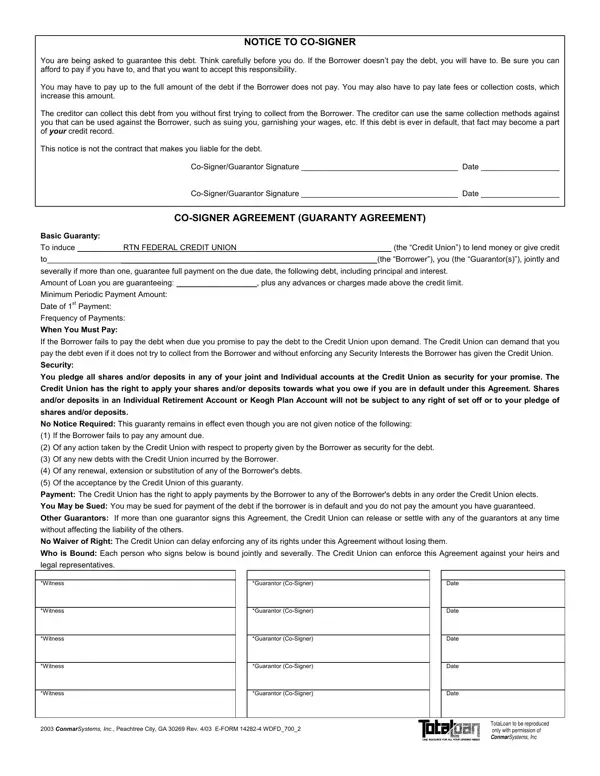
What it is: The Co-Signer Agreement (Guaranty Agreement) is the form in which you guarantee full payment of the debt, jointly and severally if more than one, to the RTN FEDERAL CREDIT UNION.

Who signs: Each person who signs is bound jointly and severally. The Credit Union can enforce this Agreement against your heirs and legal representatives.

A filled-in Co-Signer Agreement (Guaranty Agreement) example: a guarantor backs a credit union loan
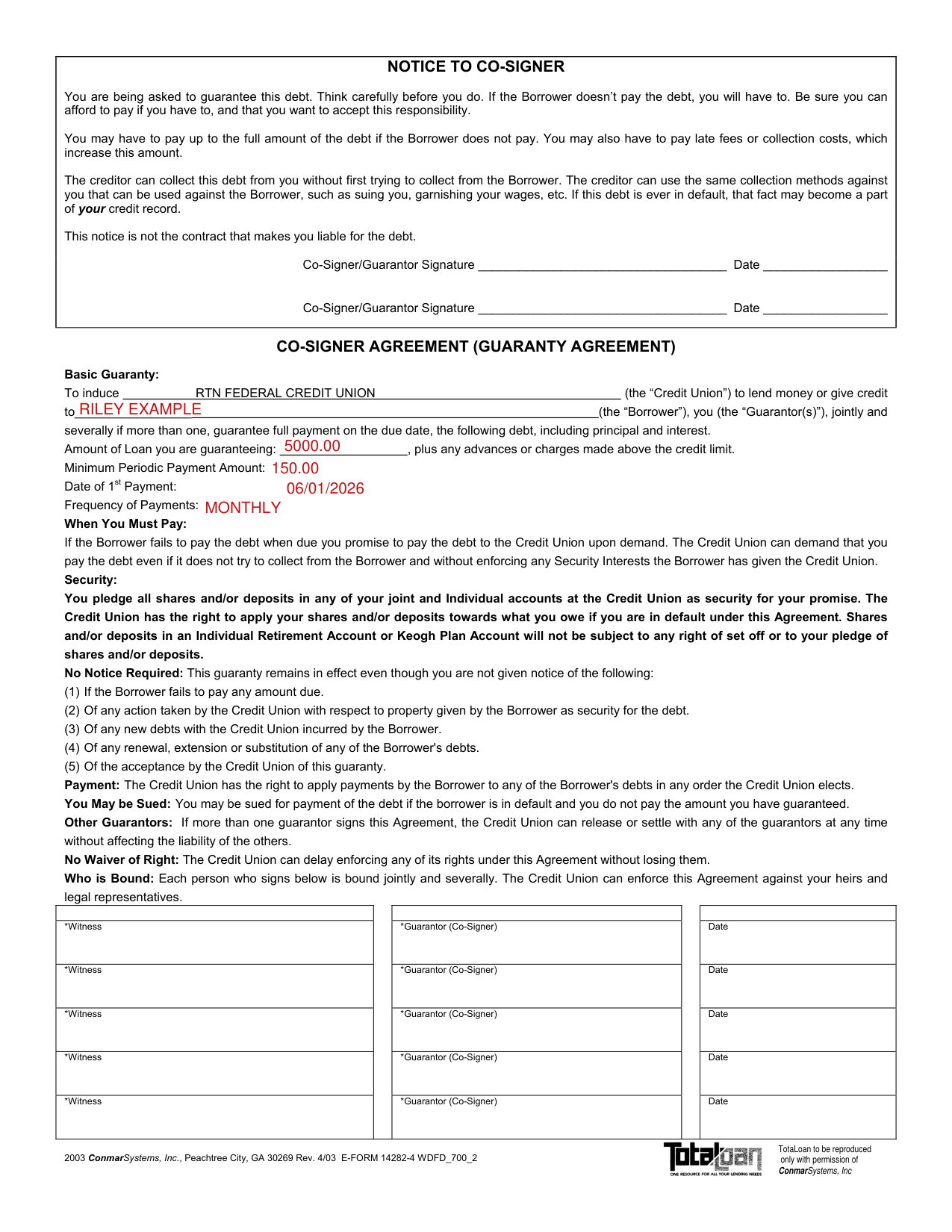
Co-Signer Agreement (Guaranty Agreement) example filled out, example: a guarantor backs a credit union loan
Jordan Sample guarantees a credit union loan for Riley Example. The loan is 5000.00, repaid monthly from 06/01/2026, with a minimum payment of 150.00. The picture shows page 1, and all its values are invented. Riley Example is the only borrower, so the second name box in the Borrower and the Amount of Loan group stays empty.

How to fill out Co-Signer Agreement (Guaranty Agreement), box by box

The Borrower and the Amount of Loan you are guaranteeing

Co-Signer Agreement (Guaranty Agreement) example filled out, the Borrower and the Amount of Loan you are guaranteeing

Fill in the line after "to" for the Borrower.

Enter the Amount of Loan you are guaranteeing.

Enter the Minimum Periodic Payment Amount, the Date of 1st Payment and the Frequency of Payments.

More rules for Co-Signer Agreement (Guaranty Agreement)

If the Borrower doesn't pay the debt, you will have to. You may have to pay up to the full amount of the debt if the Borrower does not pay. You may also have to pay late fees or collection costs, which increase this amount. The creditor can collect this debt from you without first trying to collect from the Borrower. If this debt is ever in default, that fact may become a part of your credit record.

If the Borrower fails to pay the debt when due, you promise to pay the debt to the Credit Union upon demand. The Credit Union can demand that you pay the debt even if it does not try to collect from the Borrower and without enforcing any Security Interests the Borrower has given the Credit Union.

You may be sued for payment of the debt if the borrower is in default and you do not pay the amount you have guaranteed.

You pledge all shares and/or deposits in any of your joint and Individual accounts at the Credit Union as security for your promise. Shares and/or deposits in an Individual Retirement Account or Keogh Plan Account will not be subject to any right of set off or to your pledge of shares and/or deposits.

This guaranty remains in effect even though you are not given notice of the following. (1) If the Borrower fails to pay any amount due. (2) Of any action taken by the Credit Union with respect to property given by the Borrower as security for the debt. (3) Of any new debts with the Credit Union incurred by the Borrower. (4) Of any renewal, extension or substitution of any of the Borrower's debts. (5) Of the acceptance by the Credit Union of this guaranty.

If more than one guarantor signs this Agreement, the Credit Union can release or settle with any of the guarantors at any time without affecting the liability of the others.

Sources

[1] Co-Signer Agreement (Guaranty Agreement), Rev. 4/03 (the Official source link on this page).

Co Signer Agreement Form PDF Details

A co-signer agreement form is a legally binding document that defines the obligations of a guarantor who agrees to repay a borrower's debt if the borrower defaults. Before signing, every co-signer should understand exactly what they are committing to.

What Is a Co-Signer Agreement Form?

The co signer agreement form establishes the legal relationship between a creditor, a primary borrower, and a guarantor. It confirms that the co-signer accepts equal liability for the debt and agrees to pay in full if the borrower cannot. This is not a casual promise. It is a formal financial obligation that can affect the co-signer's credit score, savings, and assets.

Key Clauses in the Agreement

A standard co-signer agreement covers several important points. First, it specifies the loan amount and repayment terms. Second, it states that the creditor may pursue the co-signer directly without first trying to collect from the primary borrower. Third, it notes that any default by the borrower will appear on the co-signer's credit report. Fourth, it may allow the creditor to seize the co-signer's savings or deposits. These points make the document essential reading before any guarantor signs.

When Do You Need a Co-Signer Agreement?

Co-signer agreements are common in rental leases, car purchases, and personal loans. A landlord may require a co-signer when a tenant has limited credit history. A lender may ask for a guarantor when a borrower's income or credit score falls below the required threshold. If you are serving as a guarantor, you may also want to review a loan agreement template or a promissory note to understand your full financial exposure.

Risks of Being a Co-Signer

Taking on co-signer responsibility comes with real financial risk. If the borrower misses payments, the co-signer may face collection calls, lawsuits, wage garnishment, and damage to their credit score. Before signing, confirm that you could afford to repay the full debt if required. Consider speaking with a financial advisor about the long-term implications.

Related Legal Documents

Depending on your situation, you may also need a rental lease agreement or a guarantor form alongside the co-signer agreement form. Having all documents in order protects both the lender and the parties involved.

QuestionAnswer
Form NameCo Signer Agreement Form
Form Length1 pages
Fillable?No
Fillable fields0
Avg. time to fill out15 sec
Other namesNOTICE, notice to cosigner, notice to cosigner form, ConmarSystems