
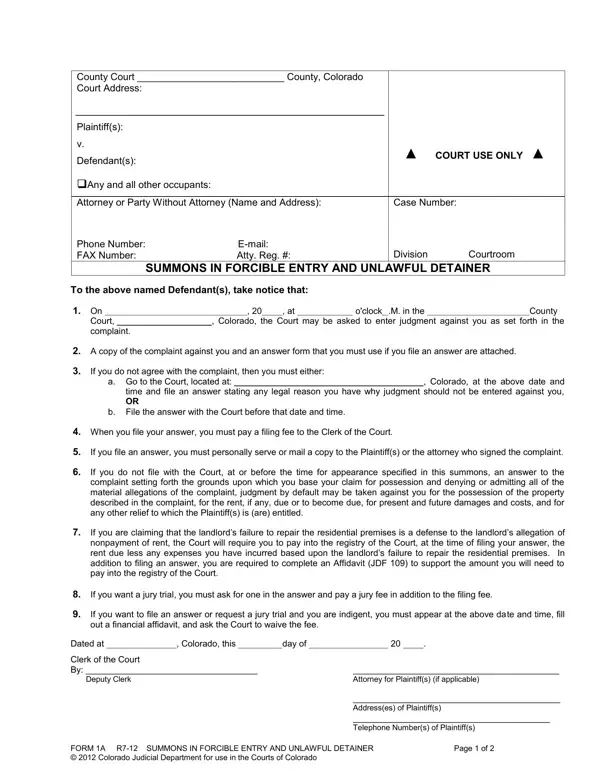

JDF 102 Eviction Summons at a glance
What it is: JDF 102 Eviction Summons, C.R.S. § 13-40-111: You (the Defendant) are now involved in a court case to decide if you should be evicted from your residence or commercial unit.
Who signs: Signed by: Court Clerk or Plaintiff's Attorney
A filled-in JDF 102 Eviction Summons example: a landlord's attorney starts an eviction case
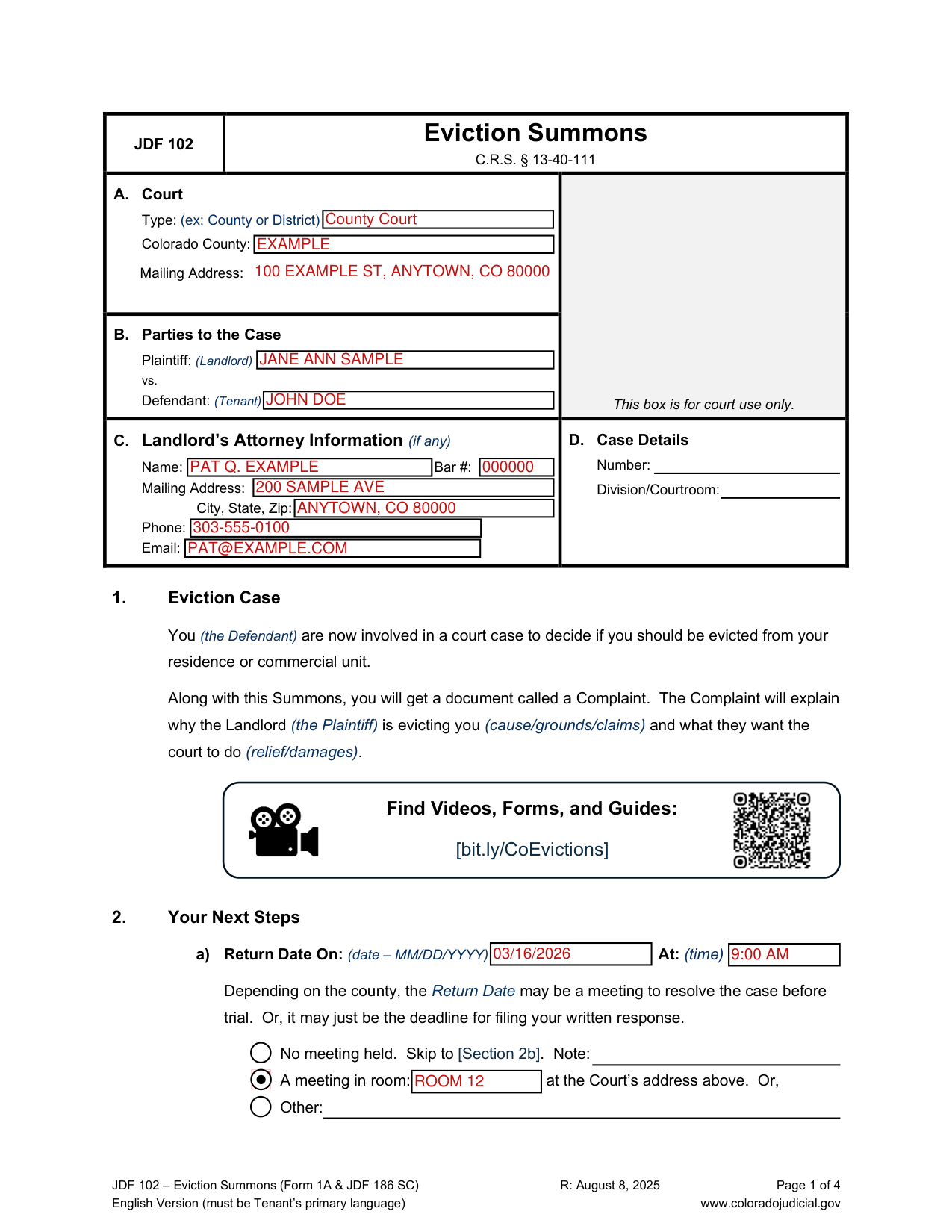
How to fill out JDF 102 Eviction Summons, box by box
A. Court

Under A. Court, enter the Type (ex: County or District), the Colorado County and the Mailing Address.
B. Parties to the Case

Under B. Parties to the Case, enter the Plaintiff: (Landlord) and the Defendant: (Tenant).
C. Landlord's Attorney Information (if any)

Under C. Landlord's Attorney Information (if any), enter Name, Bar #, Mailing Address, City, State, Zip, Phone and Email.
D. Case Details

D. Case Details, with Number: and Division/Courtroom:, is in the box that is for court use only.
Return Date
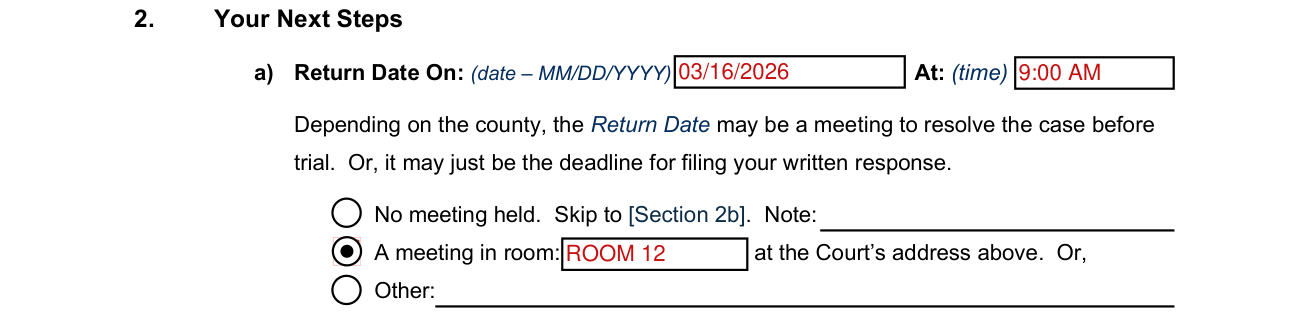
2. Your Next Steps: a) Return Date On: (date - MM/DD/YYYY) At: (time)
Depending on the county, the Return Date may be a meeting to resolve the case before trial. Or, it may just be the deadline for filing your written response.
Mark one: No meeting held. Skip to [Section 2b], or a meeting in room at the Court's address, or Other.
5. Signed and Dated

Under 5. Signed and Dated, enter the Signature and Dated.
Enter the Plaintiff's Address and the Plaintiff's Phone.
6. Certificate of Mailing

Under 6. Certificate of Mailing: If checked, I swear that on (date) this summons, eviction complaint (and attachments), blank answer form, and request for document forms were mailed by first class mail to the Defendants at the following address: (include city, state, and zip-code)
Sign as Landlord or Landlord's Agent.
Plaintiff, be sure to file JDF 98 - Affidavit of Service when service has been completed.
More rules for JDF 102 Eviction Summons
Along with this Summons, you will get a document called a Complaint. The Complaint will explain why the Landlord (the Plaintiff) is evicting you (cause/grounds/claims) and what they want the court to do (relief/damages).
In your answer to the court, you can state why you believe you have a right to remain in the property, whether you admit or deny the landlord's factual allegations against you, and whether you believe you were given proper notice of the landlord's reasons for terminating your tenancy before you got this summons.
3. Consequences If you do not file a written Answer or attend the Return Date meeting, the judge will not know if you have any defenses and may enter a default judgment against you.
This means you could be evicted and have to pay the money you owe to the landlord.
A default judgment for possession means that you will have to move out, and it may mean that you will have to pay money to the landlord.
Depending on the outcome of the Return Date, the Court may schedule the case for a formal trial. You can appear by phone or video for court events.
a) Any documents filed in this case can only be seen by the parties, not the public.
b) If the Court orders an eviction, the case documents will be made public unless both parties agree to keep them private.
a) You can choose to participate in Court events by phone or video. You can do this in your Answer form or by filing JDF 105 - Notice About Remote Participation.
If disconnected during the event, try to reconnect or contact the court.
If the defendant has experienced unlawful sexual behavior, stalking, domestic violence, or domestic abuse that was the cause of, or contributed to, or resulted in an alleged lease violation that is the subject of the action for possession, a defense may exist and the tenant may be entitled to a replayment plan pursuant to section 13-40-104(4)(e) for any rent that remains lawfully owed.
English Version (must be Tenant's primary language)
The Jury Fee is non-refundable. Sometimes, a jury trial will be denied because it is not authorized by law, even though you paid the jury trial fee.
Common questions about JDF 102 Eviction Summons
Is there a deadline?
b) Written Answer If you disagree that you should be evicted, submit an Answer form, due on the Return Date. See [Section 4].
Are there fees?
No Fees There are no filing or service fees for Tenants in Eviction Cases.
Sources
[1] JDF 102 Eviction Summons (R: August 8, 2025), Colorado Judicial Branch (the Official source link on this page).