
Ctc Form 41 Nc PDF Details

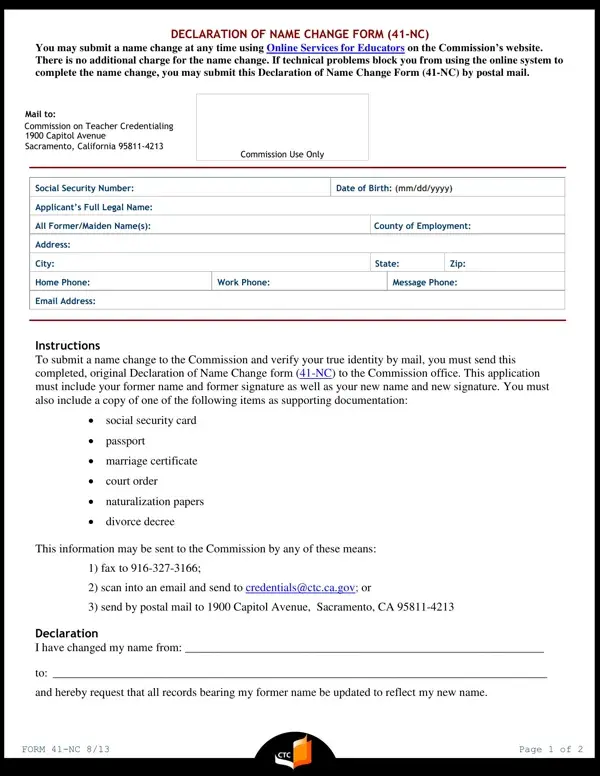
The Declaration of Name Change (41-NC) is published by the California Commission on Teacher Credentialing (CTC). California educators must file this document whenever their legal name changes due to marriage, divorce, or a court order. Filing ensures that all active teaching credentials, certificates, and permits on file with the CTC reflect the educator's current legal name.

To complete this document, educators provide their former legal name (as it appears in CTC records), their new legal name, Social Security number, and date of birth. Submitters must attach legal proof of the name change, such as a certified copy of a marriage certificate, a divorce decree showing the name restoration order, or a court-issued name change order. A copy of an updated government-issued photo ID is also required.

The CTC accepts the completed declaration by mail, fax, or email, and also through the CTC Online educator account portal. There is no fee for processing a name change request. Processing takes 4 to 6 weeks on average. Once completed, the CTC updates the educator's name across all active credentials and certificates in the state records system.

QuestionAnswer
Form NameCtc Form 41 Nc
Form Length2 pages
Fillable?No
Fillable fields0
Avg. time to fill out30 sec
Other names41-NC, LiveScan, 1900, 41-REN

How to Edit Ctc Form 41 Nc Online for Free

The Declaration of Name Change is a two-page document filed with the California Commission on Teacher Credentialing when a teacher or other educator legally changes their name. The CTC maintains official records for all credentialed California educators. A mismatch between the name on your credential and your current government-issued ID can cause problems during background checks, credential renewals, and hiring processes.

Common reasons educators need to file this form include a name change after marriage or divorce, a legal name change through a court order, or a correction to a clerical error made at the time of credentialing. If any of these apply to you, the declaration must be filed before your next credential renewal or new certificate application. Many school districts also require that your credential name match your HR records before placing you in a classroom assignment.

The California Commission on Teacher Credentialing credentials over 300,000 active educators across the state. Of these, thousands file name change declarations each year following marriage, divorce, or court-ordered name changes. Keeping your credential name current is a straightforward process, but it requires accurate documentation and complete submissions to avoid delays.

Who Needs to File This Form?

Any credentialed California educator whose legal name has changed since their credential was issued must file this declaration. This requirement applies to teachers, administrators, support staff, and permit holders at any credential level who legally changed their name through marriage, divorce, or a court order.

The following California educators are required to submit this declaration:

  • Teachers whose name changed after marriage or divorce
  • Credential holders who obtained a legal name change through a court order
  • Individuals whose teaching certificate or permit was issued under a previous legal name
  • Educators whose name appears differently on their credential compared to their current Social Security card or driver's license
  • Substitute teachers who hold a 30-day emergency substitute permit and have legally changed their name

If you are unsure whether a name change requires this form, the safest approach is to file it. Failing to update your name with the CTC can lead to delays during credential renewals and difficulties verifying your identity during district-required background clearances. California law requires credentials to match the educator's current legal name.

Required Supporting Documents

Along with the completed declaration, you must include copies of legal documentation proving the name change. The CTC requires documentary evidence that independently verifies the change from your former legal name to your new legal name. All copies must be clear and legible; originals are not required for mailing, but the CTC may request them if photocopies are difficult to read.

Acceptable documents include:

  • A copy of your marriage certificate
  • A copy of your divorce decree that includes a name restoration order
  • A certified copy of a court order for a legal name change
  • A copy of your updated Social Security card
  • A copy of a government-issued photo ID (driver's license or state ID) showing your new name

If your name changed multiple times—for example after marriage and then again after divorce—you must provide documents showing the complete chain of name changes. Each name change requires a separate supporting document. Incomplete chains are one of the most common reasons for processing delays.

If you also need to update your name with other agencies, FormsPal offers an Address and Name Change Form that you can use to notify additional institutions of your updated legal name at the same time.

How to Fill Out the Form

This two-section document collects identifying information and requires a signed declaration. Accuracy is essential: any discrepancy between your entries and your supporting documents can result in a returned submission. Follow these steps to complete it correctly:

  1. Former legal name: Enter your name as it currently appears in CTC records, including first name, middle name, and last name. This must match exactly what the CTC has on file.
  2. New legal name: Enter your name exactly as it appears on your legal name change document. Spelling must be identical to your supporting documentation.
  3. Social Security number: Provide your full 9-digit Social Security number so the CTC can locate your records in the system.
  4. Date of birth: Enter your date of birth for additional identification verification.
  5. Submission preference: Indicate whether you will send the form by mail, fax, or email, and provide the relevant contact information for CTC correspondence.
  6. Signature and date: Sign and date the declaration in Section 2 to certify that your name change is legally valid and supported by the attached documents.
  7. Attach your supporting documents: Include copies of all required documents before submitting. Do not send originals by mail.

How to Submit the Completed Form

The CTC accepts the declaration through three main submission methods: mail, fax, or email. You can also submit through the CTC Online educator portal. Choose the method that best fits your timeline and documentation setup.

  • By mail: Send the completed form and supporting document copies to the Commission on Teacher Credentialing, 1900 Capitol Avenue, Sacramento, CA 95811. Allow extra time for postal delivery.
  • By fax: Fax the completed form and documents to the fax number listed in the form instructions. Keep your fax confirmation as proof of submission.
  • By email: Scan the completed form and all attachments as a PDF and send them to the email address provided on the form.

You can also submit a name change request through the CTC Online educator portal at www.ctc.ca.gov. After creating or logging into your educator account, you can upload supporting documents directly and track the status of your update online. The portal provides real-time updates, which can reduce uncertainty during the processing period.

If you are updating your address in California at the same time, see the California Address Change Form for a quick way to notify the relevant state agencies.

Timeline and Processing Details

The CTC processes name change requests within 4 to 6 weeks of receiving the completed declaration and all required documentation. Incomplete submissions or missing documents can extend this timeline by 2 to 4 additional weeks. The CTC will notify you by mail or email if your submission is missing required documentation.

The CTC does not charge a fee for processing a name change. If your credential is due for renewal while your name change is pending, you can submit both at the same time. Indicate on your renewal application that a name change is also in process. Both the renewal and the name change will be processed together, saving you a second round of documentation and reducing wait time.

After processing is complete, the CTC will mail you an updated credential or certificate document reflecting your new legal name. Processing typically takes 2 to 3 weeks longer during peak periods. The start of the school year (August and September) and spring renewal season (March through May) are the two peak periods when the CTC receives the highest volume of applications. If your credential expires before your name change is processed, contact the CTC to request a temporary extension letter your district can use as interim documentation.

After filing with the CTC, you should update your name records with other parties as well. Notify your school district's human resources department using an Employee Status Change Form or your district's equivalent HR document. Also update your name with any teachers' union or professional association and with background clearance services such as DOJ or FBI records if your district uses a third-party vendor for fingerprint verification.

California law requires that your teaching credential match your current legal name on file with the Social Security Administration and your state-issued ID. If you renewed your Social Security card but have not yet updated your teaching credential, you are technically out of compliance. Many California school districts verify credential name against their HR records at the start of each school year. Address the name change declaration promptly after any legal name change to avoid administrative flags during annual verification cycles.

Tips for a Successful Submission

Following these best practices will help you avoid the most common causes of processing delays and returned submissions. Most problems stem from spelling mismatches, illegible copies, or incomplete document chains—all preventable with a careful review before submitting.

  • Check the name spelling twice. The name you enter as your "new legal name" must exactly match the spelling on your supporting documents. Even a single-character difference can trigger a request for clarification from the CTC, adding 2 to 4 weeks to your processing time.
  • Make high-quality copies. Blurry or cropped photocopies are one of the most common causes of processing delays. Use a flatbed scanner at 300 DPI or higher. Confirm all text is visible including the document seal, date, and signature.
  • Submit all documents at once. Sending a follow-up with missing documents after the original submission restarts the review process. Submit everything in a single envelope or email attachment.
  • Keep a copy of everything. Retain a copy of the completed declaration and all supporting documents in case the CTC needs additional information or your submission is lost in transit.
  • Track your submission. If submitting by mail, use certified mail with return receipt so you have a delivery confirmation date. If submitting by email or fax, save your sent confirmation.
  • Plan for peak processing times. Avoid submitting during August, September, March, and May if your timeline is flexible. These months see higher volume and typical processing extends to 7 to 8 weeks during these periods.
  • Notify your school district promptly. Once the CTC processes your request, bring a copy of your updated credential to your district HR department. Some districts require a matching document before adjusting their internal records.

How to Edit This PDF Online for Free

You can complete this credential document online using FormsPal's free PDF editor. No software download or account creation is required. The tool works in any modern browser and saves your completed form as a downloadable PDF.

Step 1: Click the "Get Form" button at the top of this page to open the document in FormsPal's PDF editor.

E-mail completion process detailed (portion 1)

Step 2: Click on each field and type in your information. Enter your former name, new name, Social Security number, and date of birth in the designated fields.

E-mail conclusion process detailed (part 2)

Step 3: After entering all required information and adding your signature using the built-in signature tool, click "Done" to save the completed form. Download the PDF and print it, then attach your supporting documents before submitting to the CTC.

Stage no. 3 for submitting E-mail

FormsPal also offers other educator-related credential forms. If you need a related California teaching credential document, you can find the CTC Form A-047 on FormsPal as well.

Frequently Asked Questions

How long does the CTC take to process a name change request?

The CTC typically processes submissions within 4 to 6 weeks after receiving the completed declaration and all required supporting documents. During peak periods (August, September, March, May), processing can extend to 7 to 8 weeks. You can check the status of your update through the CTC Online educator account portal. Missing or illegible documents can delay processing by an additional 2 to 4 weeks.

Is there a fee to file the name change form?

No. There is no filing fee required to submit a name change request to the CTC. If your credential also needs to be renewed at the same time, the credential renewal fee still applies separately, but the name change processing itself is free of charge.

Can I submit the name change request through CTC Online?

Yes. In addition to sending the form by mail, fax, or email, you can submit the name change request through the CTC Online educator portal at www.ctc.ca.gov. Log into your educator account, navigate to the name change option, and upload your supporting documents electronically. The portal allows you to track the status of your request in real time.

What if I have had more than one legal name change?

If you have had multiple name changes—for example a name change after marriage and then a name restoration after divorce—you must document each step in the chain. Each name change needs a separate legal document. Provide copies of all documents showing the progression from your original name to your current legal name. The CTC will not accept a single document that does not account for all intermediate names.

What happens after my name change is processed?

After the CTC processes your request, your official teaching credential record will reflect your new legal name. You will receive updated credential documents in the mail within 2 to 4 weeks of processing completion. Also notify your school district's HR department and any professional organizations where your name needs to match your credential.

Do I need to submit a new credential application after a name change?

No. A name change on an existing credential does not require a new credential application. The CTC updates the name on your current, active credential. You only need to apply for a new credential if you are also upgrading your authorization level or adding a new credential type at the same time.

Can a substitute teacher use this form?

Yes. Substitute teachers who hold a 30-day emergency substitute permit or a short-term staff permit issued by the CTC may also use this declaration to update their name. The process and required documentation are the same as for fully credentialed teachers. Contact your county office of education if you have questions about permit-specific requirements.

What should I do if my new legal name is hyphenated or compound?

Enter the hyphenated or compound name exactly as it appears on your legal documentation, including hyphens, spaces, or accent marks. The CTC records system supports hyphenated names, but you must use the precise format shown on your government-issued ID. If there is any inconsistency between your supporting documents, correct it before filing to avoid a clarification request that could add 2 to 4 weeks to your processing time.

If you need to file a formal court petition for a name change in California, FormsPal also provides a Petition for Name Change form that walks through the court-ordered name change process.