
Da Form 5701 228 R PDF Details

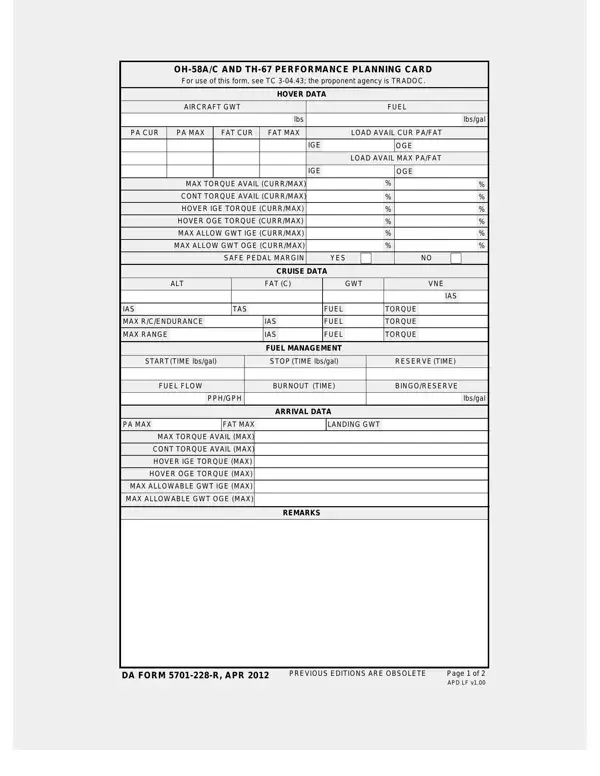
The DA Form 5701-228-R is the performance planning card for OH-58A/C Kiowa and TH-67 Creek helicopters. Army aviation crews complete it before each mission to confirm the aircraft can safely execute the planned flight. The form is governed by TC 3-04.43 and managed by the Training and Doctrine Command (TRADOC).

The card captures four categories of data. Hover data includes gross weight, IGE and OGE torque, maximum allowable gross weight, and safe pedal margin. Cruise data covers altitude, indicated airspeed, and fuel burn rate. Weight and balance fields record the center of gravity (CG) for departure and arrival configurations.

Fuel management entries track fuel on board, fuel required for the route, and fuel remaining at the destination. Together, these sections give crews the numbers needed to make a safe go or no-go decision before each flight. Pilots should complete every section before taxiing to keep operations within Army safety standards.

QuestionAnswer
Form NameDa Form 5701 228 R
Form Length2 pages
Fillable?No
Fillable fields0
Avg. time to fill out30 sec
Other namesa5701_228_r da form 5701 228r

How to Edit Da Form 5701 228 R Online for Free

What Is DA Form 5701-228-R Used For?

The DA Form 5701-228-R is a two-page performance planning card used by Army aviators flying the OH-58A/C Kiowa and TH-67 Creek helicopters. Pilots complete this form before each mission to verify hover and cruise data stays within safe limits. It captures gross weight, fuel load, torque availability, and pedal margin values for both in-ground effect (IGE) and out-of-ground effect (OGE) hover conditions.

Key Sections of the Performance Planning Card

The form divides flight performance data into four main areas:

  • Hover Data - Gross weight, IGE and OGE torque, maximum allowable gross weight, and safe pedal margin
  • Cruise Data - Altitude, indicated airspeed, fuel burn rate, and range calculations
  • Weight and Balance - Center of gravity (CG) for departure and arrival configurations
  • Fuel Management - Fuel on board, fuel required, and fuel remaining at the destination

How to Complete DA Form 5701-228-R

Follow these steps to fill out the performance planning card before your flight:

  1. Enter the mission date and aircraft tail number at the top of the card
  2. Record gross weight and fuel load for the departure configuration
  3. Look up IGE and OGE torque values from your aircraft performance charts
  4. Calculate the maximum allowable gross weight and confirm it exceeds your loaded weight
  5. Enter cruise altitude and airspeed for the planned route
  6. Complete the weight and balance section for both departure and arrival phases

Common Mistakes When Completing the Card

Avoid these errors to keep your performance data accurate:

  • Using incorrect density altitude. Always use the pressure altitude and temperature at your departure location, not standard sea level values.
  • Skipping the arrival weight and balance. Fuel burn changes the aircraft CG. Record both departure and arrival CG values every flight.
  • Confusing IGE and OGE hover limits. IGE requires less torque than OGE. Record both values correctly, as low-level hover and high-altitude hover have different safe margins.
  • Omitting the pedal margin check. A positive pedal margin confirms you have tail-rotor authority. Do not skip this step.

Related Aircraft and Planning Forms

Pilots and Army aviation crews may also need these related forms for pre-mission planning:

Frequently Asked Questions

What aircraft does DA Form 5701-228-R apply to?
The form applies to the OH-58A/C Kiowa observation helicopter and the TH-67 Creek training helicopter.

Where can I find TC 3-04.43?
TC 3-04.43 is the Army Training Circular covering aircraft performance planning. It is available through official Army publication channels managed by TRADOC.

Is the form available as a fillable PDF?
The standard form is a non-fillable PDF. Use the FormsPal editor above to complete and download the performance planning card online.

What is the difference between IGE and OGE hover data?
IGE (in-ground effect) hover refers to hovering within one rotor diameter of the surface, which requires less power. OGE (out-of-ground effect) hover occurs above that height and demands more torque. Both values appear on the planning card to cover different operational scenarios.