
DA Form 7632 PDF Details

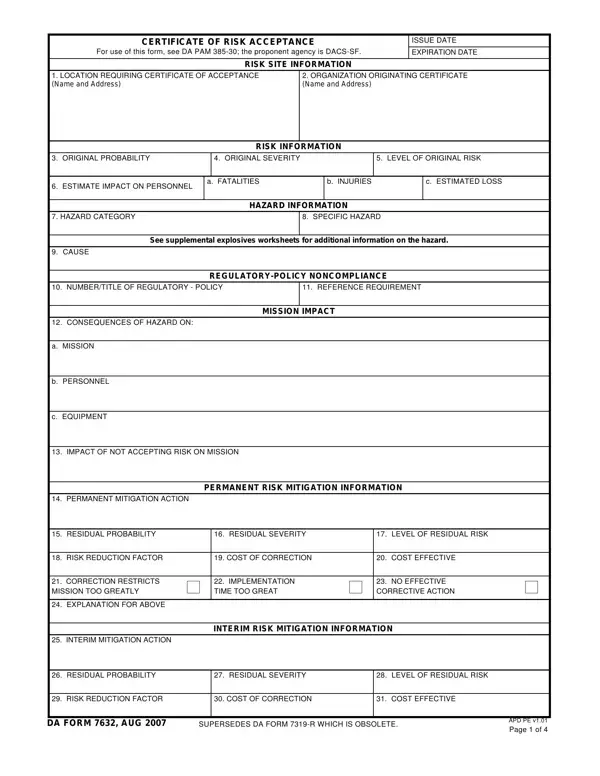
The Certificate of Risk Acceptance, known as the DARAD, is the formal Army document used to officially record and accept operational risks under DA PAM 385-30 and AR 385-10. Commanders and safety officers complete it when recognized hazards cannot be fully eliminated but operations must continue. The form creates an official, auditable record that decision-makers have reviewed the hazards, evaluated mitigation options, and chosen to proceed with a deliberate acceptance of residual risk.

What the form captures

Who completes the form

Risk management officers, unit safety officers, and commanders complete DA Form 7632 during operational planning when risk levels are elevated beyond standard acceptable thresholds. It is required for any activity where the hazard probability and severity matrix produces an overall risk rating of High or Extremely High after applying available mitigation measures.

The form is governed by DA PAM 385-30 (Risk Management) and AR 385-10 (The Army Safety and Occupational Health Program). Once signed, it becomes part of the unit's official safety documentation and must be retained in accordance with Army records management policies.

Related Army risk management forms

Depending on the specific operational context, you may also need the Army Risk Form for general risk assessment worksheets, or the DA Form 87 (Certificate of Training) to document that personnel have received required safety training before conducting high-risk activities. The DA Form 67-9-1 is also commonly used alongside the DARAD when evaluating an officer's performance in risk-sensitive missions.

QuestionAnswer
Form NameDA Form 7632
Form Length4 pages
Fillable?No
Fillable fields0
Avg. time to fill out10 min
Other namesDARAD, form da 7632, da 7632, certificate of risk acceptance, deviation approval risk acceptance document

How to Edit Da Form 7632 Online for Free

DA Form 7632 can be completed online using FormsPal's free PDF editor. No software download or installation is required. Simply open the form in your browser, fill in each section, and download the completed document. Follow the step-by-step guide below to fill out the Certificate of Risk Acceptance correctly.

Step 1: Open the form. Click the orange "Get Form" button at the top of this page. This opens DA Form 7632 in the FormsPal PDF editor, preloaded and ready to fill out. No account is required to begin.

Step 2: Enter risk site identification. In the header section, provide the unit designation, activity or task name, date of the assessment, location, and the name of the operation or mission. This section identifies who is accepting the risk and for which specific activity.

Step 3: Identify and categorize hazards. List each identified hazard in the hazard column. For each one, assign a hazard category (for example: personnel safety, equipment failure, environmental condition, or mission-critical constraint). Accurate categorization is required before you can complete the risk rating fields.

Step 4: Record initial risk assessment. Using the Army's risk assessment matrix, assign each hazard an initial probability rating (frequent, likely, occasional, seldom, or unlikely) and an initial severity rating (catastrophic, critical, marginal, or negligible). Document the estimated number of personnel fatalities, injuries, and equipment losses associated with each hazard at its initial (unmitigated) risk level.

Step 5: Document mitigation strategies. For each hazard, describe the permanent and interim risk control measures that will be applied. Indicate whether each control is currently available, requires additional resources, or is being implemented on an interim basis. Record the estimated cost of implementation and the practical feasibility of the control measure in the current operational environment.

Step 6: Record residual risk ratings. After documenting your mitigation strategies, re-rate each hazard using the same probability and severity matrix. These residual ratings reflect the risk level that will remain after all controls are applied. If the overall residual risk is High or Extremely High, the form must be escalated to the appropriate level of command for risk acceptance authority.

Step 7: Complete the risk acceptance section. The authorizing commander or designated risk acceptance authority reviews the completed hazard assessment, mitigation strategies, and residual risk ratings. Their signature in this section confirms a deliberate, informed decision to accept the documented residual risk and authorize continuation of the operation or activity.

Step 8: Save and submit. Click "Done" to save your completed form. Download it as a PDF for printing, digital filing, or submission to higher command. FormsPal allows you to save your work and return to it later using any device.

Frequently asked questions

What is DA Form 7632 used for?
DA Form 7632 is the Army's official Certificate of Risk Acceptance, also called the Deviation Approval and Risk Acceptance Document (DARAD). It formally documents operational risks that cannot be fully mitigated and records the commander's deliberate decision to accept those risks and authorize continuation of the mission or activity.

Who needs to complete DA Form 7632?
Risk management officers, unit safety officers, and commanders use this form during operational planning when a risk assessment produces a residual risk rating of High or Extremely High. It is required for activities governed by AR 385-10 and DA PAM 385-30 where standard mitigation measures are insufficient to reduce risk to an acceptable level.

Who must sign the form?
The commanding officer or designated risk acceptance authority at the appropriate command level must sign DA Form 7632. The required level of authority depends on the overall residual risk rating. High residual risk may require battalion-level acceptance; Extremely High risk typically requires brigade or higher command signature.

What regulation covers this form?
DA Form 7632 is governed by DA PAM 385-30 (Risk Management) and AR 385-10 (The Army Safety and Occupational Health Program). The probability and severity matrices used to rate hazards follow the standardized risk assessment methodology defined in DA PAM 385-30.

How long must the form be retained?
Once signed, DA Form 7632 becomes part of the unit's official safety documentation. Retention periods follow Army records management policies under AR 25-400-2 (The Army Records Information Management System). Consult your unit records manager for the applicable retention schedule for your specific activity type.