
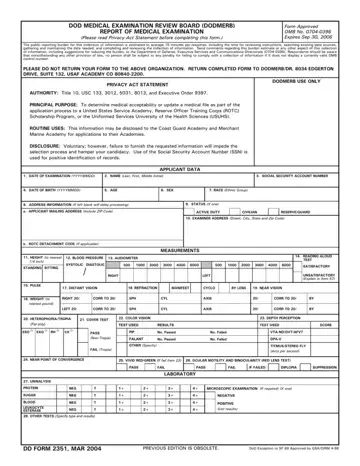
The DODMERB Report of Medical Examination is required for all candidates applying to U.S. Service Academies, ROTC Scholarship Programs, and the Uniformed Services University of the Health Sciences. Completing this report correctly and on time is essential for your application to advance through the review process.
Who Needs to Complete This Form
This medical examination report is required for applicants to the following programs and academies:
- United States Military Academy (West Point)
- United States Naval Academy
- United States Air Force Academy
- United States Coast Guard Academy
- United States Merchant Marine Academy
- Army, Navy, and Air Force ROTC Scholarship Programs
- Uniformed Services University of the Health Sciences
Each branch of service uses DODMERB examination results to verify that candidates meet the specific medical standards for their program. Applicants receive DODMERB contact information from their nominating authority or program office after receiving a conditional appointment or scholarship offer.
What the Medical Examination Covers
A DODMERB-certified physician conducts the physical examination and documents findings in the report. The examination is thorough and covers the following medical categories:
- Vision acuity, depth perception, and color vision testing
- Hearing and ear canal evaluation
- Cardiovascular function, heart rate, and blood pressure measurements
- Musculoskeletal and orthopedic assessment of joints and range of motion
- Neurological evaluation and mental health screening
- Dental and oral health review
- Urinalysis and blood panel laboratory results
- Complete past medical and surgical history review
You must disclose all medications, prior hospitalizations, surgeries, and diagnosed conditions. DODMERB reviewers verify all reported information before issuing a final determination. Incomplete or inaccurate information can result in a disqualification or delay in the review process.
How to Complete the Examination Report
Follow these steps to navigate the DODMERB examination report process:
- Wait for DODMERB contact. DODMERB sends scheduling instructions directly to your registered contact information after your program nominates you. Do not attempt to self-schedule your examination or contact DODMERB before receiving this initial outreach.
- Prepare your medical records. Gather documentation of any prior hospitalizations, surgeries, prescribed medications, and specialist visits. Bring these records to your examination appointment along with a government-issued photo identification card.
- Attend your scheduled examination. Report to the DODMERB-approved clinic at your assigned date and time. The full examination typically takes two to three hours to complete.
- Complete Section I: Applicant Information. Enter your full legal name, Social Security number, date of birth, the program you are applying for, and your service branch selection.
- Physician completes Sections II through IV. The examining physician records all physical measurements, examination findings, laboratory results, and your complete medical history in the remaining sections of the report.
- Review and certify. Confirm that all information in the report is accurate and complete before the physician signs and submits the document to DODMERB for review.
Common Questions About the DODMERB Process
How long does the DODMERB review process take?
The full process from examination to final medical determination typically takes four to six weeks. Cases involving complex medical histories or conditions that require additional documentation may take longer. DODMERB may contact you by mail or through your program office to request supplemental records or a follow-up evaluation. Monitor your contact information and respond promptly to any DODMERB requests to avoid delays.
What happens if I have a pre-existing medical condition?
You must disclose all prior medical conditions, treatments, and prescriptions in your examination report. DODMERB reviewers assess each case individually using published medical standards for each branch of service. A history of a treatable or resolved condition does not automatically result in disqualification. You should submit any relevant specialist notes, treatment records, or documentation showing resolution of the condition to support your case during the review process.
Can I appeal a disqualification finding?
Yes. If you receive a disqualifying medical finding, you have the right to request a medical waiver. Submit your waiver request through your program office or military recruiter along with supporting medical documentation from your treating physician or specialist. The waiver review board will consider your complete medical history, the severity and current status of the condition, and the specific physical requirements of the program you are applying to. Waiver approvals are not guaranteed, but applicants with well-documented medical histories and strong specialist support letters have a higher rate of success.
What medical conditions most commonly result in disqualification?
Common categories that may result in an initial disqualification include uncorrected vision below the service standard, hearing loss, certain orthopedic conditions, a history of asthma after age 13, or a documented mental health diagnosis. Many of these conditions are waiverable depending on their current status and the specific program requirements. Your program office can provide guidance on the waiver process and what documentation to submit.
Related Military and Medical Forms
After completing this examination report, you may also need the following related forms during your application process:
- DD Form 2870 – Authorization for Disclosure of Medical or Dental Information
- DD Form 93 – Record of Emergency Data
- Annual Physical Examination Form – General physical examination documentation
- DD Form 149 – Application for Correction of Military Records
