
DoDEA Form 2500.13-G-F26 at a glance
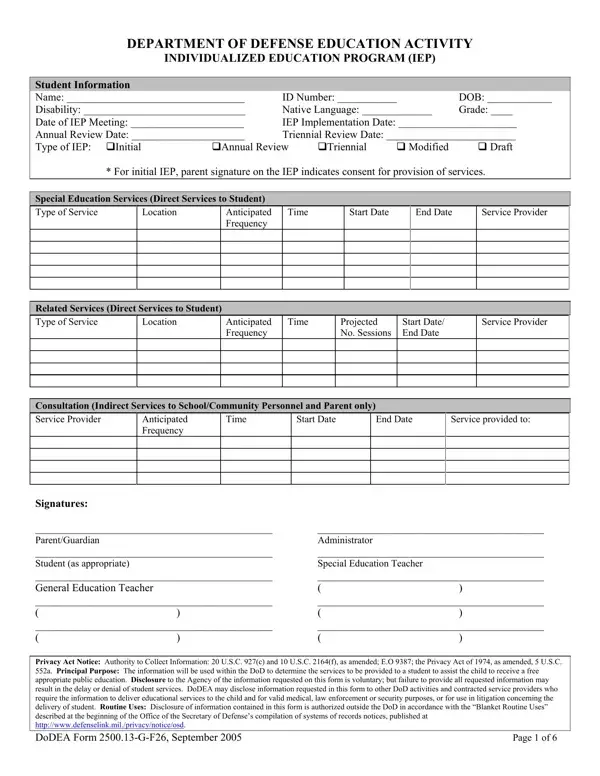
What it is: DoDEA Form 2500.13-G-F26 is the Department of Defense Education Activity Individualized Education Program (IEP).
Who signs: Signatures: Parent/Guardian, Administrator, Student (as appropriate), Special Education Teacher and General Education Teacher.
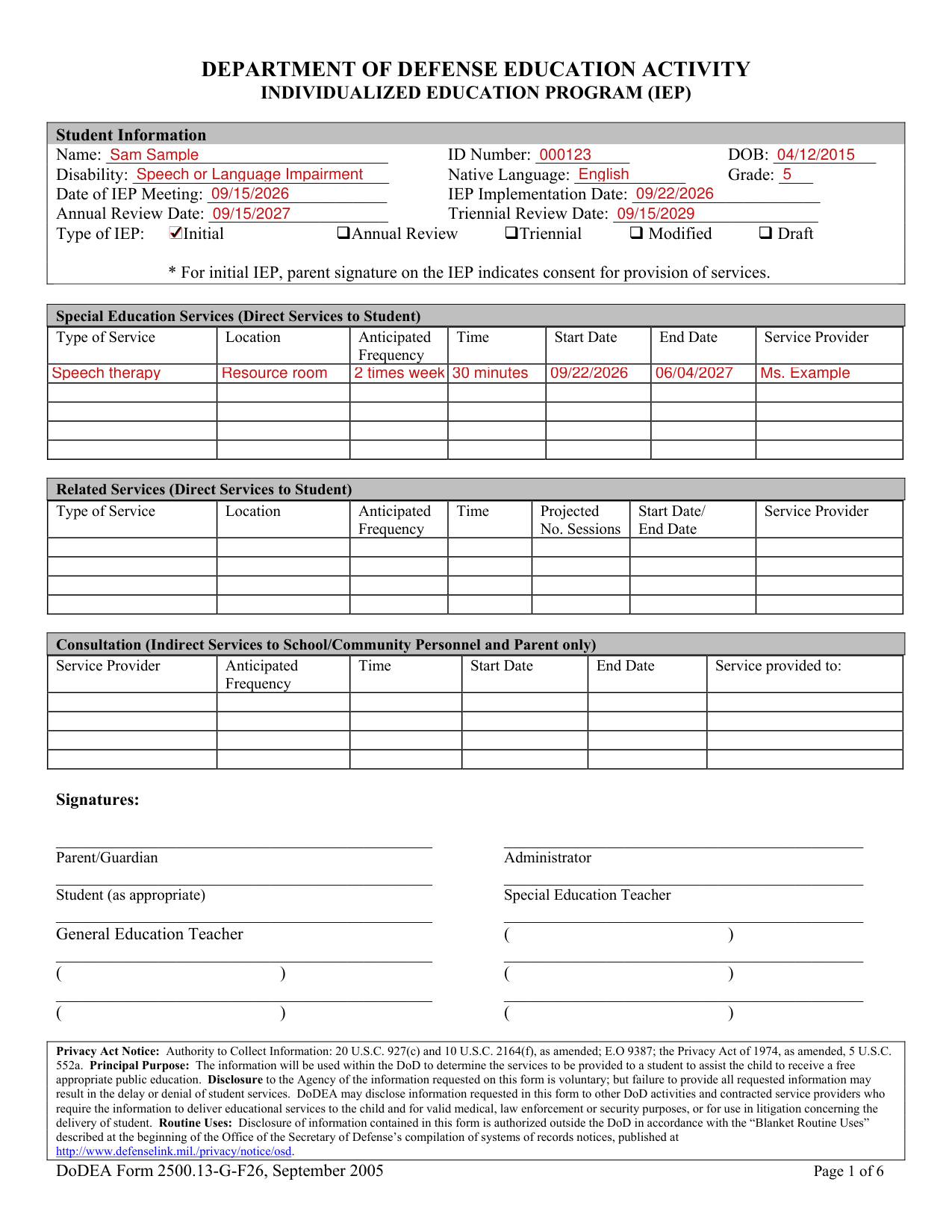
A filled-in DoDEA Form 2500.13-G-F26 example: an initial IEP with one service
How to fill out DoDEA Form 2500.13-G-F26, box by box
Student Information

Under Student Information, enter Name, ID Number, DOB, Disability, Native Language, Grade, Date of IEP Meeting, IEP Implementation Date, Annual Review Date and Triennial Review Date.
Type of IEP

For Type of IEP, mark Initial, Annual Review, Triennial, Modified or Draft.
For initial IEP, parent signature on the IEP indicates consent for provision of services.
Special Education Services (Direct Services to Student)

Under Special Education Services (Direct Services to Student), enter Type of Service, Location, Anticipated Frequency, Time, Start Date, End Date and Service Provider.
Related Services (Direct Services to Student)

Under Related Services (Direct Services to Student), enter Type of Service, Location, Anticipated Frequency, Time, Projected No. Sessions, Start Date/ End Date and Service Provider.
Consultation (Indirect Services to School/Community Personnel and Parent only)

Under Consultation (Indirect Services to School/Community Personnel and Parent only), enter Service Provider, Anticipated Frequency, Time, Start Date, End Date and Service provided to.
Signatures

Signatures: Parent/Guardian, Administrator, Student (as appropriate), Special Education Teacher and General Education Teacher.
ACCOMMODATIONS/SPECIAL CONSIDERATIONS
Under ACCOMMODATIONS/SPECIAL CONSIDERATIONS, enter Modifications Required for Physical Education and for Transportation. For Standardized Testing, mark Student will participate without accommodations, Student will participate with accommodations, Testing not required for this grade level (KN, 1, 2 and 12) or Student will participate in an alternate assessment, and enter Accommodations.
Mark y or n for Braille, Limited English Proficiency, Behavior, Communication Needs and Assistive Technology.
Each “Y” (yes) must be addressed on a goal page.
Consideration of Extended School Year
Consideration of Extended School Year: mark one. IEP team needs to collect additional data in order to make this determination and will meet again by __________. IEP team has determined that documentation does not support the need for extended school year services. IEP team has determined that the record shows student's inability to recoup skills within a reasonable time following regression and recommends extended school year services (attach documentation).
Enter the COMMENT: Accommodations/Modifications in General and Special Education.
VOCATIONAL EDUCATION/TRANSITION SERVICES
VOCATIONAL EDUCATION/TRANSITION SERVICES is for Students 14 years of age and older: identify skills, courses, and experiences the student must have to better prepare the student for post-secondary transition.
Enter Vocational Education Modifications Required, Transition Statement, Student's interests, Student's strengths/capabilities and Desired Post-Secondary Outcomes for Employment, Education and Adult Living.
Based on the student's interests, needs, and desired post-secondary outcomes, the IEP team has determined specialized transition services and/or supports are needed in the following area(s): Academic Learning, Career Planning, Employment, Daily Living Skills, Financial Planning, Health/Medical, Legal Services, Leisure/Recreation, Living Arrangements, Self Advocacy, Transportation, Social Relationships, Community Participation, Post-secondary Training and Other.
Each area checked must be addressed on a goal page.
Graduation Plan: Regular Graduation Plan or IEP - graduation based on IEP goals/objectives.
Transfer of Rights at Age of Majority. Notice was given to the student and parent at least one year prior to reaching the age of majority (18) informing the student of his/her rights under IDEA that will be transferred to the student upon reaching the age of majority (18). Enter Date notice was given and Date student reaches age of majority.
GOALS and OBJECTIVES
On GOALS and OBJECTIVES, enter Area, Need, Present Level of Performance, Service Provider(s), Annual Goal, Short Term Objectives and Mastery Criteria.
LEAST RESTRICTIVE ENVIRONMENT
For LEAST RESTRICTIVE ENVIRONMENT, mark the factors the IEP team considered in selecting the least restrictive environment: Placement of the student is based on his/her individual needs. Student is educated, to the maximum extent appropriate, with students who do not have disabilities. Removal from general education only when the nature and severity of the student's educational needs are such that education in the general education program with supplementary support and services cannot be achieved satisfactorily. Participation with general education students, to the maximum extent appropriate, in school activities. Placement is as close as possible to the student's home or in the school she/he would attend if not disabled.
For Justification for Placement, Explanation of the extent, if any, to which the student will not participate with non-disabled peers, and describe how the student's disability affects his/her involvement and progress in the general curriculum. For preschool children, indicate how the child's disability affects his/her participation in appropriate activities.
Student Progress: Parents will be informed of their child's progress in meeting the goals of his/her IEP on the same timeline as non-disabled students; DoDEA requires the reporting of student progress on a quarterly basis. Enter the Method by which the student's progress will be reported. If progress will be reported more frequently, indicate schedule for reporting the student's progress.
More rules for DoDEA Form 2500.13-G-F26
The information on the form will be used within the DoD to determine the services to be provided to a student to assist the child to receive a free appropriate public education.
Sources
[1] DoDEA Form 2500.13-G-F26, September 2005, Individualized Education Program (IEP), Department of Defense Education Activity.