
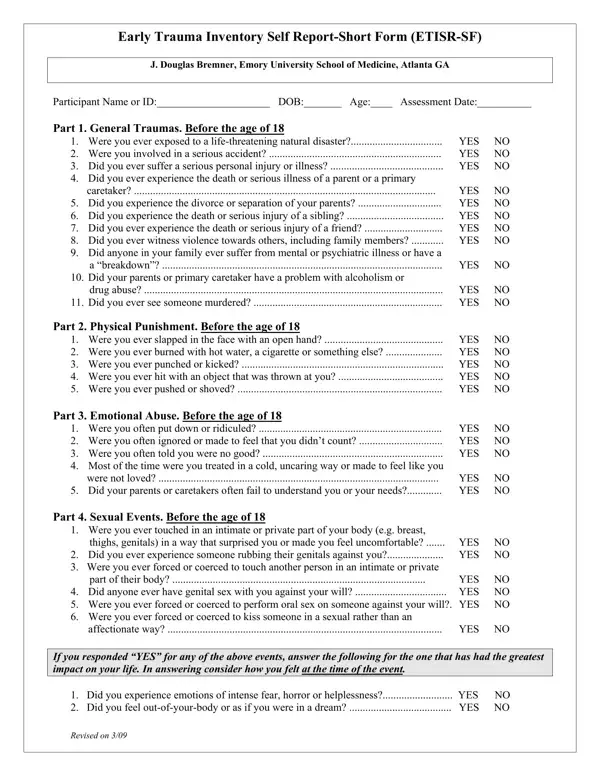
Early Trauma Inventory Form PDF Details

The Early Trauma Inventory Self Report-Short Form (ETISR-SF) serves as a critical tool created by Dr. J. Douglas Bremner from Emory University School of Medicine in Atlanta, Georgia, to gauge the range and depth of trauma experiences individuals have encountered before the age of 18. By carefully compiling a series of questions divided into four primary categories—General Traumas, Physical Punishment, Emotional Abuse, and Sexual Events—the form endeavors to meticulously outline the participant's exposure to potentially life-altering events. From grappling with the devastation of natural disasters to enduring the pains of physical and emotional maltreatment, this inventory spans a broad spectrum of traumatic experiences. Furthermore, it probes into the complex arena of early sexual encounters, whether consensual or forced, shedding light on sensitive issues often shrouded in silence. Participants are asked to reflect not only on the occurrence of these experiences but also on the profound emotional and psychological impacts they may have engendered, with a distinct focus on feelings of fear, alienation, or helplessness. This detailed self-reporting mechanism acts as a gateway to understanding the cascading effects of early traumas on an individual's mental and emotional well-being, paving the way for targeted therapeutic interventions and support mechanisms.

QuestionAnswer
Form NameEarly Trauma Inventory Form
Form Length1 pages
Fillable?No
Fillable fields0
Avg. time to fill out15 sec
Other namestrauma inventory report, early trauma inventory questionnaire, early trauma inventory report, trauma inventory self report form

How to Fill Out Early Trauma Inventory Self Report-Short Form (ETISR-SF)

Early Trauma Inventory Self Report-Short Form (ETISR-SF) at a glance

What it is: Early Trauma Inventory Self Report-Short Form (ETISR-SF), J. Douglas Bremner, Emory University School of Medicine, Atlanta GA.

A filled-in Early Trauma Inventory Self Report-Short Form (ETISR-SF) example: a participant fills in the header
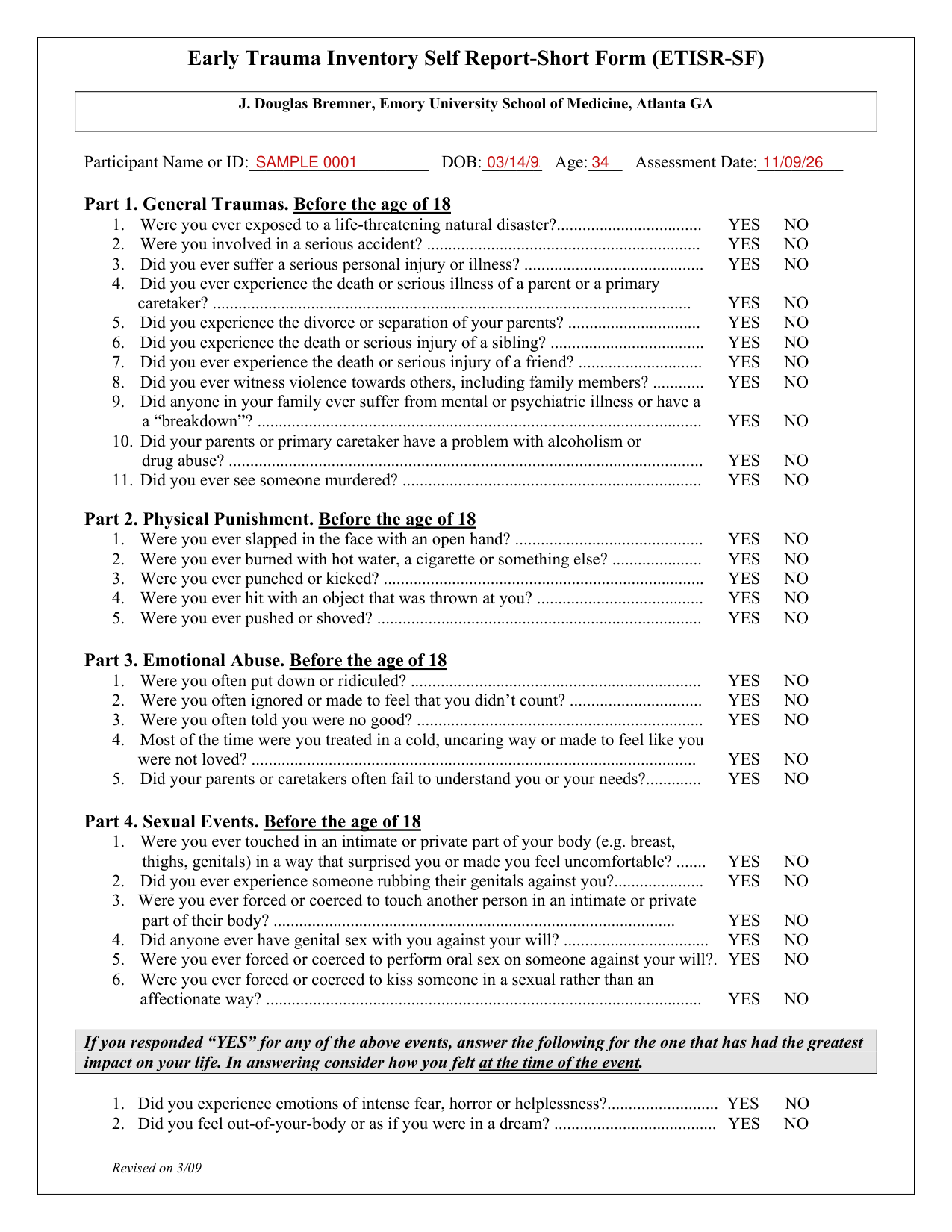
Early Trauma Inventory Self Report-Short Form (ETISR-SF) example filled out, example: a participant fills in the header
A participant fills in the header of the ETISR-SF. The participant, aged 34, enters a name or ID, date of birth, age and assessment date. The picture shows page 1 only, and all its values are invented. The YES and NO boxes stay empty because this participant has not answered the questions yet.

How to fill out Early Trauma Inventory Self Report-Short Form (ETISR-SF), box by box

Participant Name or ID, DOB, Age and Assessment Date

Early Trauma Inventory Self Report-Short Form (ETISR-SF) example filled out, participant Name or ID, DOB, Age and Assessment Date

Fill in Participant Name or ID, DOB, Age and Assessment Date.

More rules for Early Trauma Inventory Self Report-Short Form (ETISR-SF)

Part 1. General Traumas. Before the age of 18, 1 to 11: Mark YES or NO.

Part 2. Physical Punishment. Before the age of 18, 1 to 5: Mark YES or NO.

Part 3. Emotional Abuse. 1 to 5, before the age of 18: Mark YES or NO.

Part 4. Sexual Events. Before the age of 18, 1 to 6: Mark YES or NO.

If you responded “YES” for any of the events in Part 1, Part 2, Part 3 or Part 4, answer 1 and 2 after Part 4 for the one that has had the greatest impact on your life. In answering consider how you felt at the time of the event.

1. Did you experience emotions of intense fear, horror or helplessness? Mark YES or NO.

2. Did you feel out-of-your-body or as if you were in a dream? Mark YES or NO.

Revised on 3/09.

Sources

[1] Early Trauma Inventory Self Report-Short Form (ETISR-SF), revised 3/09, J. Douglas Bremner, Emory University School of Medicine (the Official source link on this page).