
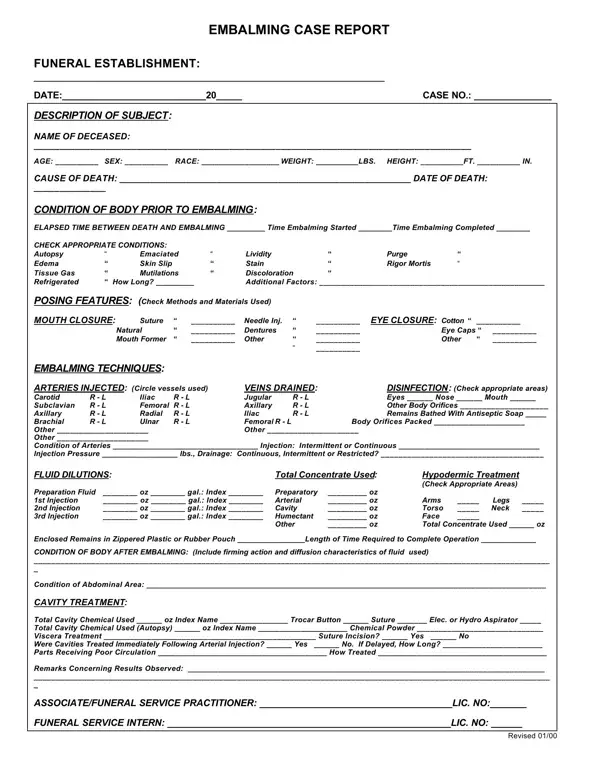

Embalming Case Report at a glance
What it is: Embalming Case Report: case record of the preparation of human remains.
Who signs: Embalmer and intern: Embalmer Printed name, Signature, Date. Intern or apprentice Printed name, Signature, Date.
Complete one report for each case. Mark check boxes with an X. Record marks and conditions by body area in section 5, and every product used in section 8.
A filled-in Embalming Case Report example: a funeral home records one case
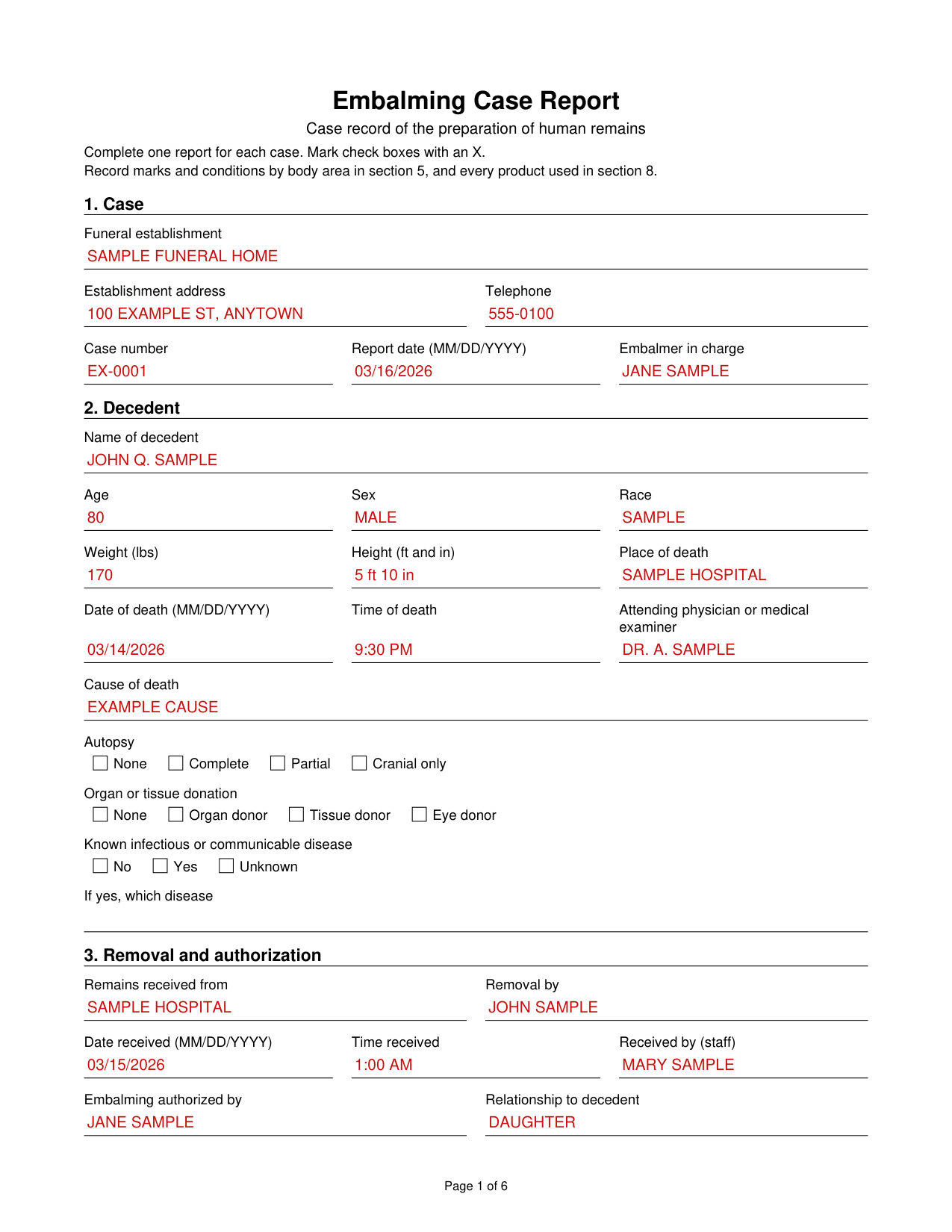
How to fill out Embalming Case Report, box by box
1. Case

1. Case: enter Funeral establishment, Establishment address, Telephone, Case number, Report date (MM/DD/YYYY) and Embalmer in charge.
2. Decedent
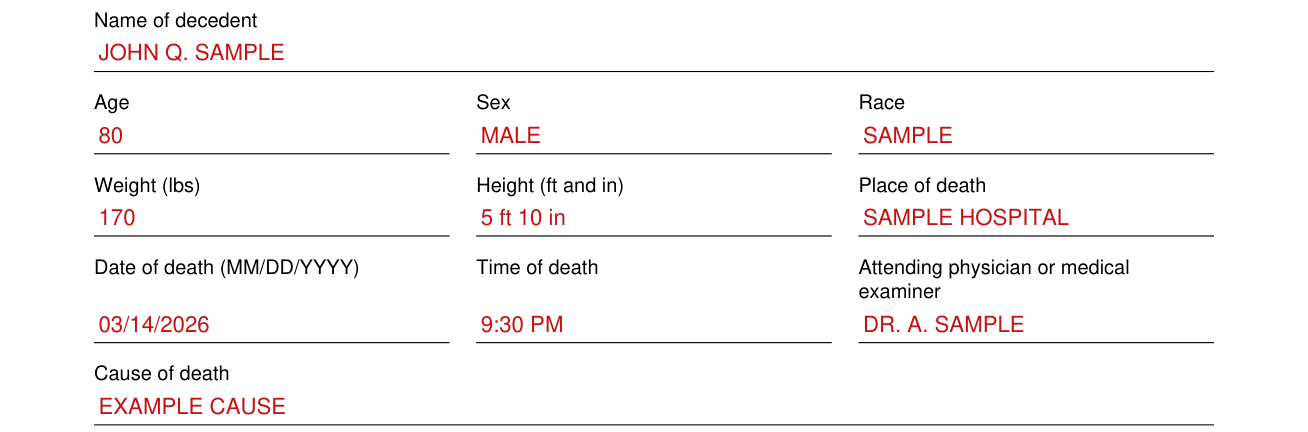
2. Decedent: enter Name of decedent, Age, Sex, Race, Weight (lbs), Height (ft and in), Place of death, Date of death (MM/DD/YYYY), Time of death, Attending physician or medical examiner and Cause of death.
Autopsy: None, Complete, Partial or Cranial only. Organ or tissue donation: None, Organ donor, Tissue donor or Eye donor.
Known infectious or communicable disease: No, Yes or Unknown. If yes, which disease.
3. Removal and authorization

3. Removal and authorization: enter Remains received from, Removal by, Date received (MM/DD/YYYY), Time received, Received by (staff), Embalming authorized by and Relationship to decedent.
Authorization given: In writing, By telephone, In person or Other. Enter Date authorized (MM/DD/YYYY), Time authorized, Taken by (staff), Witness to authorization and Where the authorization is filed.
4. Condition before embalming
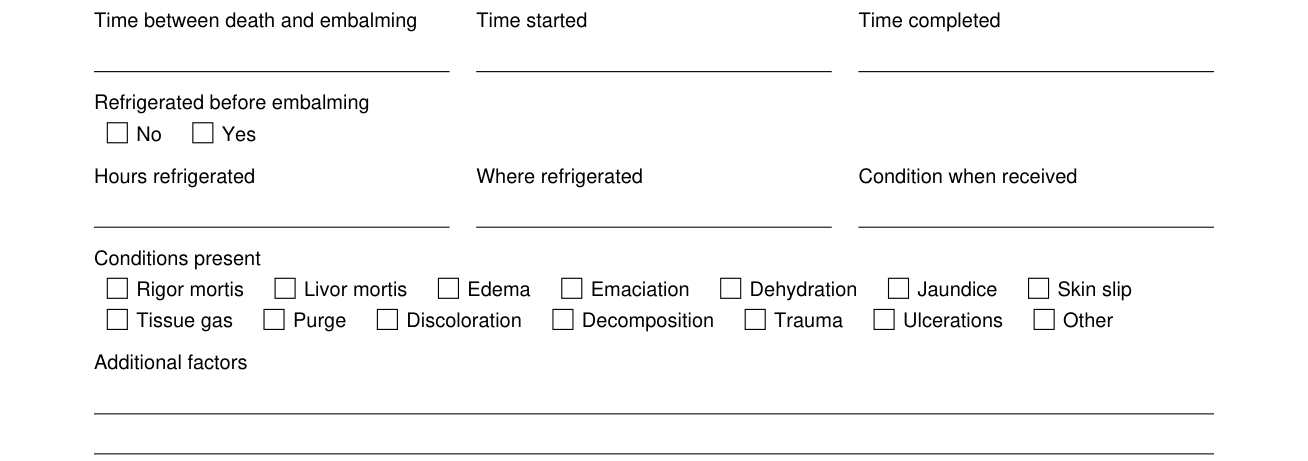
4. Condition before embalming: enter Time between death and embalming, Time started and Time completed. Refrigerated before embalming: No or Yes. Enter Hours refrigerated, Where refrigerated and Condition when received.
Conditions present: Rigor mortis, Livor mortis, Edema, Emaciation, Dehydration, Jaundice, Skin slip, Tissue gas, Purge, Discoloration, Decomposition, Trauma, Ulcerations or Other. Enter Additional factors.
5. Marks and conditions by body area
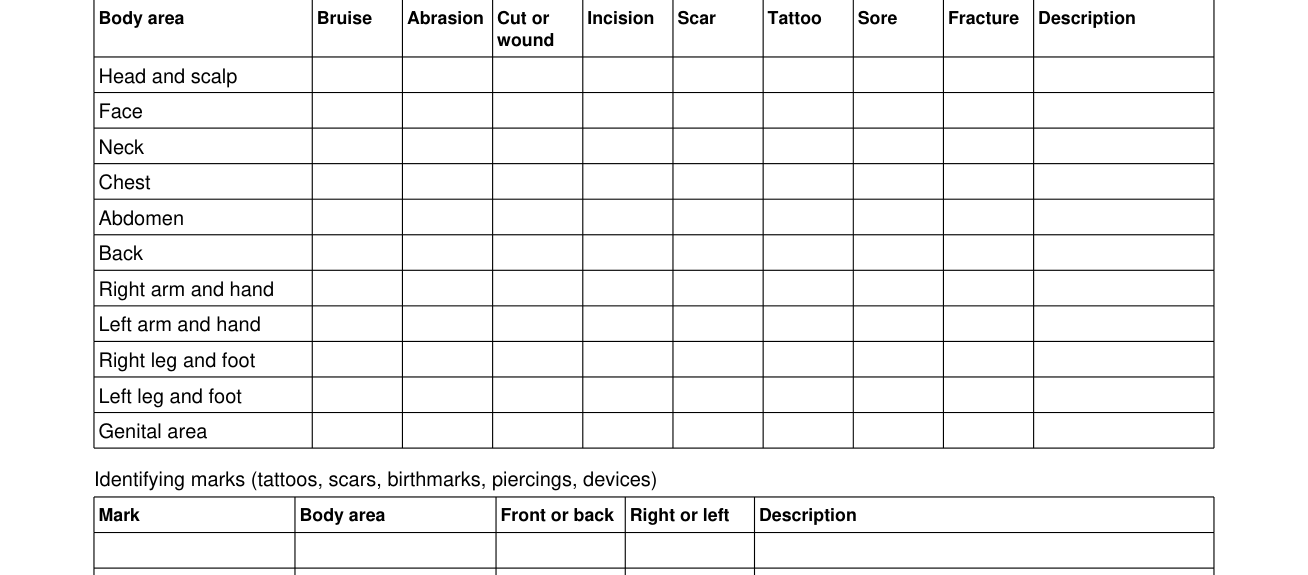
5. Marks and conditions by body area: Mark the column for each condition found; describe it in the last column. Body area: Head and scalp, Face, Neck, Chest, Abdomen, Back, Right arm and hand, Left arm and hand, Right leg and foot, Left leg and foot, Genital area.
Identifying marks (tattoos, scars, birthmarks, piercings, devices): enter Mark, Body area, Front or back, Right or left and Description.
6. Setting the features

6. Setting the features: Mouth closure: Natural, Suture, Needle injector, Mouth former, Dentures in place or Other. Eye closure: Eye caps, Cotton, Adhesive or Other. Enter Materials used and notes.
7. Arterial injection and drainage
7. Arterial injection and drainage: Arteries injected: Artery, Right, Left, Notes for Common carotid, Subclavian, Axillary, Brachial, Radial, Ulnar, Iliac, Femoral and Other.
Veins drained: Vein, Right, Left, Notes for Internal jugular, Axillary, Iliac, Femoral and Other.
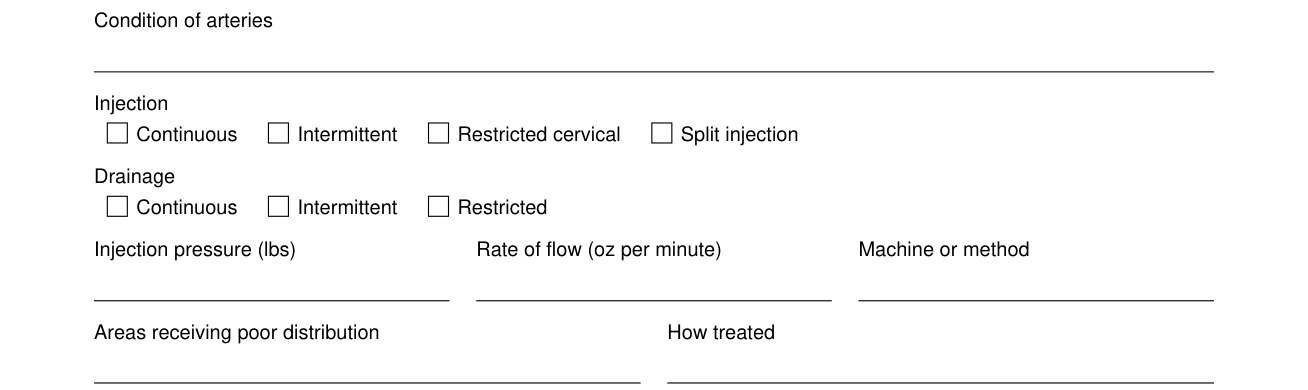
Enter Condition of arteries. Injection: Continuous, Intermittent, Restricted cervical or Split injection. Drainage: Continuous, Intermittent or Restricted. Enter Injection pressure (lbs), Rate of flow (oz per minute), Machine or method, Areas receiving poor distribution and How treated.
8. Chemicals and products used

8. Chemicals and products used: Arterial solutions: Stage, Product, Index, Concentrate (oz), Water (gal), Other additive (oz). Enter Total solution injected (gal), Total concentrate used (oz) and Length of operation.
Hypodermic and surface treatment: Area, Hypodermic, Surface pack, Product, Quantity (oz) for Face, Neck, Arms and hands, Torso, Legs and feet and Other.
Other products (cavity, sealing, cosmetic, disinfectant): enter Product, Purpose, Quantity and Lot number.
9. Cavity treatment
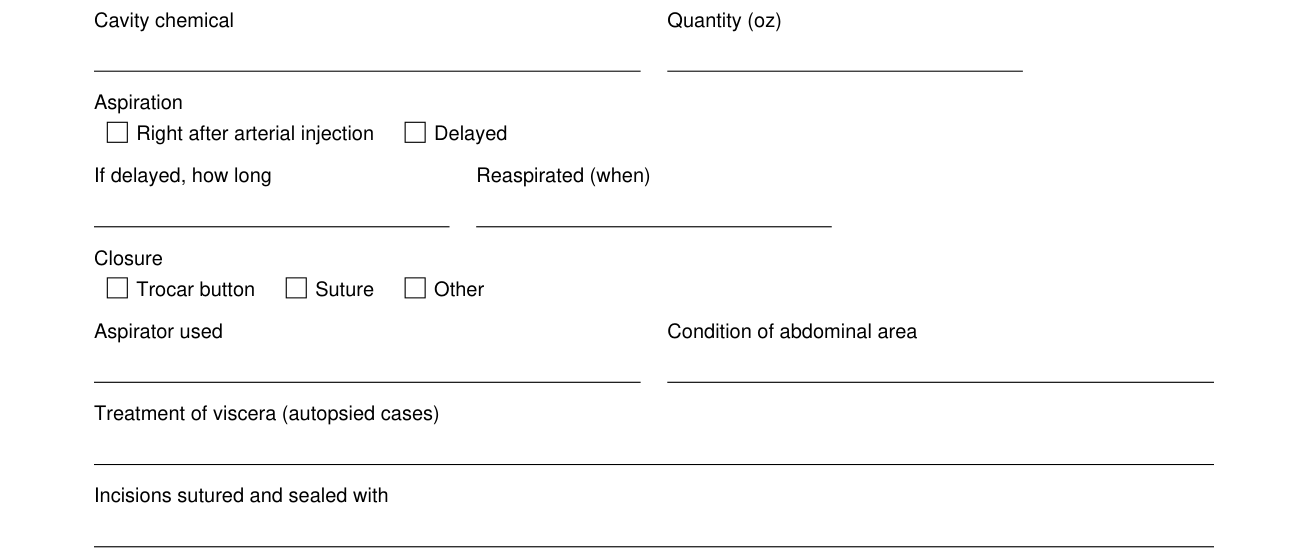
9. Cavity treatment: enter Cavity chemical and Quantity (oz). Aspiration: Right after arterial injection or Delayed. If delayed, how long. Reaspirated (when).
Closure: Trocar button, Suture or Other. Enter Aspirator used, Condition of abdominal area, Treatment of viscera (autopsied cases) and Incisions sutured and sealed with.
10. Disinfection and protective equipment
10. Disinfection and protective equipment: Disinfected: Eyes, Nose, Mouth, Other orifices, Body bathed with germicidal soap, Orifices packed. Protective equipment worn: Gloves, Double gloves, Gown, Apron, Face mask, Respirator, Face shield, Goggles, Head cover, Shoe covers or boots, Other. Enter Other items used.
Completed without incident: Yes or No. If no, describe the incident and how the case was completed.
11. Results
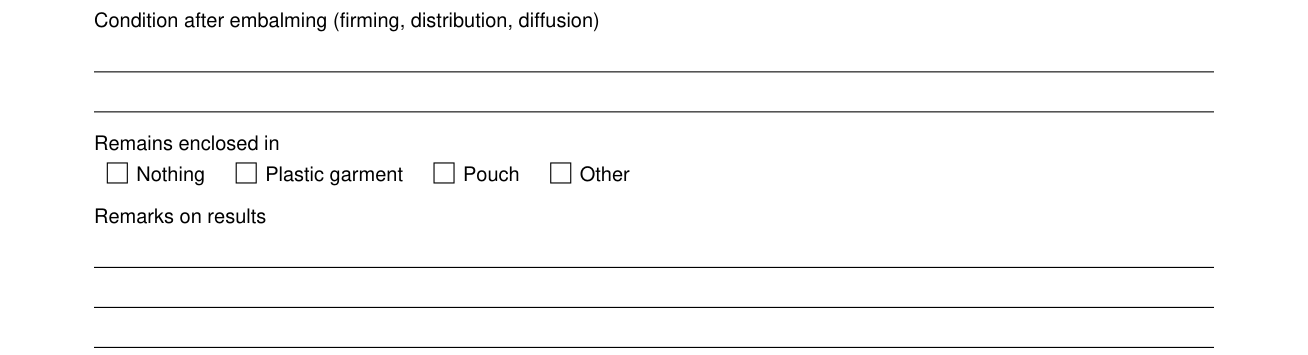
11. Results: enter Condition after embalming (firming, distribution, diffusion). Remains enclosed in: Nothing, Plastic garment, Pouch or Other. Enter Remarks on results.
12. Cosmetics and dressing

12. Cosmetics and dressing: enter Cosmetics applied, Hair styled by, Restorative work done, Dressed by, Casketed by and Ready for viewing (MM/DD/YYYY).
13. Personal property

13. Personal property: Personal property received with the remains: enter Item (clothing, jewelry, dentures, papers, cash, other), Description and Kept, returned or released. Enter Property released to, Relationship to decedent, Person receiving the property, Printed name, Signature and Date.
14. Disposition

14. Disposition: Disposition of remains: Burial, Entombment, Cremation, Ship out, Donation to science or Other. Enter Cemetery, mausoleum or crematory, City and state, Receiving funeral home (ship out), City and state, Casket description and Outer burial container.
15. Embalmer and intern
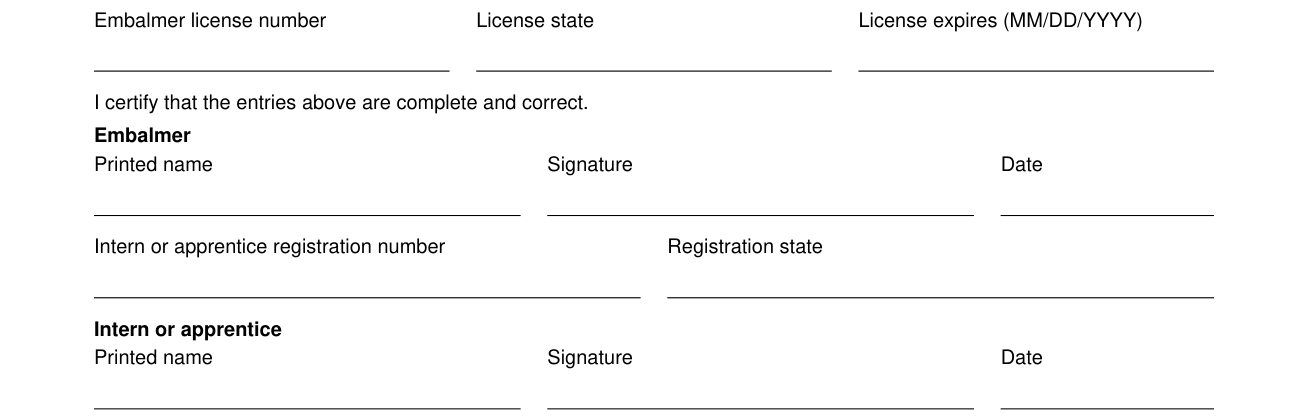
15. Embalmer and intern: enter Embalmer license number, License state and License expires (MM/DD/YYYY).
By signing, the Embalmer certifies that the entries are complete and correct. Embalmer: Printed name, Signature, Date.
Enter Intern or apprentice registration number and Registration state.
Sources
[1] Embalming Case Report, case record of the preparation of human remains (the Official source link on this page).