
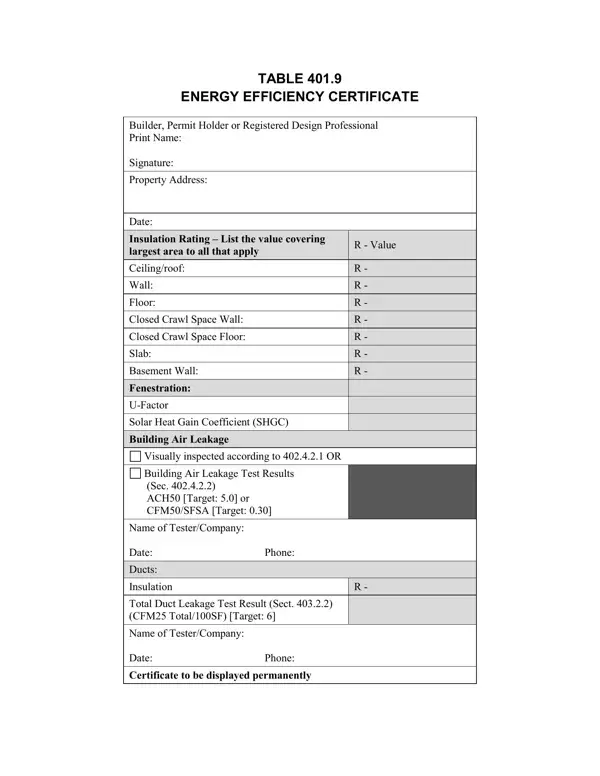
At the heart of efforts to enhance energy efficiency within buildings lies the Energy Efficiency Certificate form, a critical document that serves as a testament to a building's compliance with established energy standards. This form is meticulously filled out by builders, permit holders, or registered design professionals, who are required to provide their names, signatures, the property address, and the date. Essential details captured in the form include the insulation ratings specified for various components such as the ceiling, walls, floors, basements, and more, each denoted by an “R-value”—a measure of thermal resistance. The form also delves into specifics like the fenestration's U-Factor and Solar Heat Gain Coefficient (SHGC), critical measures for evaluating a window's energy efficiency. A key segment focuses on the building’s air leakage, which can be assessed through a visual inspection or a more rigorous air leakage test, with results quantified in Air Changes per Hour at 50 Pascals (ACH50) or Cubic Feet per Minute per Square Foot of Shell Area (CFM50/SFSA). Ductwork is not overlooked, with details required on the duct insulation’s R-value and total duct leakage test results. Tester or company details involved in these evaluations further ensure the form's accuracy and reliability. Notably, this certificate is not merely a formality; it is to be displayed permanently within the building, serving as a continuous reminder of the structure's energy performance and the commitment to energy efficiency it represents.
| Question | Answer |
|---|---|
| Form Name | Energy Efficiency Certificate Form |
| Form Length | 1 pages |
| Fillable? | No |
| Fillable fields | 0 |
| Avg. time to fill out | 15 sec |
| Other names | north carolina energy efficiency certificate, energy efficiency certificate pdf, nc energy efficiency certificate, certificate efficiency energy |
Energy Efficiency Certificate Form isn’t the one you’re looking for?