
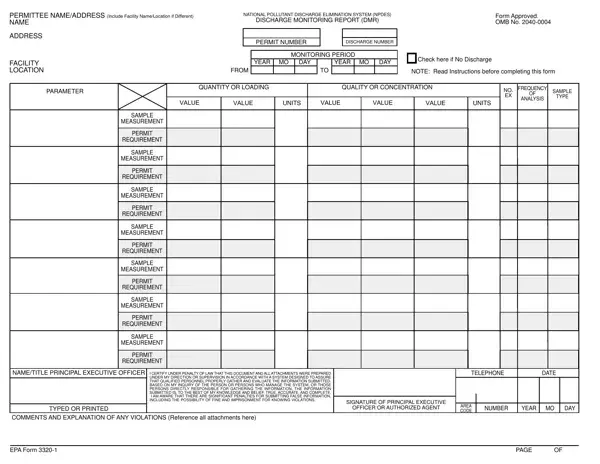
In the complex world of environmental regulation, compliance forms like the EPA Form 3320-1 play a pivotal role in maintaining the integrity of our waterways. This form, under the purview of the National Pollutant Discharge Elimination System (NPDES), is a crucial tool used by permittees to report the specifics of their discharge monitoring. At its core, the form seeks detailed information including the permittee's name and address, alongside the facility's name and location if different, which establishes a clear line of responsibility. Furthermore, it meticulously records monitoring periods, discharges numbers, and, importantly, if there were instances of no discharge. What sets this document apart are the sections demanding data on quantity or loading and quality or concentration of discharged substances, which are vital in assessing compliance with environmental standards. The form also requires the permittee to report the frequency and types of samples taken, alongside the analytical methods employed, thus ensuring a comprehensive overview of discharges. Additionally, an integral part of this process is the certification by the principal executive officer, who under penalty of law, verifies the accuracy and completeness of the information provided. This aspect underscores the seriousness with which these reports are treated and highlights the potential legal consequences for inaccuracies. Embedded in the process is also a segment for comments and explanations of any violations, making it a transparent mechanism for accountability and environmental stewardship. As this form bridges the gap between regulatory standards and actual environmental impacts, its importance cannot be overstated in safeguarding water quality and, by extension, public health and ecosystems.
| Question | Answer |
|---|---|
| Form Name | Epa Form 3320 1 From |
| Form Length | 1 pages |
| Fillable? | No |
| Fillable fields | 0 |
| Avg. time to fill out | 15 sec |
| Other names | false, 24hc, Form, 1 |
Epa Form 3320 1 From isn’t the one you’re looking for?