
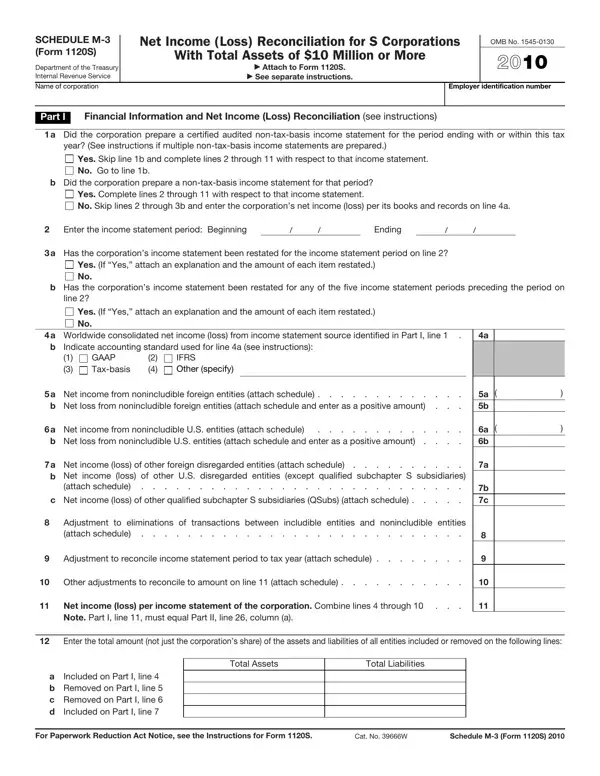
Schedule M-3 (Form 1120-S) at a glance
What it is: Schedule M-3 (Form 1120-S) is the Net Income (Loss) Reconciliation for S Corporations With Total Assets of $10 Million or More (checked November 8, 2026).
Where and when to file: If the corporation is required to file (or voluntarily files) Schedule M-3 (Form 1120-S), the corporation must file Form 1120-S and all attachments, schedules, including Schedule M-3 (Form 1120-S), and statements at the following address. Department of the Treasury Internal Revenue Service Center Ogden, UT 84201-0013. Any corporation required to file Form 1120-S, U.S. Income Tax Return for an S Corporation, that reports on Schedule L of Form 1120-S total assets at the end of the corporation's tax year that equal or exceed $10 million must file Schedule M-3 (Form 1120-S) (checked November 8, 2026).[2]
A filled-in Schedule M-3 (Form 1120-S) example: an S corporation with no income statement
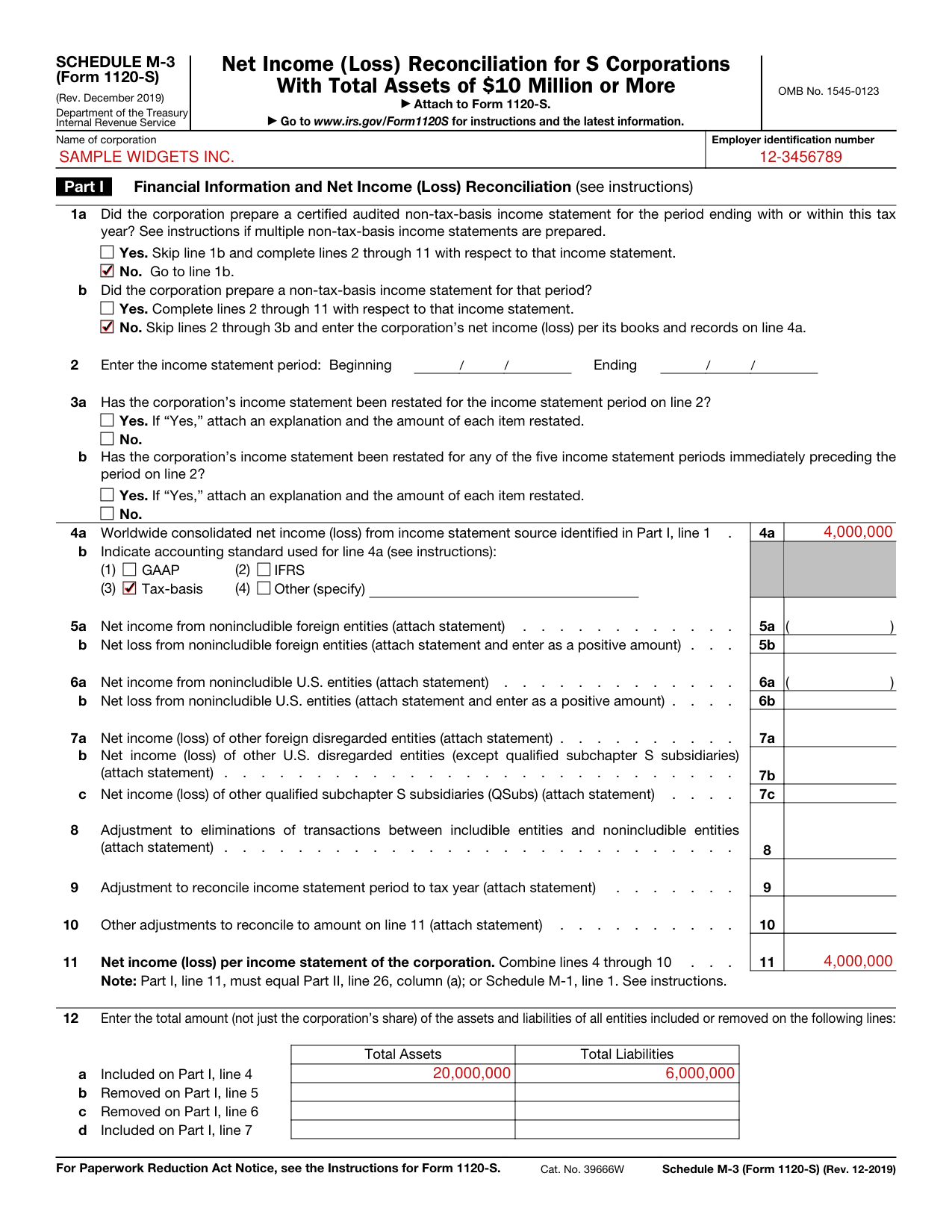
How to fill out Schedule M-3 (Form 1120-S), box by box
Name of corporation and employer identification number

Enter the Name of corporation and the Employer identification number.
Line 1: certified audited non-tax-basis income statement

Line 1a: Did the corporation prepare a certified audited non-tax-basis income statement for the period ending with or within this tax year? See instructions if multiple non-tax-basis income statements are prepared. Yes. Skip line 1b and complete lines 2 through 11 with respect to that income statement. No. Go to line 1b: Did the corporation prepare a non-tax-basis income statement for that period? Yes. Complete lines 2 through 11 with respect to that income statement. No. Skip lines 2 through 3b and enter the corporation's net income (loss) per its books and records on line 4a.
Lines 2, 3a and 3b: income statement period and income statement restated

On line 2, enter the income statement period: Beginning / / Ending / /
Enter the beginning and ending dates on line 2 for the corporation's annual income statement period ending with or within the current tax year.
Line 3a: Has the corporation's income statement been restated for the income statement period on line 2? Line 3b: Has the corporation's income statement been restated for any of the five income statement periods immediately preceding the period on line 2? Yes or No. If “Yes,” attach an explanation and the amount of each item restated.
Answer “Yes” on lines 3a and/or 3b if the corporation's annual income statement has been restated for any reason.[2]
Line 4: net income and accounting standard

On line 4a, enter the worldwide consolidated net income (loss) from income statement source identified in Part I, line 1. On line 4b, indicate the accounting standard used for line 4a (see instructions): (1) GAAP, (2) IFRS, (3) Tax-basis, (4) Other (specify).
If the corporation doesn't prepare non-tax-basis financial statements and has checked “No” on Part I, line 1b, enter the net income (loss) per the books and records of the U.S. corporation on Part I, line 4a.[2]
Lines 5 and 6: nonincludible entities

Enter on line 5a the net income from nonincludible foreign entities (attach statement), and on line 5b the net loss from nonincludible foreign entities (attach statement and enter as a positive amount).
Remove the financial net income (line 5a) or loss (line 5b) of each foreign entity that is included on line 4a and isn't an includible entity in the U.S. tax return (nonincludible foreign entity).
Enter on line 6a the net income from nonincludible U.S. entities (attach statement), and on line 6b the net loss from nonincludible U.S. entities (attach statement and enter as a positive amount).[2]
Lines 7, 8, 9 and 10: other entities and adjustments
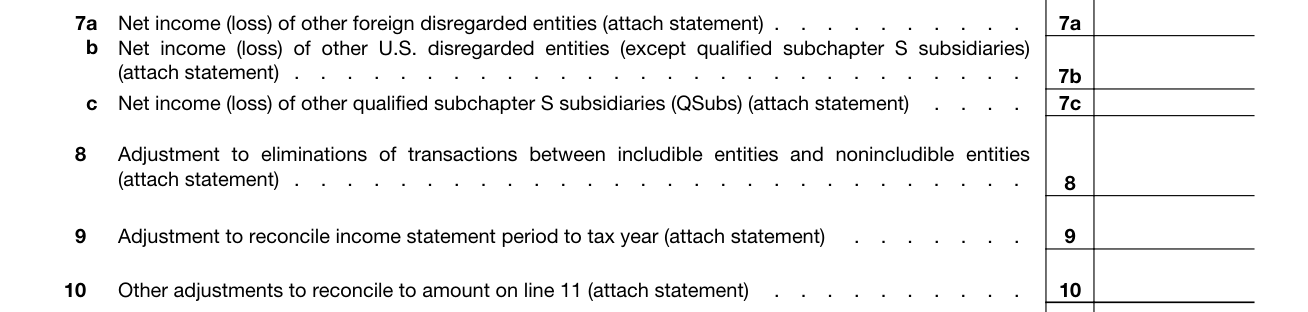
Enter on line 7a the net income (loss) of other foreign disregarded entities (attach statement), on line 7b the net income (loss) of other U.S. disregarded entities (except qualified subchapterS subsidiaries) (attach statement), and on line 7c the net income (loss) of other qualified subchapterS subsidiaries (QSubs) (attach statement).
On line 8, enter the adjustment to eliminations of transactions between includible entities and nonincludible entities (attach statement).
On line 9, enter the adjustment to reconcile income statement period to tax year (attach statement).
On line 10, enter other adjustments to reconcile to amount on line 11 (attach statement).
Line 11: net income per income statement

On line 11, enter the net income (loss) per income statement of the corporation: combine lines 4 through 10. Part I, line 11, must equal Part II, line 26, column (a); or Schedule M-1, line 1.
Don't, in any event, report on this line 11 the net income of entities not included in the U.S. income tax return for the tax year.[2]
Line 12: total assets and total liabilities

On line 12, enter the total amount (not just the corporation's share) of the assets and liabilities of all entities included or removed, under Total Assets and Total Liabilities: a, included on Part I, line 4; b, removed on Part I, line 5; c, removed on Part I, line 6; d, included on Part I, line 7.
If your situation is different
Completing Parts II and III of Schedule M-3
A corporation that is required to file Schedule M-3 (Form 1120-S) and has at least $50 million total assets at the end of the tax year must complete Schedule M-3 (Form 1120-S) entirely (checked November 8, 2026).
If the corporation chooses to complete Form 1120-S, Schedule M-1 instead of completing Parts II and III of Schedule M-3 (Form 1120-S), line 1 of Form 1120-S, Schedule M-1 must equal line 11 of Part I of Schedule M-3 (Form 1120-S).
Part II, line 26, column (a) must equal Part I, line 11, and column (d) must equal the amount on Form 1120-S, Schedule K, line 18.
In Part II, attach statements for lines 1 through 10 of the Income (Loss) Items.
On Part III, line 32 (Total expense/deduction items), combine lines 1 through 31 and enter the total there and on Part II, line 24, reporting positive amounts as negative and negative amounts as positive.[2]
Attach Schedule M-3 to Form 1120-S
Attach to Form 1120-S.
Any corporation filing Schedule M-3 must check the box on Form 1120-S, item C, indicating that Schedule M-3 is attached (whether required or voluntary).[2]
The corporation is not required to file Schedule M-3
A U.S. corporation filing Form 1120-S that isn't required to file Schedule M-3 may voluntarily file Schedule M-3 instead of Schedule M-1.
If a corporation was required to file Schedule M-3 for the preceding tax year, but reports on Form 1120-S, Schedule L, total assets at the end of the current tax year of less than $10 million, the corporation isn't required to file Schedule M-3 for the current tax year (checked November 8, 2026).
A corporation or group of corporations that completes Parts II and III of Schedule M-3, isn't required to complete Form 1120-S, Schedule M-1, Reconciliation of Income (Loss) per Books With Income (Loss) per Return.[2]
Reportable entity partner reporting responsibilities
A reportable entity partner to a partnership filing Form 1065, U.S. Return of Partnership Income, is an entity that owns or is deemed to own, directly or indirectly, a 50% or greater interest in the income, loss, or capital of the partnership on any day of the tax year; and was required to file Schedule M-3 on its most recently filed U.S. federal income tax return or return of income filed prior to that day.
A reportable entity partner must report to the partnership within 30 days of first becoming a reportable entity partner and, after first reporting to the partnership, within 30 days of the date of any change in the interest it owns or is deemed to own, directly or indirectly, in the partnership.[2]
Common questions about Schedule M-3 (Form 1120-S)
What is schedule m3 form 1120?
Schedule M-3 (Form 1120-S) is the Net Income (Loss) Reconciliation for S Corporations With Total Assets of $10 Million or More (checked November 8, 2026). Schedule M-3, Parts II and III, reconcile financial statement net income (loss) for the U.S. tax return (per Schedule M-3, Part I, line 11) to total income (loss) on Form 1120-S, Schedule K, line 18.[2]
Sources
[1] Schedule M-3 (Form 1120-S) (Rev. December 2019), Internal Revenue Service.
[2] Instructions for Schedule M-3 (Form 1120-S) (Rev. December 2019), Internal Revenue Service.