
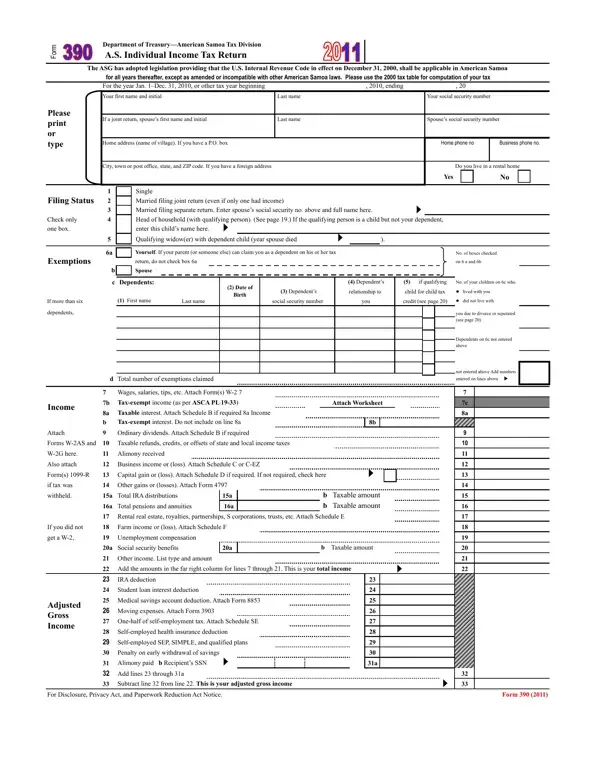
Form 390 at a glance
What it is: Form 390 is the A.S. Individual Income Tax Return of the Department of Treasury American Samoa Tax Division.
Who signs: Enter Your signature, Date, Your occupation and Day time phone number; on a joint return, both spouses must sign.
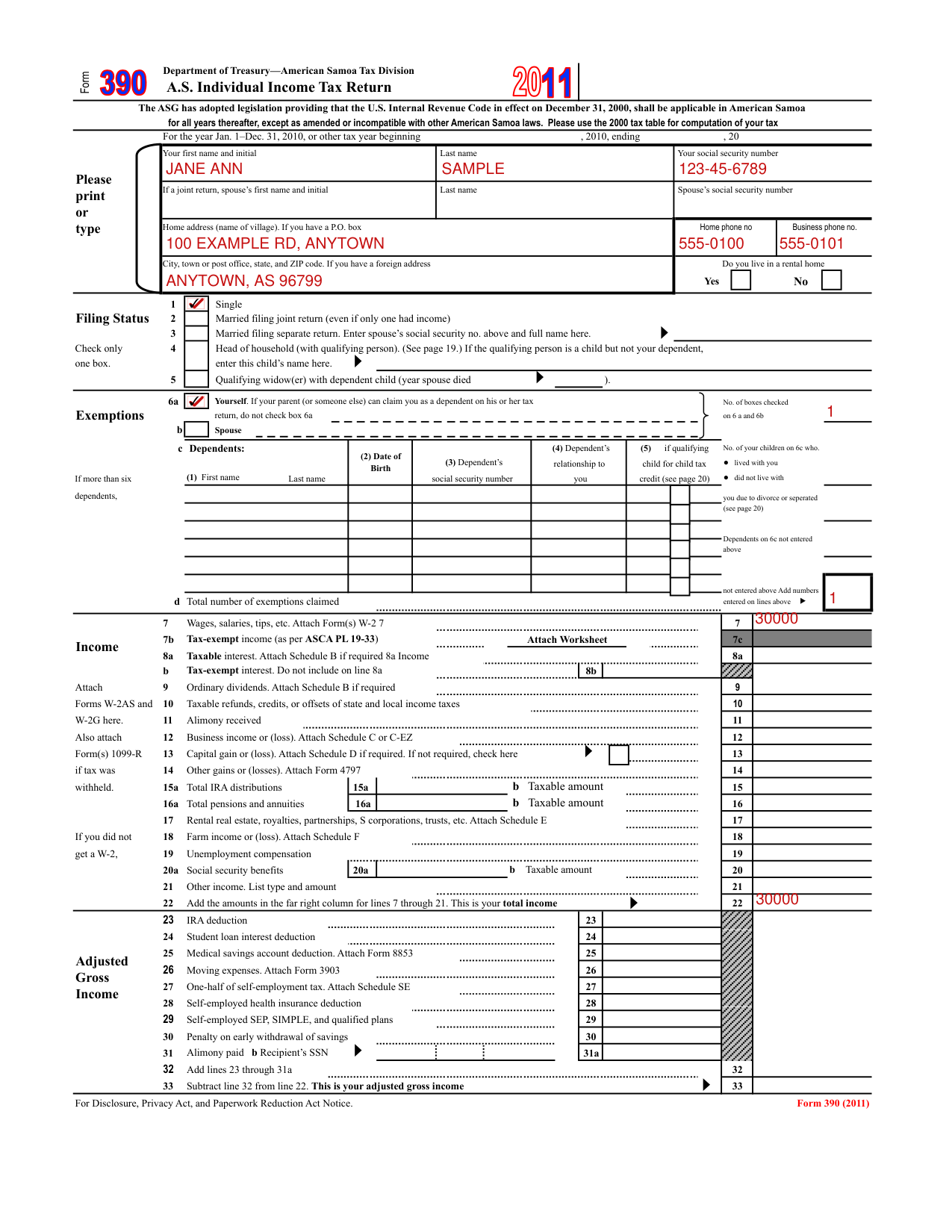
A filled-in Form 390 example: a single filer with wages only
How to fill out Form 390, box by box
Your name and social security number

Print or type your first name and initial, your last name and your social security number.
Spouse's name and social security number

If a joint return, enter spouse's first name and initial, last name and spouse's social security number.
Home address and phone no

Enter your home address (name of village), then the city, town or post office, state, and ZIP code.
Enter your business phone no. and home phone no.
Filing Status

Under Filing Status, check only one box: 1 Single. 2 Married filing joint return (even if only one had income). 3 Married filing separate return. If you check 3, enter spouse's social security no. in the Spouse's social security number box and full name here. 4 Head of household (with qualifying person). (See page 19.) If the qualifying person is a child but not your dependent, enter this child's name here.
For 5 Qualifying widow(er) with dependent child, enter the year spouse died.
Exemptions
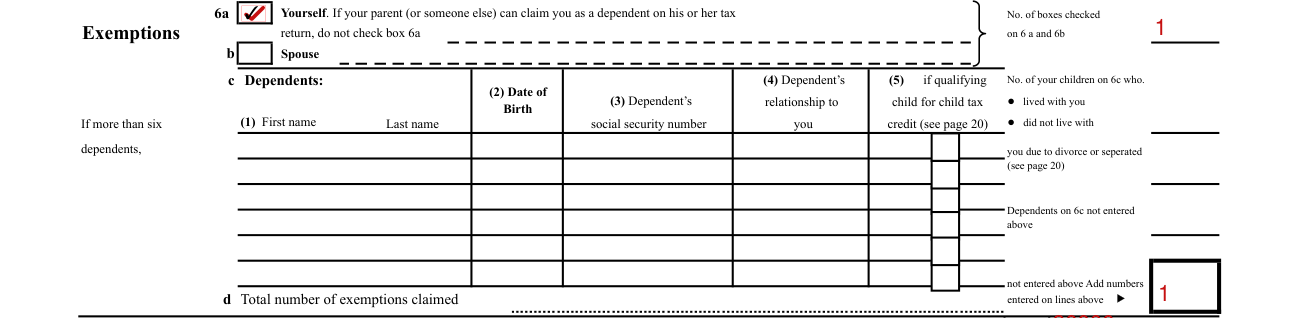
Under Exemptions, check 6a Yourself and b Spouse; if your parent (or someone else) can claim you as a dependent on his or her tax return, do not check box 6a.
For c Dependents, enter (1) First name, Last name, (2) Date of Birth, (3) Dependent's social security number and (4) Dependent's relationship to you.
On d, enter the Total number of exemptions claimed: add numbers entered on lines under Exemptions.
Income
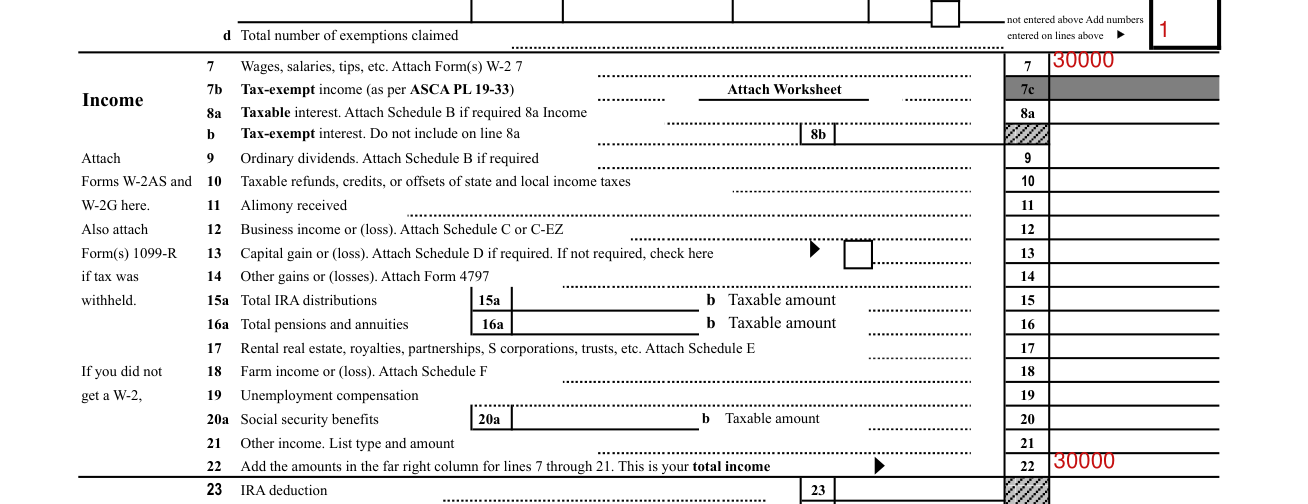
Enter wages, salaries, tips, etc. on line 7 and attach Form(s) W-2.
Attach Forms W-2AS and W-2G here.
Also attach Form(s) 1099-R if tax was withheld. On line 13, enter capital gain or (loss) and attach ScheduleD if required; if not required, check here.
Enter ordinary dividends on line 9 and attach Schedule B if required.
Add the amounts in the far right column for lines 7 through 21; this is your total income on line 22.
More rules for Form 390
The ASG has adopted legislation providing that the U.S. Internal Revenue Code in effect on December 31, 2000, shall be applicable in American Samoa for all years thereafter, except as amended or incompatible with other American Samoa laws. Please use the 2000 tax table for computation of your tax.
Add lines 23 through 31a for line 32, then subtract line 32 from line 22; this is your adjusted gross income on line 33.
Enter the amount from line 33 (adjusted gross income) on line 34.
On line 35a, check if you were 65 or older, Blind; Spouse was 65 or older, Blind, and add the number of boxes checked above and enter the total here.
On line 36, enter your itemized deductions from Schedule A, line 28, or standard deduction shown on the left, but see page 31 to find your standard deduction if you checked any box on line 35a or 35b or if someone can claim you as a dependent.
Subtract line 36 from line 34 for line 37.
If line 34 is $96,700 or less, multiply $2,800 by the total number of exemptions claimed on line 6d (checked November 14, 2026). If line 34 is over $96,700, see the worksheet on page 32 for the amount to enter on line 38 (checked November 14, 2026).
Taxable income on line 39: subtract line 38 from line 37; if line 38 is more than line 37, enter -0-.
For line 40, see page 32 for the tax and check if any tax is from a Form(s) 8814 or Form 4972.
Add lines 43 through 49; these are your total credits on line 50.
Subtract line 50 from line 42 on line 51; if line 50 is more than line 42, enter -0-.
On line 56, enter the American Samoa Minimum Tax (4% of the AGI, line 34 or attach worksheet if PL 19-33 applies).
Line 57a is your total income tax: line 55 or 56 whichever is larger; line 57b is Wage Tax (2% of line 7); line 57c is Total tax (add line 57a and line 57b).
Enter Samoa income and wage tax withheld from Forms W-2AS and 1099 on line 58, and 2011 estimated tax payments and amount applied from 2010 return on line 59.
Earned income credit (EIC) on line 60 is not applicable in American Samoa, and line 61 is Not Applicable.
Add lines 58, 59, 60a, and 61 through 64 for line 65; these are your total payments.
If line 65 is more than line 57, subtract line 57 from line 65 on line 66 for the amount you overpaid; on line 67 enter the amount of line 66 you want refunded to you, and on line 68 the amount you want applied to your 2011 estimated tax.
If line 57c is more than line 65, subtract line 65 from line 57c on line 69; this is the amount you owe. For details on how to pay, call the ASG Tax Office, refer to the Collection Section.
Line 71: Do you want to allow another person to discuss this return with the ASG? Yes, complete the following: Designee's Name, Telephone Number and Personal Identification Number (PIN). No.
Spouse's signature: if a joint return, both must sign; add the Date and Spouse's occupation.
Keep a copy for records.
Declaration of preparer (other than taxpayer) is based on all information of which preparer has any knowledge; a paid preparer enters the Preparer's signature, Date and Preparer's SSN or PTIN.
Common questions about Form 390
Who signs it?
Enter Your signature, Date, Your occupation and Day time phone number; on a joint return, both spouses must sign.
Is there a penalty?
Enter the Estimated tax penalty on line 70 and also include it on line 69.
What am I certifying when I sign?
Under Sign Here, you declare under penalties of perjury that you have examined this return and accompanying schedules and statements, and to the best of your knowledge and belief, they are true, correct, and complete.
Sources
[1] Form 390 (2011), A.S. Individual Income Tax Return, Department of Treasury American Samoa Tax Division (the Official source link on this page).